

Whether you’re stuck on a tricky rack in Scrabble or need a fresh word for Wordle, having a stash of reliable vocabulary can make all the difference. That’s where useful German 6-letter words come in — compact, punchy, and often packed with high-value letters that can turn a losing board into a winning one.
In this guide, we’ll explore practical German 6-letter words worth memorizing, explain what they mean, and show you how to use them strategically in your favorite word games. Ready to boost your play? Let’s dive in.
Introduction
German six-letter words are a quiet powerhouse in the world of word games. Whether you play Scrabble, Words With Friends, Wordle variants, or online crossword puzzles, knowing a reliable set of six-letter German words can turn a stalled turn into a winning move. This article explores Useful German 6-Letter Words for Word Games with clear, practical guidance. You do not need to be fluent in German to benefit. You need curiosity, a decent word list, and a method for practicing recall under time pressure.
The appeal is simple. Six-letter words hit a sweet spot between short, common words that score little and long, rare words that are hard to remember. German offers many six-letter words built from high-value tiles like Z, K, and W. Words such as Zahlen (numbers), Koffer (suitcase), and Wunder (wonder) are short enough to memorize but long enough to clear awkward racks. They also connect easily with common prefixes and suffixes, which makes them flexible in tight board positions.
Understanding the fundamentals of Useful German 6-Letter Words for Word Games helps you make informed decisions. You learn which words are legal in your specific game, which ones score best, and which ones are worth the memory space. Reliable information and consistent habits lead to better long-term outcomes, whether you are a casual player or someone preparing for a tournament. This guide breaks the topic into key concepts, a deep dive, a step-by-step method, best practices, and answers to common questions.
Key Concepts
Before memorizing lists, it helps to understand the landscape. Several concepts shape how useful a German six-letter word actually is in play.
Legality and word lists
Not every German word is allowed in every game. Scrabble in German-speaking countries uses a specific dictionary, often the Duden or an official tournament list. English-language Scrabble generally does not accept German words unless they have been absorbed into English, such as kindergarten (too long) or wanderlust. Words With Friends and similar apps usually follow their own curated dictionaries. Always confirm your game’s word source before you invest time memorizing. A word that is valid in one app may be rejected in another.
Letter value and scoring
German Scrabble tile values differ from English. The letter Z is worth 3 points, K is 4, and W is 3 in many German sets. Vowels like E and N are worth 1. A six-letter word that includes a Z, K, or W can easily score 20 to 40 points before board multipliers. Words like Zweige (branches), Kranz (wreath, but five letters), and Koffer become high-value plays. The goal is not just length but tile efficiency.
Vowel-consonant balance
German six-letter words often have a balanced mix of vowels and consonants. This matters because a rack full of vowels is painful. Words such as Eimer (bucket), Ozean (ocean), and Ufer (shore, four letters) help you dump vowels. Longer six-letter examples like Eingang (entrance) and Ameise (ant) show how German uses vowel teams. Understanding this balance helps you choose words that fix a bad rack rather than worsen it.
Common prefixes and suffixes
German builds words with prefixes like ge-, ver-, be-, and er-. Suffixes like -en, -er, -lich, and -ung appear constantly. A six-letter word like Gebiet (area) or Verlag (publisher) can be extended or shortened. Knowing these building blocks lets you create multiple plays from one root. That is far more efficient than memorizing isolated words.
Frequency and familiarity
Some German six-letter words appear often in everyday language: Freund (friend), Stunde (hour), Wasser (water), Zimmer (room). Others are rare or archaic. For word games, prioritize words you can actually recall under pressure. Frequency beats obscurity. A word you remember every time is more useful than a rare gem you forget.
Deep Dive
Now let us look closer at the specific categories and examples that make German six-letter words so effective. This section moves from general concepts to concrete word families and tactical uses.
High-value tile words
If you draw a Z, K, or W, you want a six-letter word that uses it. Consider these examples:
- Zahlen — numbers. Uses Z and N. Good for hooking onto an existing S or T.
- Zweige — branches. Uses Z and W together for a strong score.
- Koffer — suitcase. Uses K and double F, which can be worth 4 points each in some sets.
- Kuchen — cake. Uses K and CH, a common German digraph.
- Wunder — wonder. Uses W and D, easy to pluralize or extend.
- Wetter — weather. Uses W and double T.
These words rarely appear in English word lists, so they give you an edge if your game supports German. Even in English games, some have crossed over, but check legality first.
Vowel-heavy words
When your rack is clogged with A, E, I, O, and U, German six-letter words can rescue you. Examples include:
- Ameise — ant. Uses A, E, I, and E.
- Eingang — entrance. Uses E, I, A, and a final G.
- Ozean — ocean. Uses O, E, A.
- Uebung — practice (alternative spelling of Übung). Uses U, E, U.
- Eimer — bucket. Uses E, I, E.
These words help you balance your rack without sacrificing too many points. They also set up future plays by leaving consonants for later.
Words with common endings
German six-letter words often end in -en, -er, -el, or -ig. This is useful because you can often add an S or an E to extend them. For example:
- Worten — words (dative plural). You can add an S to make Wortens? No, that is not standard. But you can hook it to other letters.
- Kindes — child’s (genitive). Ends in -es, easy to pluralize.
- Hauses — house’s. Ends in -es.
- Leben — life. Ends in -en. Can become Lebens (genitive).
- Zahlen — numbers. Can become Zahlens? Not standard, but zahlen is a verb.
The key is not to overthink grammar. In word games, the dictionary decides. Learn which endings are legal and which allow hooks.
Compound words
German loves compounds. Six-letter compounds are common and often easier to remember than abstract nouns. Examples: Handbuch (handbook, 8 letters), but six-letter ones include Haustür (front door), Kühlschrank (fridge, too long), Schlüssel (key, 8). Six-letter compounds are rarer but exist, such as Zugang (access) and Abgang (exit). These are useful because they combine two simple words you already know.
Tactical placement
Six-letter words are ideal for hitting double and triple word squares. Because they cover more board space, they increase the chance of stacking multipliers. They also block opponents less predictably than short words. Use them to open a lane for future high-scoring plays. If you can place a word like Koffer across two triple letter squares, the score can exceed 50 points. That is often game-changing.
Another tactic is to use six-letter words to dump duplicate letters. German has double consonants like ff, ll, mm, nn, tt. Words like Koffer (ff), Welle (ll), Stimme (mm), Kanne (nn), and Wetter (tt) let you play duplicates productively. In English games, duplicates are often a nuisance. In German, they are a scoring opportunity.
Step-by-Step Guide
Follow these steps to build your own useful German six-letter word toolkit. Each step is actionable and designed for real play, not theory.
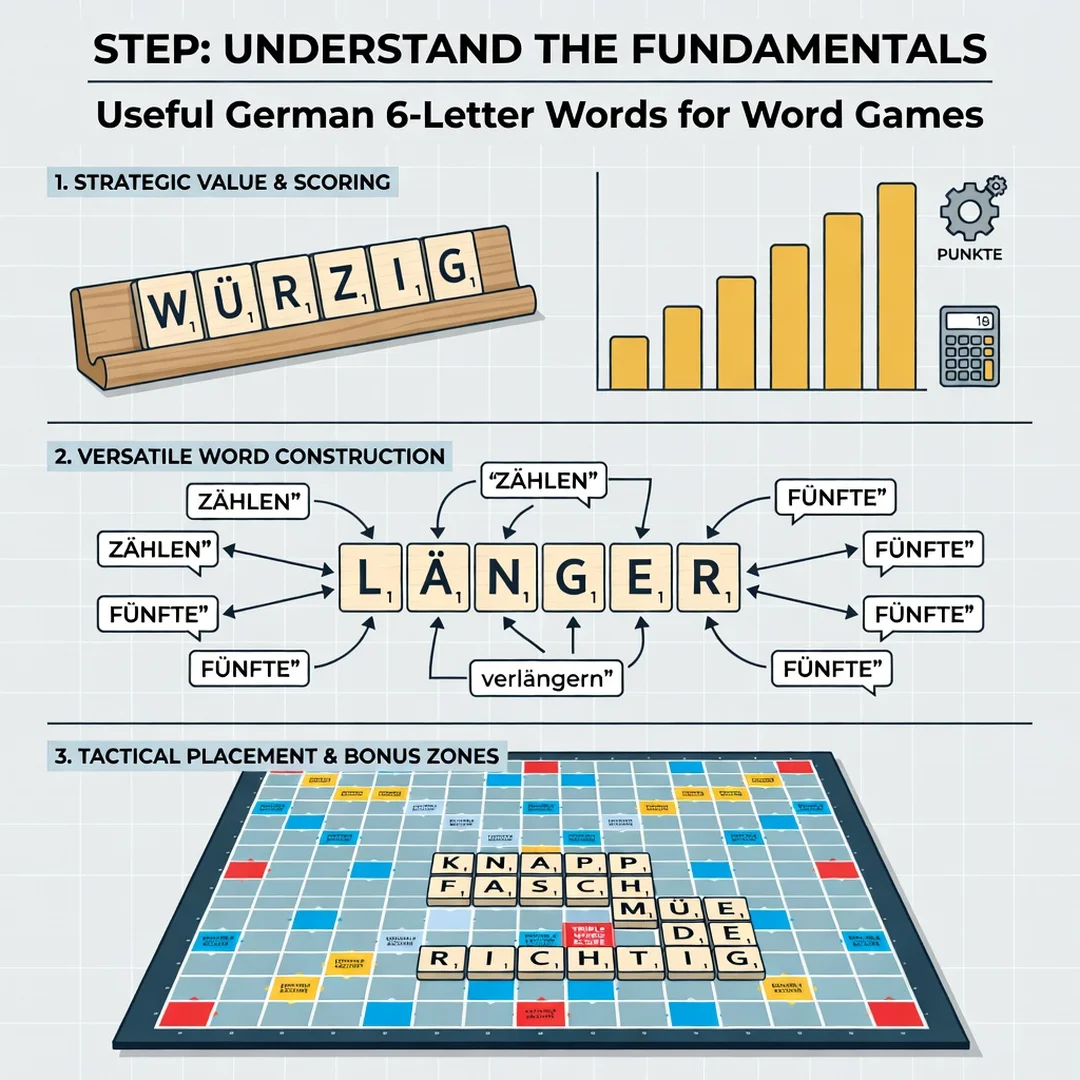
Step 1: Understand the fundamentals
Start by learning the basic rules of your game and the German alphabet quirks. German has 26 letters plus umlauts (Ä, Ö, Ü) and the eszett (ß). Most word games either treat umlauts as regular vowels or as separate tiles. Scrabble in German uses Ä, Ö, Ü as separate tiles worth 6 points each, while ß is not used. Words With Friends and online clones may simplify. Know your platform. Also learn that German nouns are capitalized, but in word games, capitalization usually does not matter. Focus on letter sequences, not grammar.
Step 2: Assess your starting point
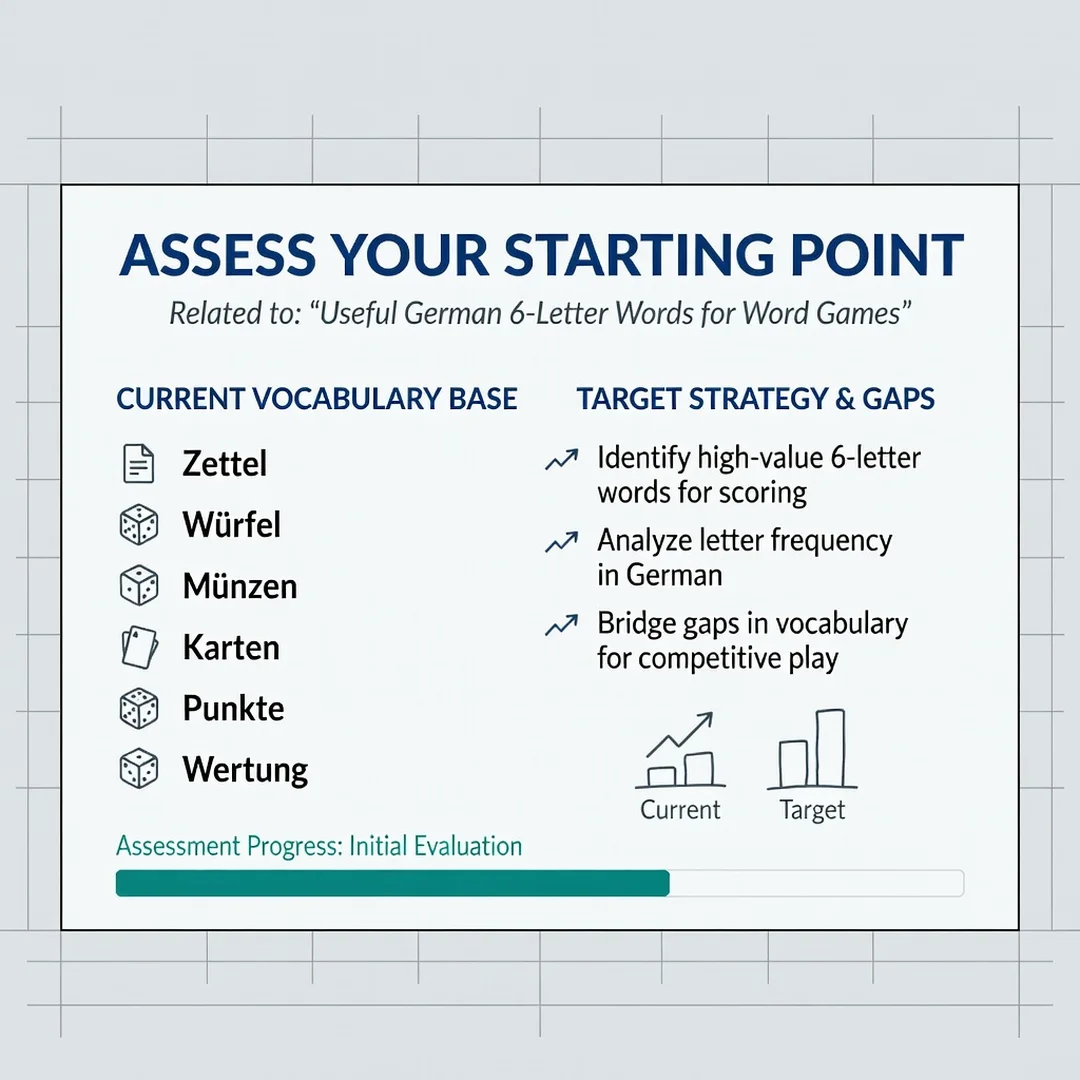
Be honest about your current vocabulary. Can you recall ten German six-letter words without help? Five? Zero? Write down what you know. Then check a word list. Common starting words include Wasser, Freund, Stunde, Zimmer, Koffer, Wunder, Zahlen, Leben, Haus (4 letters), and Kind (4). Identify gaps. If you know many nouns but few verbs, that is a gap. If you avoid words with Z or K, that is another gap. Your assessment determines what to study next.
Step 3: Set clear goals
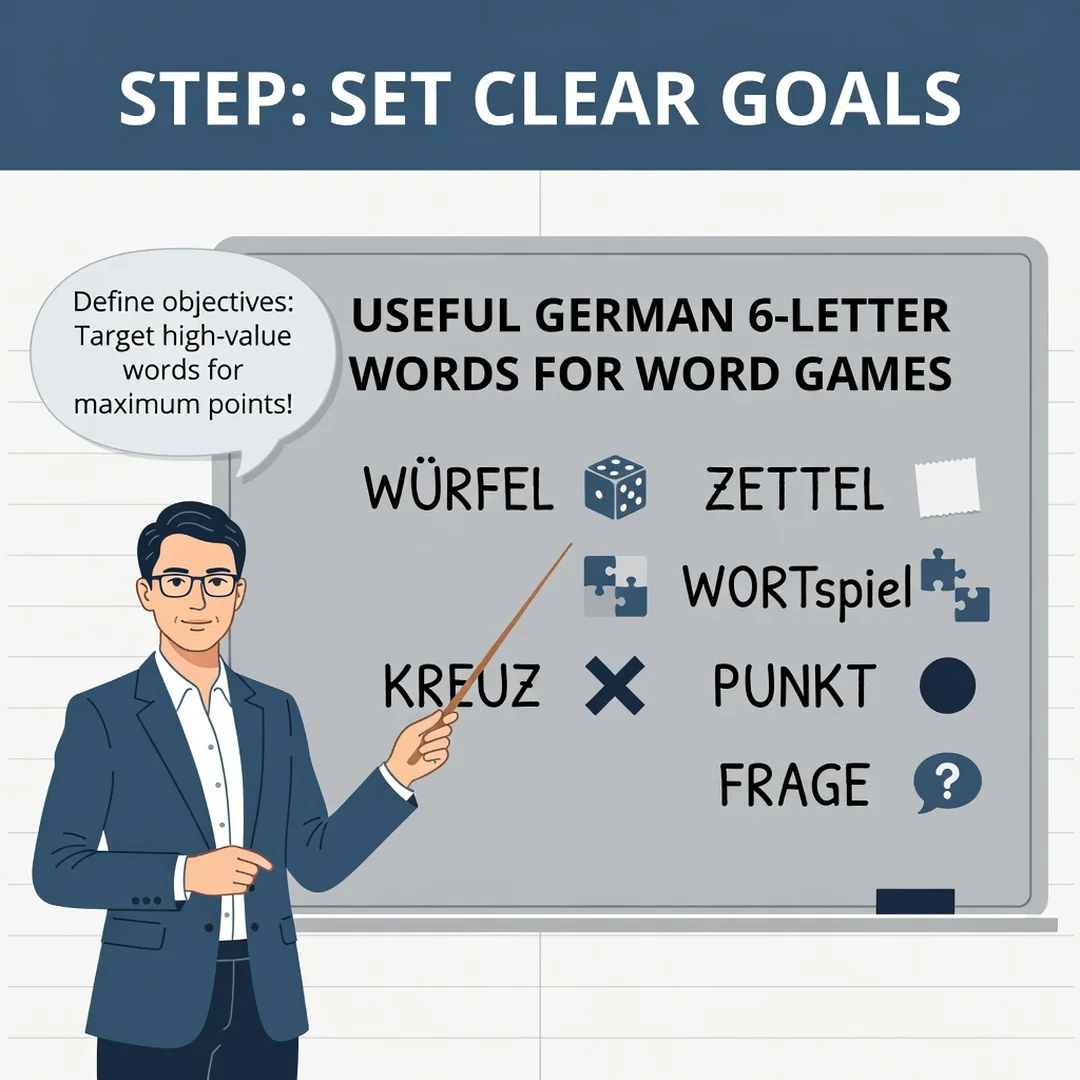
Vague goals like “learn German words” fail. Set specific, measurable targets. For example: “Learn 20 six-letter German words in two weeks.” Or “Use at least one German six-letter word in every game for the next ten games.” Or “Score a 40-point play using a German six-letter word by the end of the month.” Write your goal down. Track it. Goals turn scattered memorization into focused progress.
Step 4: Gather necessary resources
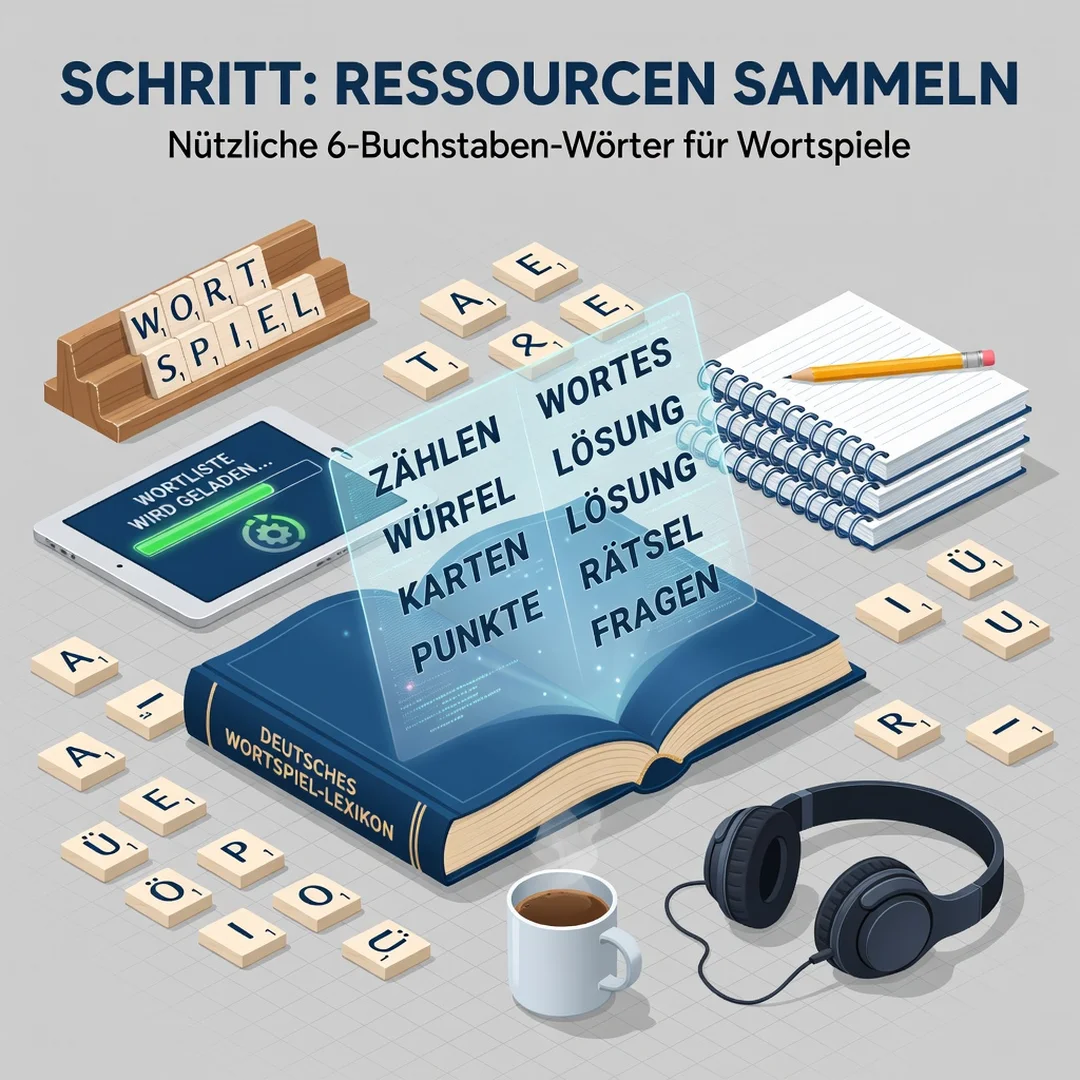
You need three things: a legal word list, a study method, and a way to practice. For word lists, use the official dictionary for your game. If you play German Scrabble, use the latest Duden or tournament list. For English games that allow some German loans, check the official word list. For study, use flashcards (Anki, Quizlet, or paper). Group words by tile value or ending. For practice, play actual games. Apps like Wordfeud, Scrabble Go, and online German Scrabble servers let you test words in real time. Also consider a word finder tool, but use it to verify, not to replace learning.
Step 5: Apply the core methods
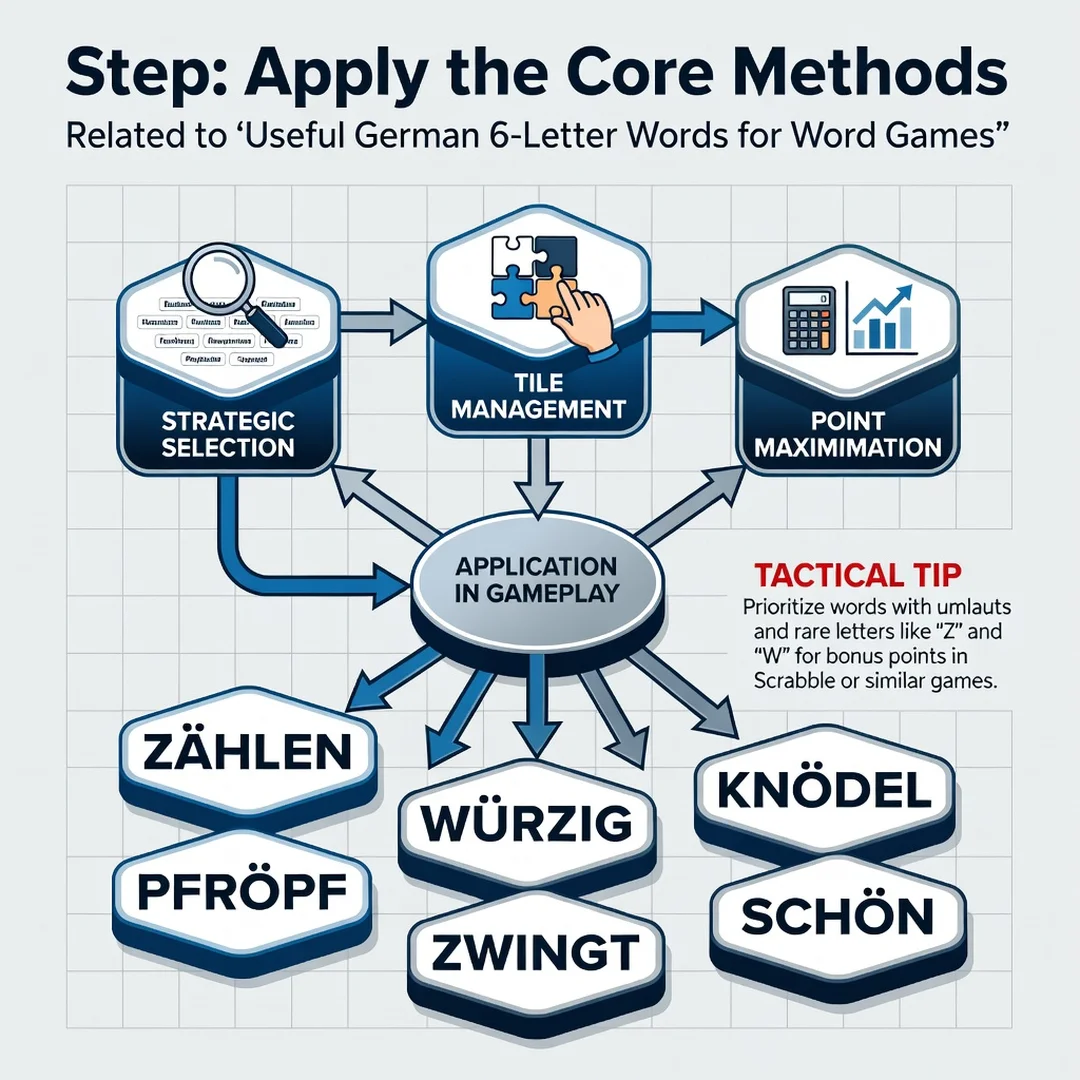
Now put your words into play. Use these three methods:
- Chunking: Group six-letter words by pattern. For example, all words ending in -en: Leben, Wesen, Zahlen, Worten. Learn the pattern, not just the word.
- Spaced repetition: Review your flashcards at increasing intervals. Day 1, day 3, day 7, day 14. This moves words into long-term memory.
- Game-based recall: After each game, write down any German six-letter word you missed or forgot. Add it to your deck. Review it before the next game.
You now have a solid foundation for Useful German 6-Letter Words for Word Games. Apply the best practices above and revisit this guide as your needs evolve.