

How to Order Food in German Restaurant: A Step-by-Step Phrases Guide
Walking into a German restaurant without the language can feel like a small performance where you do not know your lines. The host says something fast, you freeze, you point at a menu, and lunch becomes a lottery. This guide fixes that. Learning how to order food in German restaurant settings is mostly about knowing the sequence — what happens first, what you say at each step, and the handful of phrases that carry you through. Once you know the choreography, the words are easy.
German restaurant culture has a few quirks worth knowing upfront. You usually seat yourself unless there is a sign saying Bitte warten, Sie werden platziert (please wait to be seated) — rare outside upscale places. The bill never arrives unasked; you must request it. And tipping works differently than in the US: service is included in the price, so a tip is a genuine bonus, not an obligation. We will cover all of this below, step by step, with the exact phrases and short dialogues for each stage.
Before You Go In: How to Order Food in German Restaurant Culture
A few cultural notes will save you from the most common tourist mistakes:
- Seating: In casual restaurants, beer gardens, and cafés, just walk in and sit where you like — unless a table has a Reserviert (reserved) sign. In nicer restaurants, wait by the entrance to be seated.
- Sharing tables: In beer gardens and busy traditional restaurants, it is normal to ask Ist hier noch frei? (ist heer nokh fry — is this seat free?) and share a large table with strangers. This is friendly, not rude.
- Greeting: Always greet when entering — a Guten Tag or Hallo to the room or your server sets the tone. Germans notice when you skip it.
- Water: Tap water (Leitungswasser) is drinkable everywhere but rarely served free in restaurants. Order ein Mineralwasser and specify still or mit Kohlensäure (sparkling).
- Sunday closures and hours: Many restaurants close one weekday and have a Ruhetag (rest day). Kitchens often close between lunch and dinner (roughly 14:00–17:30). Check hours before a late lunch.
Step 1: Getting a Table
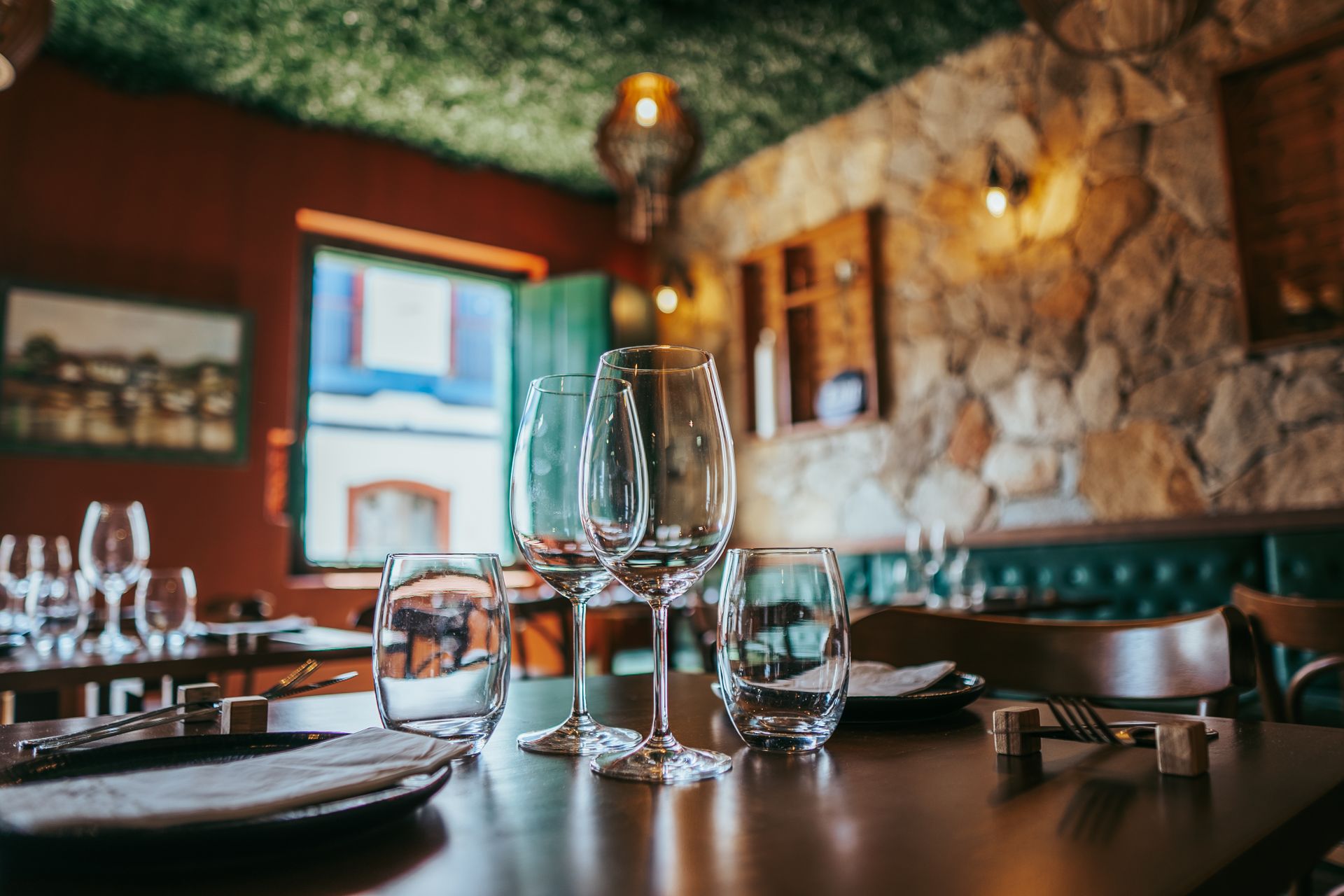
Walk in, greet, and state your party size. If you have a reservation, say so immediately — it changes everything about how you are received.
Key phrases:
- Guten Abend! (GOO-ten AH-bent) — Good evening!
- Einen Tisch für zwei, bitte. (INE-en tish foor tsvy BIT-teh) — A table for two, please. Swap in drei (three) or vier (four) as needed.
- Wir haben reserviert. (veer HAH-ben reh-zer-VEERT) — We have a reservation.
- Die Reservierung ist auf den Namen Müller. (dee reh-zer-VEE-rung ist owf dayn NAH-men MOOL-er) — The reservation is under the name Müller.
- Haben Sie einen Tisch frei? (HAH-ben zee INE-en tish fry) — Do you have a table free?
- Für wie viele Personen? (foor vee FEE-leh pair-ZOH-nen) — For how many people? (What they will ask you.)
- Wie lange müssen wir warten? (vee LAHNG-eh MOOS-en veer VAR-ten) — How long do we have to wait?
- Können wir draußen sitzen? (KURN-en veer DROW-sen ZITS-en) — Can we sit outside?
- Ist hier noch frei? (ist heer nokh fry) — Is this seat free? (For shared tables.)
Dialogue — walking in without a reservation:
You: Guten Abend! Einen Tisch für zwei, bitte.
Host: Guten Abend! Drinnen oder draußen?
You: Draußen, bitte, wenn möglich.
Host: Gerne. Folgen Sie mir bitte.
Translation: Good evening! A table for two, please. / Good evening! Inside or outside? / Outside, please, if possible. / Gladly. Please follow me.
Dialogue — with a reservation:
You: Guten Tag! Wir haben reserviert, auf den Namen Smith.
Host: Einen Moment bitte… Ja, hier ist es. Tisch Nummer zwölf, bitte schön.
Translation: Hello! We have a reservation under the name Smith. / One moment please… yes, here it is. Table number twelve, here you go.
Step 2: Reading the Menu
Your server will bring the Speisekarte (menu) and usually ask about drinks first. Take your time — nobody will rush you.
Key phrases:
- Die Speisekarte, bitte. (dee SHPY-zeh-kar-teh BIT-teh) — The menu, please.
- Könnte ich die Speisekarte auf Englisch haben? (KURN-teh ikh dee SHPY-zeh-kar-teh owf ENG-lish HAH-ben) — Could I have the menu in English? Many tourist-area restaurants have one; there is no shame in asking.
- Was empfehlen Sie? (vahs emp-FAY-len zee) — What do you recommend? Servers genuinely enjoy answering this.
- Was ist das? (vahs ist dahs) — What is that? Point at the menu item.
- Was ist heute das Tagesgericht? (vahs ist HOY-teh dahs TAH-ges-geh-rikht) — What is today’s special? The Tageskarte (daily menu) is often the best value.
- Ist das vegetarisch? (ist dahs veh-geh-TAH-rish) — Is that vegetarian?
- Ist das vegan? (ist dahs veh-GAHN) — Is that vegan?
- Ist das scharf? (ist dahs sharf) — Is that spicy?
Decoding a German menu: Menus are organized by course. Vorspeisen are starters, Suppen soups, Hauptgerichte main courses, Beilagen side dishes, Nachspeisen or Desserts are desserts. Getränke is the drinks section. A Menü (note the spelling) usually means a set multi-course meal, not the menu card — the card is the Speisekarte. Confusing these two is the classic beginner mistake.
Common dishes you will meet: Schnitzel (breaded cutlet), Bratwurst (fried sausage), Sauerkraut (fermented cabbage), Knödel (dumplings), Sauerbraten (marinated pot roast), Currywurst (sausage with curry ketchup — Berlin street food royalty), Maultaschen (Swabian filled pasta), Käsespätzle (cheese noodles). For our full restaurant vocabulary, see the 50 German restaurant phrases list.
Step 3: Ordering Drinks First
In Germany, drinks are typically ordered first, often within a minute or two of sitting down. Have your drink order ready.
Key phrases:
- Ich hätte gern ein Bier. (ikh HET-teh gairn ine beer) — I’d like a beer.
- Ein großes Bier, bitte. (ine GROH-ses beer BIT-teh) — A large beer, please. Beer sizes: klein (small, 0.3l) and groß (large, 0.5l).
- Ein Glas Rotwein / Weißwein, bitte. (ine glahs ROHT-vine / VICE-vine BIT-teh) — A glass of red/white wine, please.
- Eine Apfelschorle, bitte. (INE-eh AHP-fel-shor-leh BIT-teh) — An apple juice spritzer, please. Germany’s beloved non-alcoholic default — apple juice mixed with sparkling water.
- Ein Mineralwasser, bitte. Still. (ine mee-neh-RAHL-vah-ser BIT-teh. shtil) — A mineral water, please. Still.
- Einen Kaffee, bitte. (INE-en kah-FEH BIT-teh) — A coffee, please.
Dialogue — ordering drinks:
Server: Was darf es zu trinken sein?
You: Ich hätte gern ein großes Bier und eine Apfelschorle, bitte.
Server: Sehr gerne. Kommt sofort.
Translation: What would you like to drink? / I’d like a large beer and an apple spritzer, please. / Gladly. Coming right away.
A beer note: If you order ein Bier without specifying, you will usually get a Pils (0.3l or 0.5l depending on region). In Bavaria, default beer culture is Helles (lager) or Weißbier (wheat beer). In Cologne, they serve Kölsch in tiny 0.2l glasses that keep coming until you put your coaster on top — the famous Deckel drauf signal. In Düsseldorf it is Altbier. Ordering the local style earns quiet respect.
Step 4: Ordering Your Meal
When the server asks Haben Sie schon gewählt? (have you decided?) or Was darf es sein? (what would you like?), it is your cue. Use Ich hätte gern… (I would like…) — it is the politest, most natural ordering phrase in German.
Key phrases:
- Ich hätte gern das Schnitzel. (ikh HET-teh gairn dahs SHNIT-sel) — I’d like the schnitzel.
- Ich nehme die Suppe. (ikh NAY-meh dee ZUP-eh) — I’ll take the soup. Slightly more casual, perfectly fine.
- Für mich bitte das Gleiche. (foor mikh BIT-teh dahs GLY-kheh) — The same for me, please.
- Als Vorspeise nehme ich… (ahls FOR-shpy-zeh NAY-meh ikh) — For a starter I’ll have…
- Zum Nachtisch hätte ich gern… (tsoom NAHKH-tish HET-teh ikh gairn) — For dessert I’d like…
- Ohne Zwiebeln, bitte. (OH-neh TSVEE-beln BIT-teh) — Without onions, please.
- Ist es möglich, das ohne… zu bekommen? (ist es MOOKH-likh dahs OH-neh tsoo beh-KOM-en) — Is it possible to get that without…?
Dietary needs — say these clearly:
- Ich bin Vegetarier / Vegetarierin. (ikh bin veh-geh-TAH-ree-er / veh-geh-tah-ree-EH-rin) — I’m vegetarian (male/female form).
- Ich esse kein Schweinefleisch. (ikh ES-eh kine SHVY-neh-flysh) — I don’t eat pork. Useful: many “vegetarian-looking” German dishes contain bacon or meat stock.
- Ich bin allergisch gegen Nüsse. (ikh bin ah-LAIR-gish GAY-gen NOOS-eh) — I’m allergic to nuts.
- Ich bin allergisch gegen Gluten. (ikh bin ah-LAIR-gish GAY-gen gloo-TEN) — I’m allergic to gluten.
- Enthält das Milchprodukte? (ent-HELT dahs MILKH-proh-duk-teh) — Does that contain dairy?
German restaurants take allergies seriously — by law, the 14 major allergens must be declared. Do not hesitate to ask; staff are used to it.
Dialogue — ordering a full meal:
Server: Haben Sie schon gewählt?
You: Ja. Als Vorspeise hätte ich gern die Kürbissuppe, und als Hauptgericht das Wiener Schnitzel.
Server: Sehr gern. Und zu trinken?
You: Ein Mineralwasser, still, bitte.
Server: Kommt sofort. Guten Appetit schon mal!
Translation: Have you decided? / Yes. For a starter I’d like the pumpkin soup, and for the main course the Wiener schnitzel. / Gladly. And to drink? / A mineral water, still, please. / Coming right away. Enjoy your meal in advance!
Step 5: During the Meal
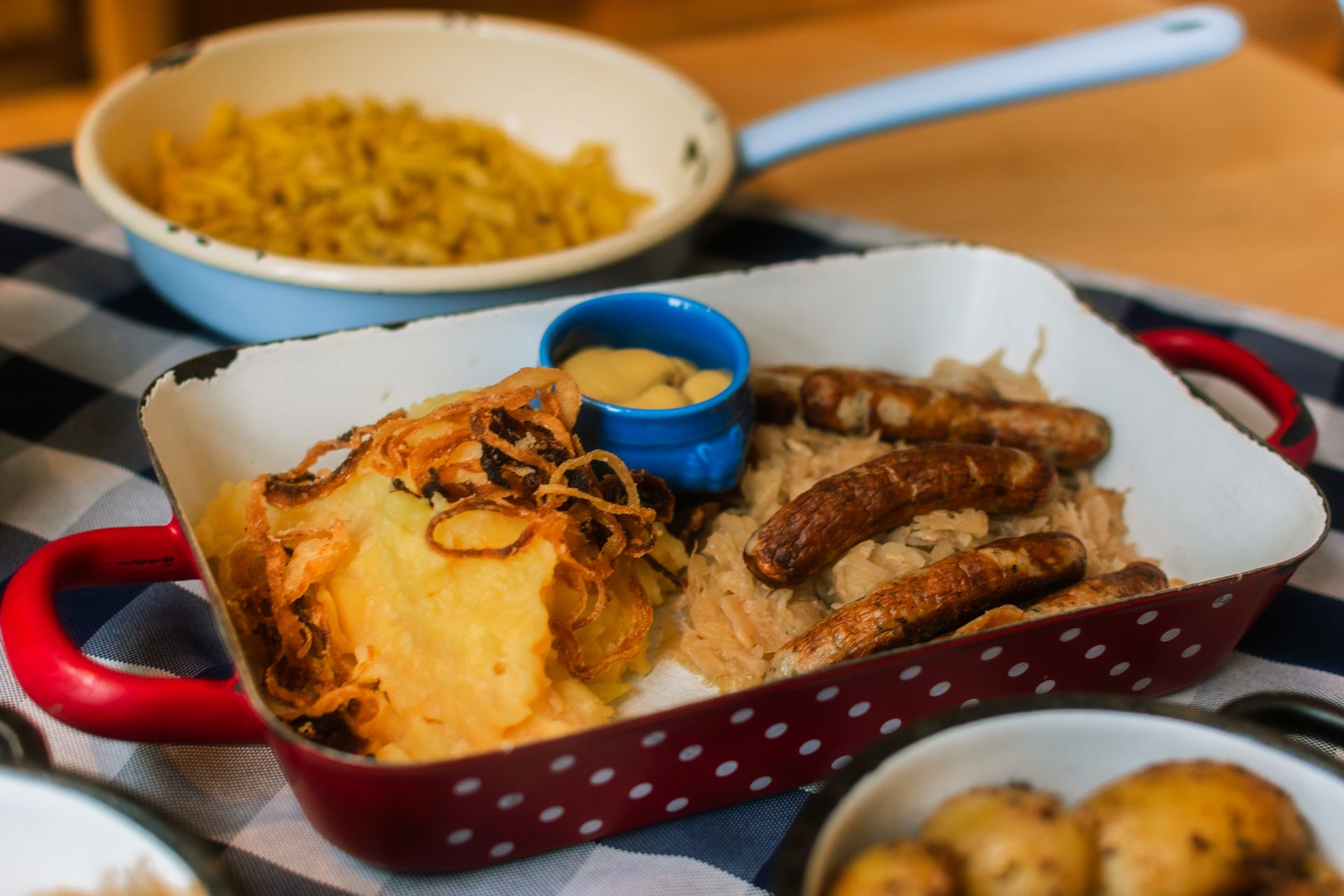
- Das schmeckt ausgezeichnet! (dahs shmekt OWS-geh-tsy-khnet) — That tastes excellent! Say it when the server checks on you — it genuinely makes their day.
- Es fehlt… (es faylt) — …is missing. Es fehlt ein Glas. (A glass is missing.)
- Könnte ich bitte noch Brot haben? (KURN-teh ikh BIT-teh nokh broht HAH-ben) — Could I have some more bread, please?
- Noch eins, bitte. (nokh ines BIT-teh) — Another one, please. (Drinks.)
- Das war sehr lecker. (dahs vahr zair LEK-er) — That was very tasty.
If something is wrong, be direct but polite: Entschuldigung, das habe ich nicht bestellt. (Sorry, I didn’t order this.) Germans respect straightforwardness far more than elaborate softening.
Step 6: Paying and Tipping — How to Order Food in German Restaurant Bills Work
This is where culture matters most. The bill does not come automatically — you must ask. Catch your server’s eye and say:
- Könnte ich bitte zahlen? (KURN-teh ikh BIT-teh TSAH-len) — Could I pay, please?
- Die Rechnung, bitte. (dee REKH-nung BIT-teh) — The bill, please.
- Getrennt oder zusammen? (geh-TRENT OH-der tsoo-ZAH-men) — Separate or together? (What the server will ask a group.)
- Getrennt, bitte. (geh-TRENT BIT-teh) — Separate, please.
How tipping actually works: Service (Bedienung) is included in menu prices by law. The tip (Trinkgeld) is a bonus for good service, typically 5–10%, rounded up. The mechanics matter: when the server tells you the total, you state the amount you want to pay including the tip while handing over cash or card. Example: the bill is €23.50. You say “Fünfundzwanzig, bitte” (twenty-five, please) and hand over your card — the server charges €25. Or simply say “Stimmt so” (keep the change) when paying cash.
- Stimmt so. (shtimt zoh) — Keep the change.
- Das passt so, danke. (dahs pahst zoh DAHN-keh) — That’s fine as is, thanks. (No extra tip, but polite.)
- Nehmen Sie Kreditkarten? (NAY-men zee kreh-DEET-kar-ten) — Do you take credit cards?
Card acceptance has improved enormously since 2020, but small and traditional restaurants may still be cash-only — the phrase above, asked before ordering, prevents an awkward ending.
Dialogue — paying:
You: Entschuldigung! Könnten wir bitte zahlen?
Server: Ja, gern. Zusammen oder getrennt?
You: Zusammen, bitte.
Server: Das macht dreiundvierzig Euro fünfzig.
You: Fünfundvierzig, bitte. Stimmt so.
Server: Vielen Dank! Auf Wiedersehen!
Translation: Excuse me! Could we pay, please? / Yes, gladly. Together or separate? / Together, please. / That comes to forty-three euros fifty. / Forty-five, please. Keep the change. / Thank you very much! Goodbye!
Quick Reference: The Whole Meal in 20 Phrases
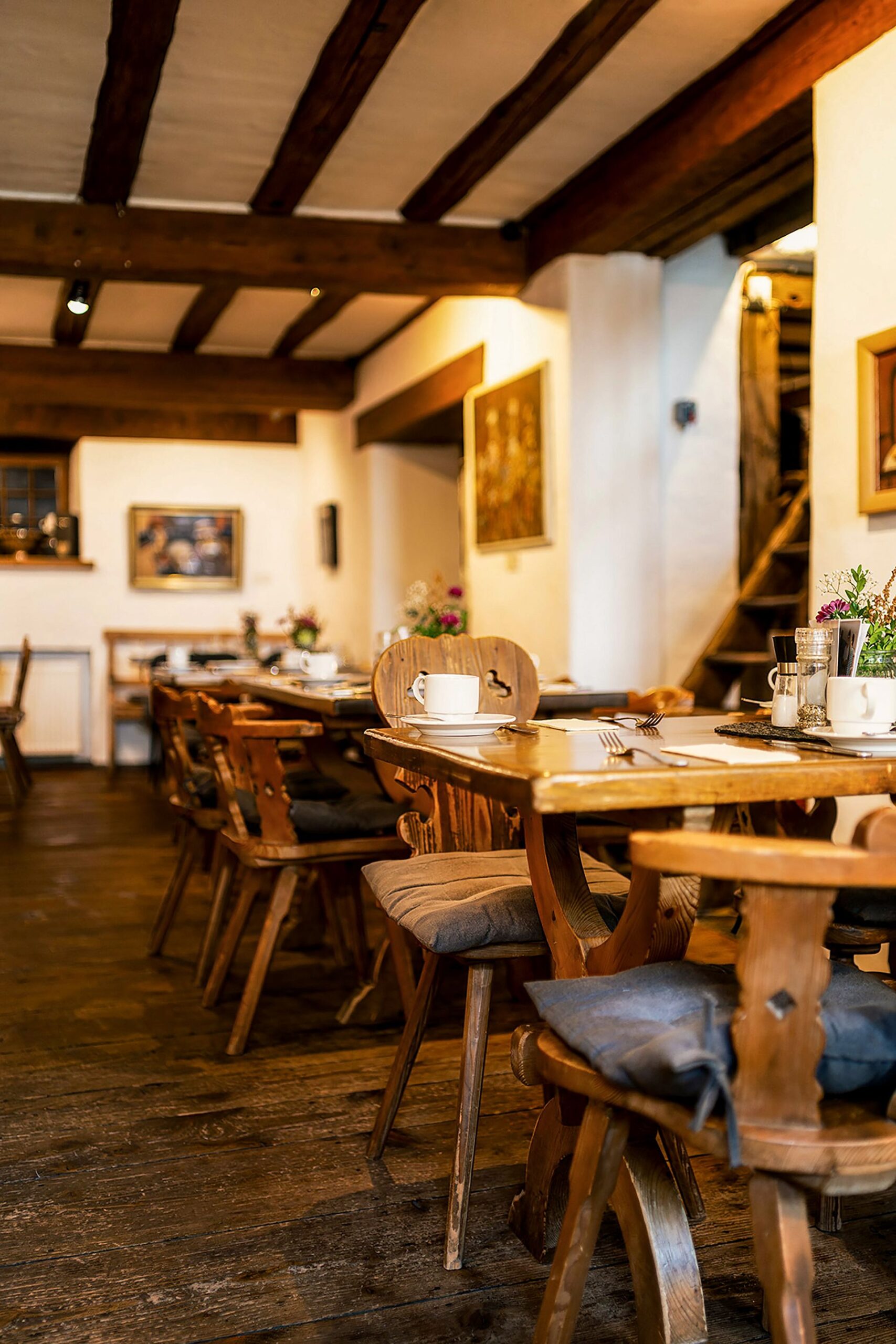
For a compact list you can screenshot, our 50 German restaurant phrases covers cafés and bars too. The survival essentials:
- Einen Tisch für zwei, bitte. — A table for two, please.
- Die Speisekarte, bitte. — The menu, please.
- Was empfehlen Sie? — What do you recommend?
- Ich hätte gern… — I would like…
- Ist das vegetarisch? — Is that vegetarian?
- Ohne …, bitte. — Without …, please.
- Ein Bier / ein Glas Wein, bitte. — A beer / a glass of wine, please.
- Das schmeckt ausgezeichnet! — That tastes excellent!
- Noch eins, bitte. — Another one, please.
- Die Rechnung, bitte. — The bill, please.
- Stimmt so. — Keep the change.
- Guten Appetit! — Enjoy your meal!
Breakfast, Brunch, and Café Culture
German breakfast (Frühstück) is a serious meal, and cafés run on their own phrase set:
- Was gibt es zum Frühstück? (vahs gipt es tsoom FROO-shtook) — What is there for breakfast?
- Ich hätte gern ein belegtes Brötchen. (ikh HET-teh gairn ine beh-LAYK-tes BRURT-khen) — I’d like a filled bread roll. (Brötchen are the crusty rolls Germany is famous for.)
- Ein Croissant und einen Cappuccino, bitte. — A croissant and a cappuccino, please.
- Gibt es auch etwas Warmes? (gipt es owkh ET-vahs VAR-mes) — Is there something warm too? (Rührei = scrambled eggs, Spiegeleier = fried eggs, der Speck = bacon.)
- Kaffee und Kuchen (kah-FEH unt KOO-khen) — coffee and cake, the sacred German afternoon ritual (around 15:00–16:00). Order ein Stück Apfelkuchen (a slice of apple cake) or Schwarzwälder Kirschtorte (Black Forest gateau) and you are doing it right.
At the bakery (die Bäckerei): Point and say “Ich hätte gern drei von denen da” (three of those there, please) — or learn the names: das Brötchen (roll), die Brezel (pretzel), das Croissant, der Berliner (jam-filled donut — in Berlin itself it is called Pfannkuchen, a guaranteed confusion), der Apfelstrudel.
Beer Gardens and Breweries
The Biergarten is Germany’s greatest dining institution, with rules worth knowing:
- Selbstbedienung (zelpst-beh-DEE-nung) — self-service. In traditional beer gardens you fetch your own beer and food from counters; only some have table service (Bedienung).
- Eine Maß, bitte. (INE-eh mahs BIT-teh) — A liter of beer, please. (Bavaria. Elsewhere: ein großes Bier.)
- Ein Radler, bitte. (ine RAHD-ler BIT-teh) — A shandy (beer + lemonade). Refreshing, lower alcohol, zero shame.
- Darf man sein eigenes Essen mitbringen? (dahrf mahn zine EYE-geh-nes ES-en mit-BRING-en) — May one bring one’s own food? In traditional Bavarian beer gardens: yes! Bringing your own Brotzeit (snack) while buying beer is the authentic move.
- Prost! — and the rule: look people in the eye when clinking. Always.
Beer styles to order by name: Pils (bitter lager, the northern default), Helles (mild Bavarian lager), Weißbier/Weizen (wheat beer — served in tall glasses, often with lemon), Dunkles (dark lager), Kölsch (Cologne’s light ale, served in small glasses), Altbier (Düsseldorf’s dark ale), Bockbier (strong seasonal beer).
Vegetarian and Vegan Dining in Germany
Germany is one of Europe’s easiest countries for meat-free eating — but traditional menus hide meat in surprising places:
- Ich bin Vegetarier / Vegetarierin. (ikh bin veh-geh-TAH-ree-er / veh-geh-tah-ree-EH-rin) — I’m vegetarian.
- Ich esse vegan. (ikh ES-eh veh-GAHN) — I eat vegan.
- Ist das vegetarisch oder ist da Fleisch drin? (ist dahs veh-geh-TAH-rish OH-der ist dah FLYSH drin) — Is that vegetarian or is there meat in it? (Ask directly — Speck (bacon) and Brühe (meat stock) appear in “vegetable” soups and salads.)
- Haben Sie vegetarische Gerichte? (HAH-ben zee veh-geh-TAH-rish-eh geh-RIKH-teh) — Do you have vegetarian dishes?
- Gibt es eine vegane Option? (gipt es INE-eh veh-GAH-neh op-TSYOHN) — Is there a vegan option?
- Ohne Fleisch, ohne Fisch, bitte. (OH-neh flysh OH-neh fish BIT-teh) — Without meat, without fish, please. (In traditional places, fish sometimes doesn’t count as “meat” — spell it out.)
Look for the V-Label (a green V logo) on menus and products — it certifies vegetarian/vegan. And Käsespätzle (cheese noodles), Kartoffelpuffer (potato pancakes), Flammkuchen (thin flatbread — order ohne Speck), and Pilzgerichte (mushroom dishes) are the vegetarian traveler’s best friends.
Tipping Cheat Sheet and Menu Abbreviations
The tipping rule in one line: round up 5–10% by stating the total aloud when you pay. €18.40 → “Zwanzig, bitte.” €47 → “Fünfzig, bitte.” Cash under €10 → “Stimmt so.” Card → state the rounded total before they run it. Done.
Menu abbreviations decoded: inkl. MwSt. = VAT included (always, by law) — zzgl. = plus/additional (watch for zzgl. Bedienung = service extra, rare but legal) — Tageskarte = daily specials — Saisonkarte = seasonal menu — Aperitif = pre-dinner drink — Digestif = after-dinner drink — Hausgemacht = homemade — Spezialität des Hauses = house specialty (usually the safest, best order on the menu).
Conclusion: Ordering With Confidence
Knowing how to order food in German restaurant settings is less about vocabulary and more about rhythm: greet, get seated, order drinks first, use Ich hätte gern for everything, ask for the bill, and round up the tip. The phrases above cover every step, and the dialogues show you exactly how each exchange sounds in real life.
Pair this guide with our German for travelers survival guide for the core 100 words, and the essential travel phrases list for everything beyond the restaurant. Guten Appetit — you have got this.