

Stuck with a rack full of awkward letters and no idea what to play? Whether you’re a casual player or a tournament regular, learning how to find German Scrabble words from your letters can turn a frustrating turn into a game-changing move. German tiles reward smart thinking, and a few simple strategies will help you spot hidden words fast.
In this guide, you’ll discover practical methods for rearranging your letters, using word lists and online tools, and recognizing common German prefixes and suffixes. By the end, you’ll know exactly how to find German Scrabble words from your letters and play with confidence every turn.
Introduction
German Scrabble — whether you play the international German-language edition, the classic German set, or a digital version like Scrabble Deutschland — presents a distinct challenge for word finders. The language allows long compound nouns, uses umlauts (Ä, Ö, Ü), and treats the Eszett (ß) as a tile in many editions. If you have a rack of seven or eight letters and no obvious word, finding valid German Scrabble words from your letters requires both a method and the right reference tools. This article explores How to Find German Scrabble Words From Your Letters with clear, practical guidance.
Unlike English Scrabble, where memorizing two- and three-letter words often carries the day, German Scrabble rewards pattern recognition around prefixes, suffixes, and common word stems. You do not need to be fluent in German to improve. You need a repeatable process: identify your tiles, apply known building blocks, check against an official word list, and practice consistently. Understanding the fundamentals of How to Find German Scrabble Words From Your Letters helps you make informed decisions, whether you are a casual player or preparing for tournament play.
This guide is designed for readers who want actionable steps rather than vague advice. It covers tile distributions, the role of umlauts and ß, the best word-finding techniques, and how to avoid common mistakes. By the end, you will have a step-by-step system you can use on every turn.
Key Concepts
Before you start rearranging tiles on your rack, you need to understand the building blocks of German Scrabble word finding. These concepts separate players who guess from players who find consistent plays.
Tile distribution and letter values
German Scrabble uses a different letter distribution than English. There are more E, N, R, and S tiles, but also multiple umlaut tiles. In the official German set (often based on 100 tiles), the letter values differ: E is 1 point, N is 1 point, R is 1 point, S is 1 point, while Ä, Ö, and Ü are typically 6 points each. The ß is often 6 points. Q and Y are 10 points. This means high-value letters like Q, Y, Ä, Ö, Ü, and ß can dramatically change your score — but only if you can use them in valid words.
Knowing how many of each letter exist helps you judge whether a word is likely to appear. For example, there are six N tiles and six S tiles, so words ending in -en or -es are common. There are two blank tiles (Joker), which can represent any letter, including umlauts.
Umlauts and ß
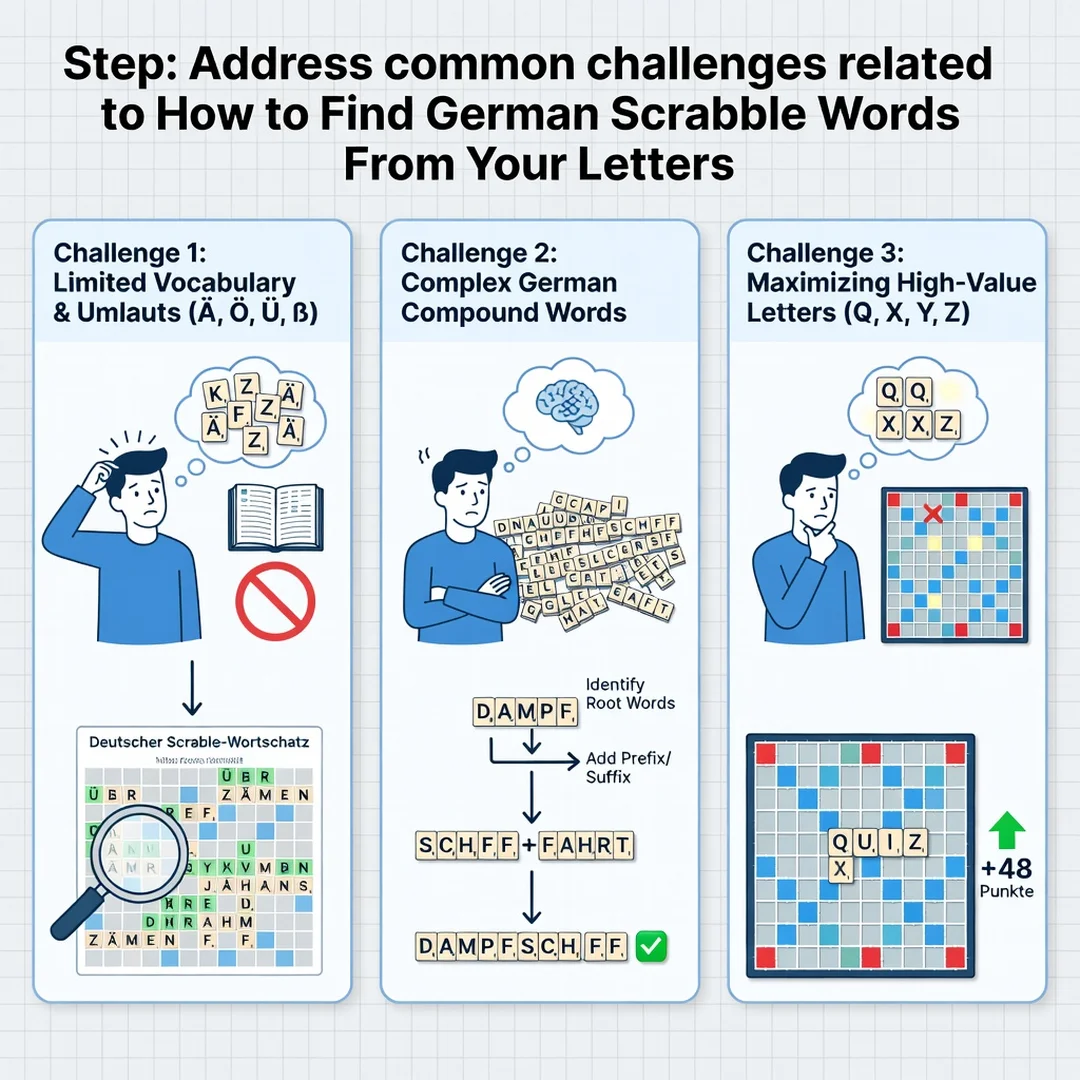
Ä, Ö, and Ü are separate letters, not accented versions of A, O, and U. That means “schön” uses Ö, not O. “Für” uses Ü. The ß is a distinct letter that cannot be replaced by “ss” in Scrabble play. Some word lists treat ß as interchangeable with SS for certain words, but official tournament rules usually require the exact tile. Always confirm which ruleset you are playing under.
Compound words
German loves compound nouns. “Krankenhaus” (hospital) combines “krank” and “Haus.” “Autobahn” combines “Auto” and “Bahn.” In Scrabble, you can often build a long word by finding a short base word and adding a common prefix or suffix. This is one of the most powerful techniques for finding words from your letters.
Official word lists
The authoritative reference for German Scrabble is the “Deutsche Scrabble-Wörterbuch” or the official tournament word list maintained by the German Scrabble association. For casual play, online word finders and apps often use a standard list. You should know which list is valid in your game before you challenge a word.
Deep Dive
Now that you understand the basics, let’s go deeper into the actual techniques for finding German Scrabble words from your letters. These methods work whether you have seven tiles or eight, and whether you are playing on a board or in an app.
Pattern 1: Start with common endings
German words frequently end in -en, -er, -es, -te, -st, and -ung. If your rack contains E, N, R, S, T, or U, you can often form a word by arranging other letters around one of these endings. For example, if you have D, E, N, and S, “endens” or “sendes” might be valid. If you have K, E, N, and N, “kennen” is a strong play.
Pattern 2: Look for prefixes
Common German prefixes include be-, ge-, er-, ver-, zer-, un-, and vor-. If you have B, E, and a base word, you can often add “be-” to create a new valid word. For example, “halten” becomes “behalten.” “kommen” becomes “bekommen.” This is especially useful when you have high-value letters you want to use.
Pattern 3: Use the umlaut tiles wisely
Ä, Ö, and Ü are high-value but restrictive. Instead of treating them as obstacles, memorize a short list of common words that use them. “Äpfel,” “Öl,” “Über,” “Grün,” “Schön,” “Möglich,” “Für,” “Wärme,” “Können,” “Müssen.” When you see an umlaut on your rack, scan for these patterns. You can also use a blank tile to represent an umlaut if you cannot otherwise play it.
Pattern 4: Build around the ß
The ß is rare but valuable. Common words with ß include “Straße,” “groß,” “weiß,” “Fuß,” “schließen,” “heiß,” and “außer.” If you have ß, try to form one of these words or extend an existing word on the board by adding ß.
Pattern 5: Use anagramming and word finders
Anagramming is the skill of rearranging letters to form new words. For German, you can practice by taking your rack letters and sorting them alphabetically, then looking for common combinations. Online tools — often called “German Scrabble word finders” or “Buchstabensalat-Löser” — let you enter your letters and return all valid words. These are excellent for learning, but in tournament play you must rely on your own knowledge.
Pattern 6: Extend existing board words
Sometimes the best word from your letters is not a standalone word but an extension of a word already on the board. Add -S to make a plural, -N to make a verb form, or -E to make an adjective ending. In German, plurals often add -e, -en, -er, or -s. Verb forms change with -st, -t, -en, or -te. Scan the board for hooks before you look for a completely new word.
Best Practices
Finding German Scrabble words consistently is a habit, not a talent. These best practices will help you improve faster and avoid common pitfalls.
- Study the two- and three-letter words. In German, short words like “ab,” “an,” “auf,” “aus,” “bei,” “da,” “du,” “es,” “in,” “ja,” “so,” “um,” “wo,” and “zu” are essential. They let you play parallel to other words and set up future moves.
- Keep a balanced rack. If you have too many vowels, look for words with umlauts or consonant-heavy endings. If you have too many consonants, look for words with E, N, or S.
- Learn word families. Instead of memorizing isolated words, learn groups: “fahren, fährt, fuhr, gefahren” or “lesen, liest, las, gelesen.” This expands your options exponentially.
- Use blanks strategically. A blank tile is not just a substitute for a missing letter. It can represent an umlaut, an ß, or a high-value letter like Q or Y. Save it until you can use it for a high-scoring play.
- Check the official list. Before you challenge or play a word, make sure it is in the word list your group uses. German Scrabble has regional variations, so “valid” depends on the agreed source.
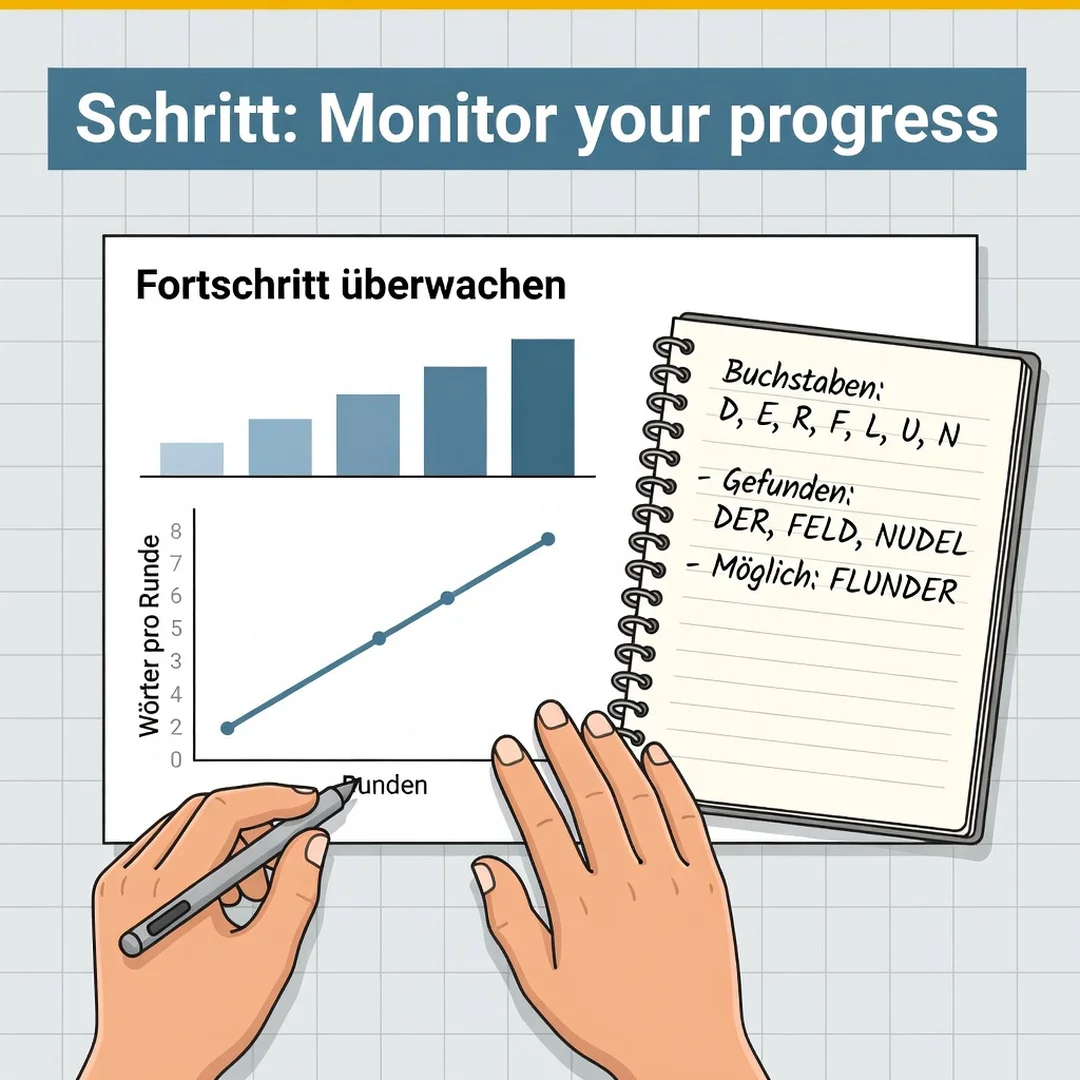
- Practice with a word finder daily. Enter random letters and see what words appear. Over time, you will internalize patterns without needing the tool.
- Review your games. After each game, note the words you missed. Look up their meanings and add them to a personal list. Reliable information and consistent habits lead to better long-term outcomes.
Step-by-Step Guide
Here is a practical six-step process you can use on every turn to find German Scrabble words from your letters.
Step 1: Understand the fundamentals
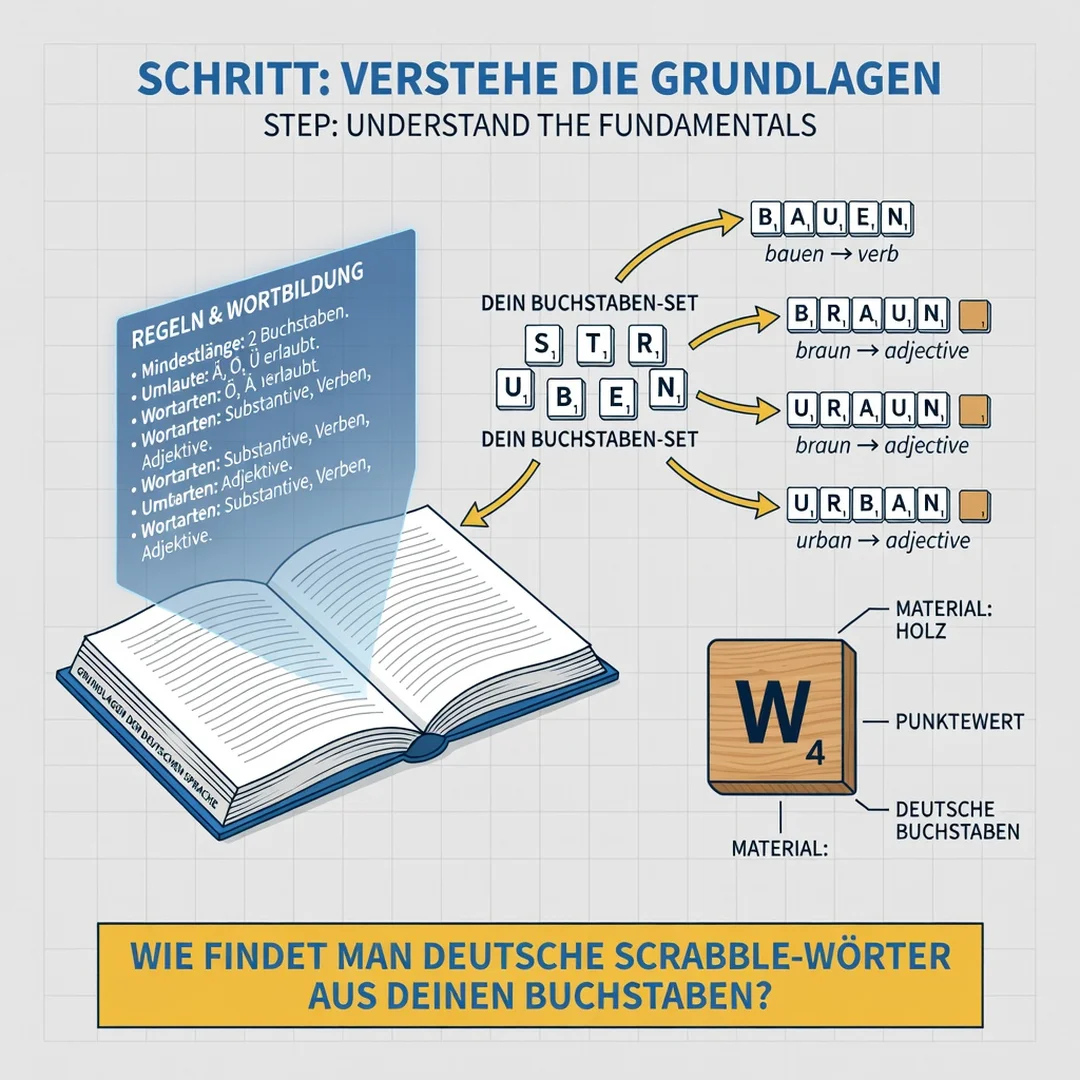
Before you look at your letters, remind yourself of the basics: German tile values, the role of umlauts and ß, and the word list you are using. Know that Ä, Ö, Ü, and ß are distinct letters. Know that compound words are allowed. Know that short words like “ab,” “an,” and “zu” are valid. This mental checklist takes five seconds and prevents illegal plays.
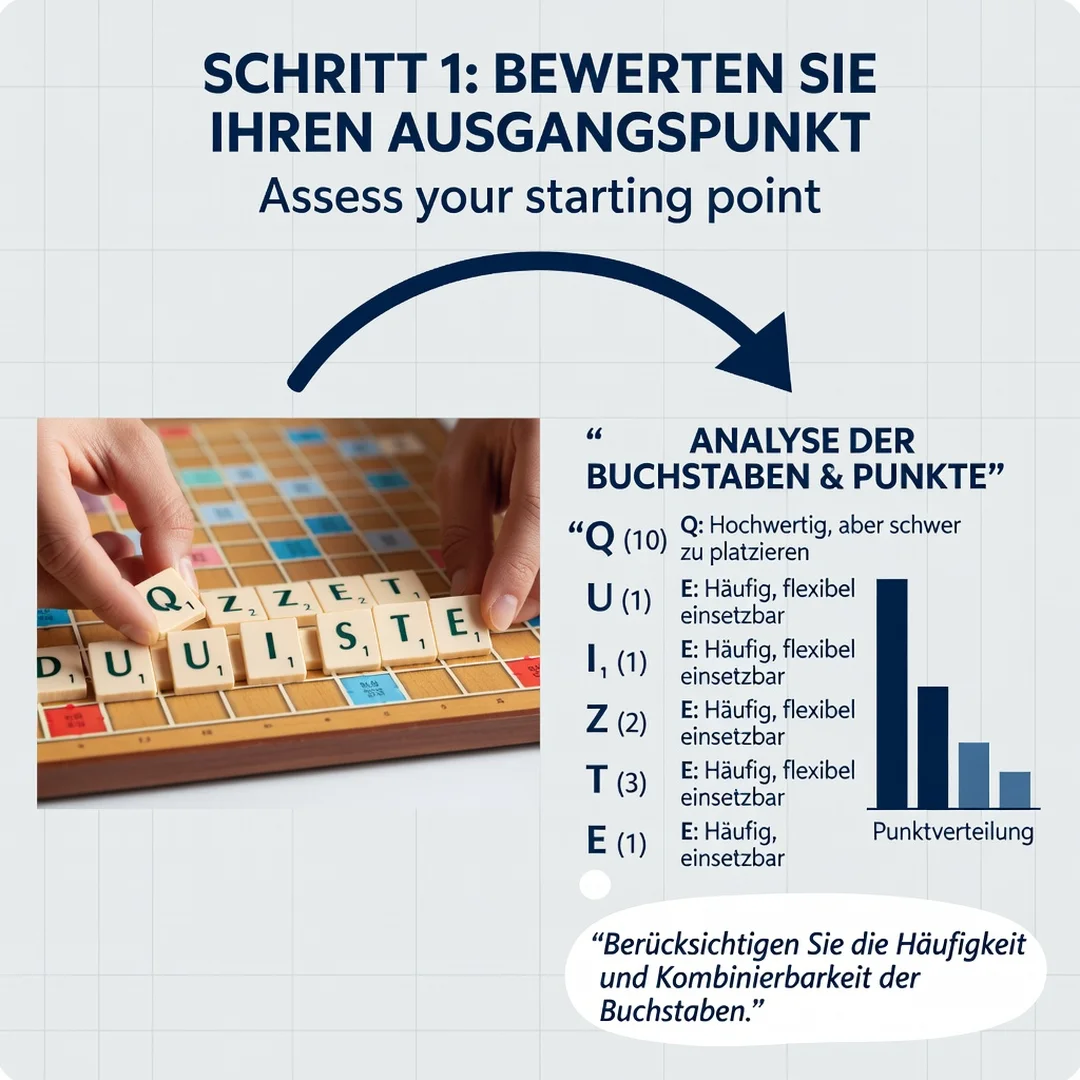
Step 2: Assess your starting point
Look at your rack. Sort your letters alphabetically. Count your vowels and consonants. Identify any high-value tiles (Q, Y, Ä, Ö, Ü, ß, J, X). Note any blanks. Then look at the board. Where are the high-scoring squares? Where are the open lanes? Are there existing words you can extend? This assessment tells you whether to play a defensive move or go for a big score.
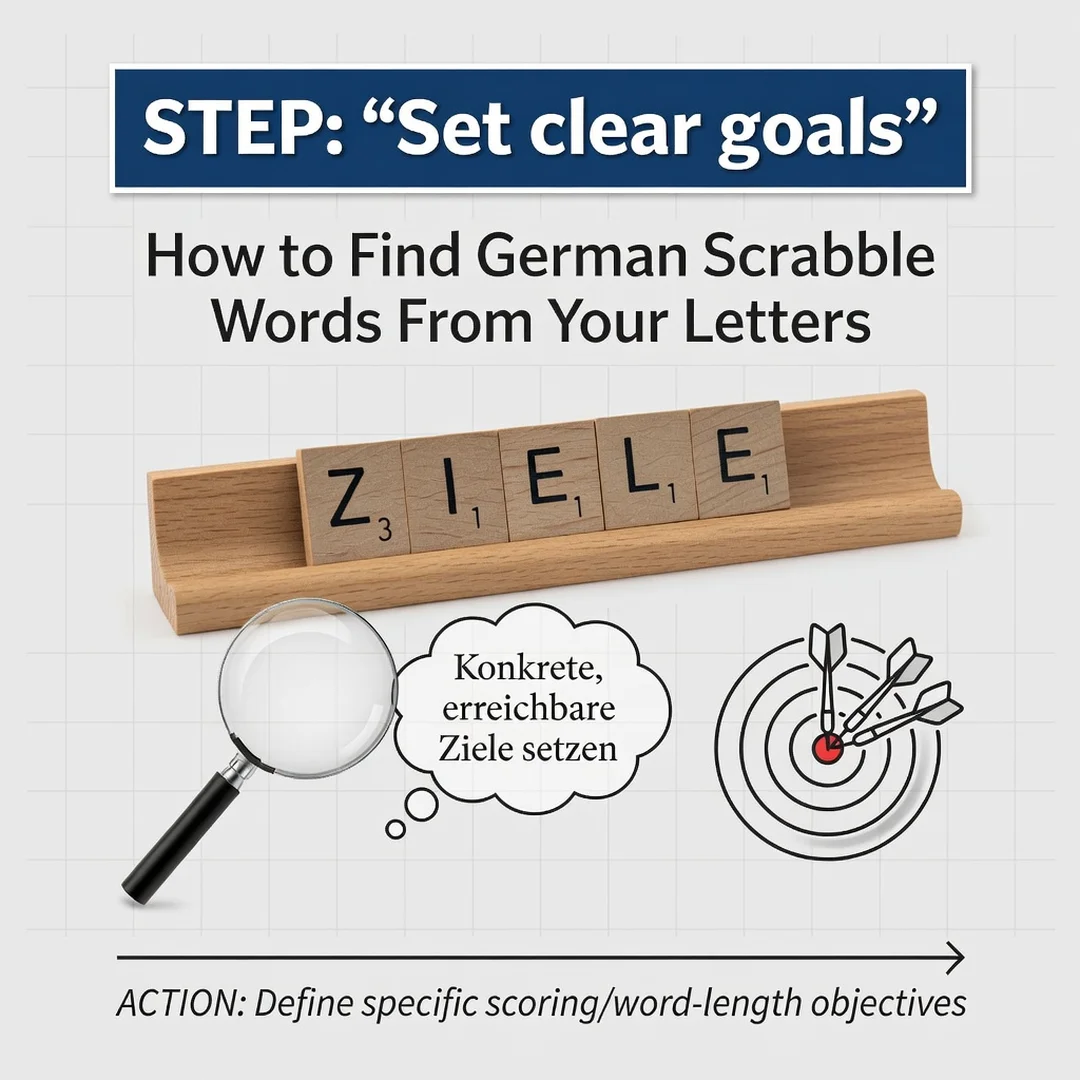
Step 3: Set clear goals
For this turn, decide what you want to achieve. Do you want to play a bingo (use all seven tiles for a 50-point bonus)? Do you want to block your opponent’s best lane? Do you want to get rid of an awkward letter like Q or Y? Do you want to set up a future high-scoring play? Your goal determines your word choice. Without a goal, you will default to the first word you see, which is often not the best one.
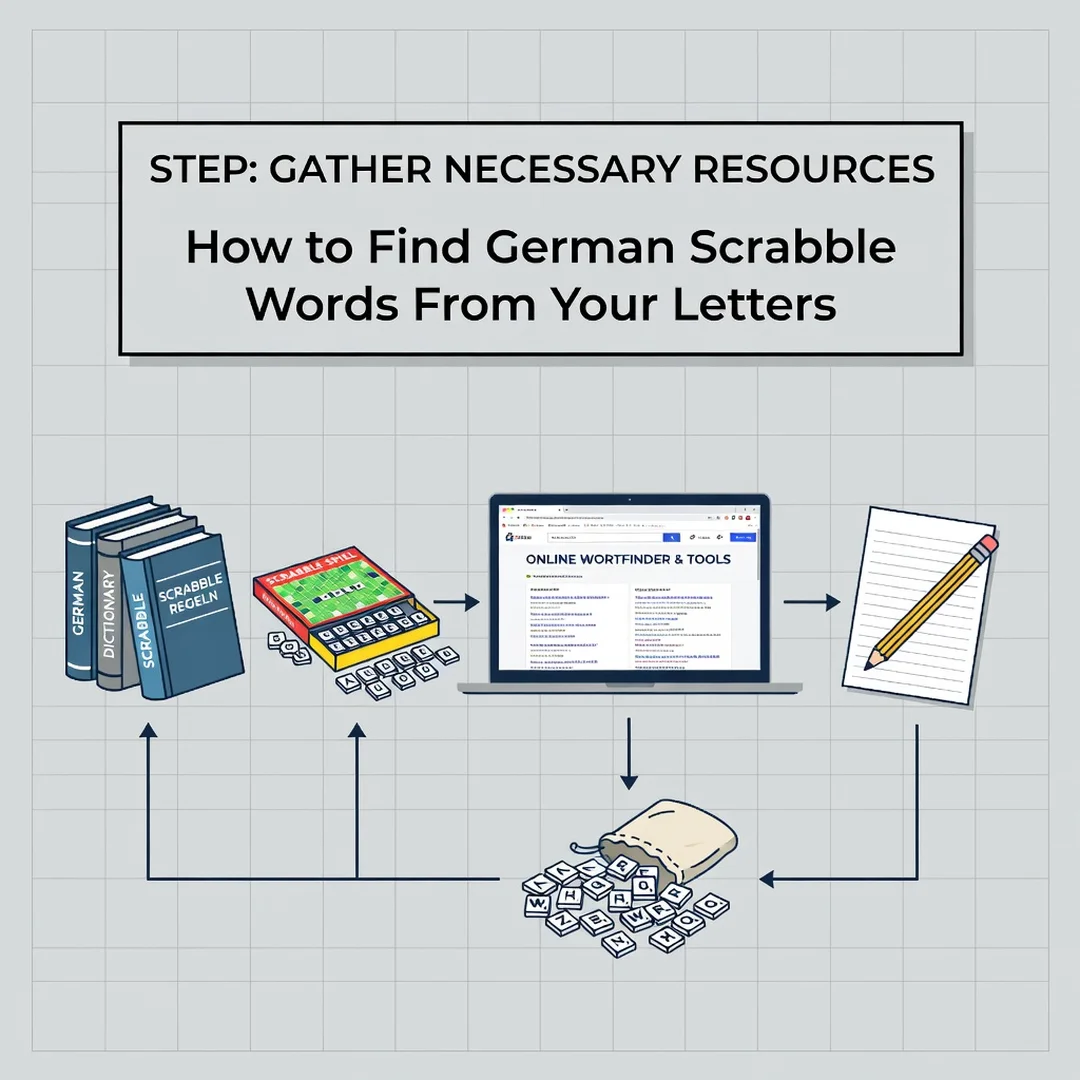
Step 4: Gather necessary resources
Gather the tools you need. If you are playing casually, you can use a German Scrabble word finder on your phone or computer. If you are in a tournament, you rely on your memory and the official word list. At home, keep a printed list of common German prefixes, suffixes, and short words. Have a pen and paper to write down candidate words. The more organized your resources, the faster you will find valid words.
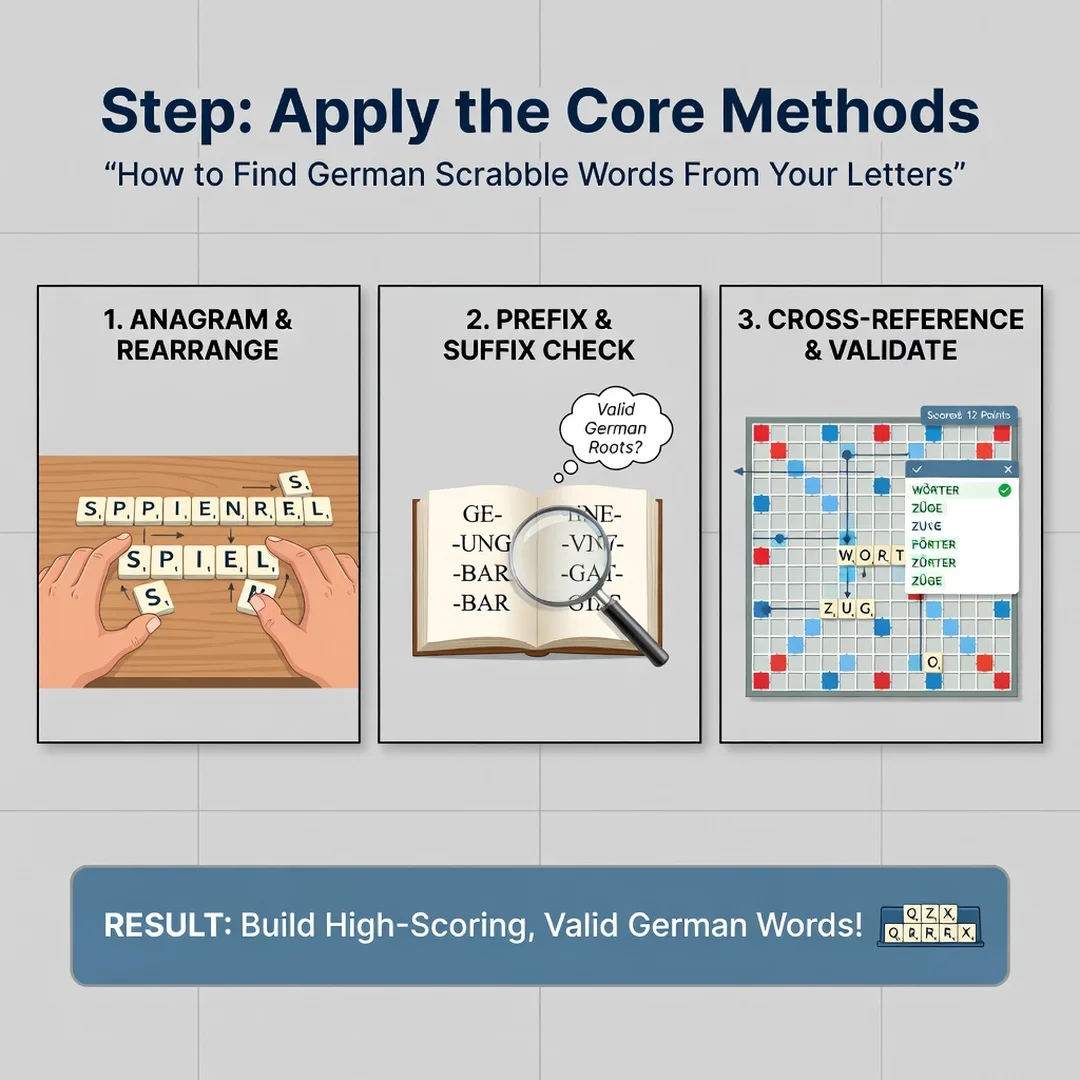
Step 5: Apply the core methods
Now apply the techniques from the Deep Dive section. Start with common endings (-en, -er, -es, -te, -st, -ung). Add common prefixes (be-, ge-, er-, ver-, zer-,.
You now have a solid foundation for How to Find German Scrabble Words From Your Letters. Apply the best practices above and revisit this guide as your needs evolve.