

German anagrams can feel intimidating at first, thanks to special characters like ä, ö, ü, and ß that don’t exist in standard English word puzzles. But once you understand how these letters behave, you gain a real advantage over the average solver. Learning how to solve anagrams using German letters is a skill anyone can build with the right approach.
In this guide, we’ll break down practical techniques for rearranging German letter sets, handling umlauts and eszett, and spotting common word patterns fast. Whether you’re a puzzle enthusiast or preparing for a language exam, these actionable tips will help you crack anagrams with confidence.
Introduction
Anagrams are word puzzles in which the letters of a word or phrase are rearranged to form a new word or phrase. When the letters involved are German — including characters such as ä, ö, ü, and ß — the challenge becomes both more interesting and more manageable once you understand the rules of the language. This article explores how to solve anagrams using German letters with clear, practical guidance that you can apply immediately, whether you are a language learner, a puzzle enthusiast, or someone preparing for a word game tournament.
The German alphabet contains 26 basic letters plus the umlauted vowels ä, ö, ü and the ligature ß (Eszett). These special characters often intimidate solvers, but they follow predictable patterns. Once you learn how they behave in anagrams, you gain a significant advantage over solvers who treat them as random obstacles. Understanding the fundamentals of how to solve anagrams using German letters helps you make informed decisions about which letter combinations to try first, which tools to use, and how to avoid common dead ends.
Reliable information and consistent habits lead to better long-term outcomes. That principle applies directly to anagram solving. By the end of this guide, you will have a repeatable system: recognizing letter patterns, applying substitution rules for umlauts and ß, using dictionaries and digital tools effectively, and practicing in a way that builds speed and accuracy over time. The sections below move from core concepts to a step-by-step method, followed by best practices and answers to frequently asked questions.
Key Concepts
Before diving into solving techniques, you need a firm grasp of the building blocks specific to German anagrams. These concepts distinguish German anagram solving from English anagram solving and explain why certain approaches work better than others.
The German letter inventory
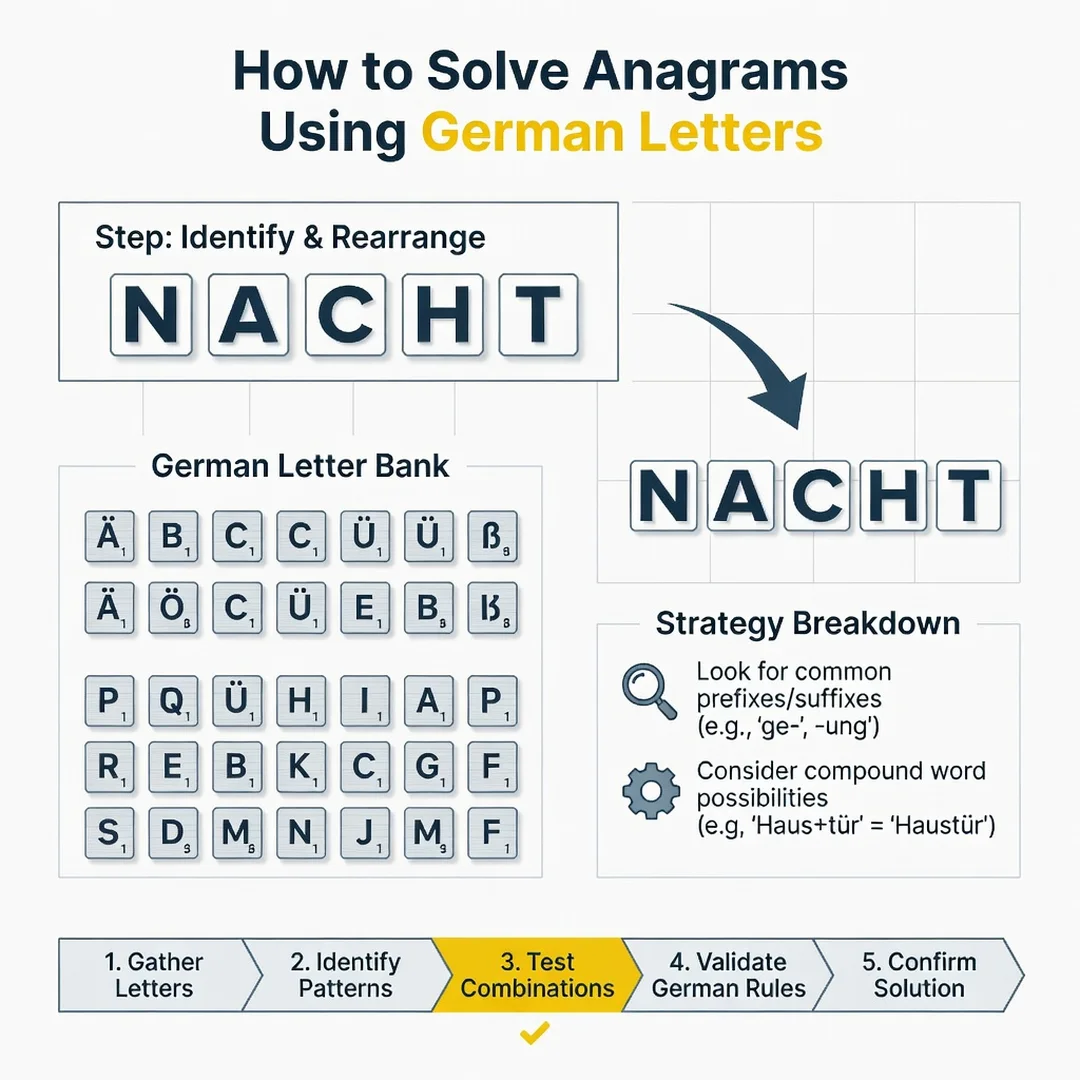
German uses the same 26 Latin letters as English, plus four additional characters: ä, ö, ü, and ß. In anagram puzzles, these characters may appear as-is, or they may be represented by digraphs: ae for ä, oe for ö, ue for ü, and ss for ß. Recognizing both representations is essential because puzzle creators are inconsistent. A word like “Mädchen” might appear as M Ä D C H E N or as M A E D C H E N. Your anagram-solving system must handle both forms.
Umlaut behavior in anagrams
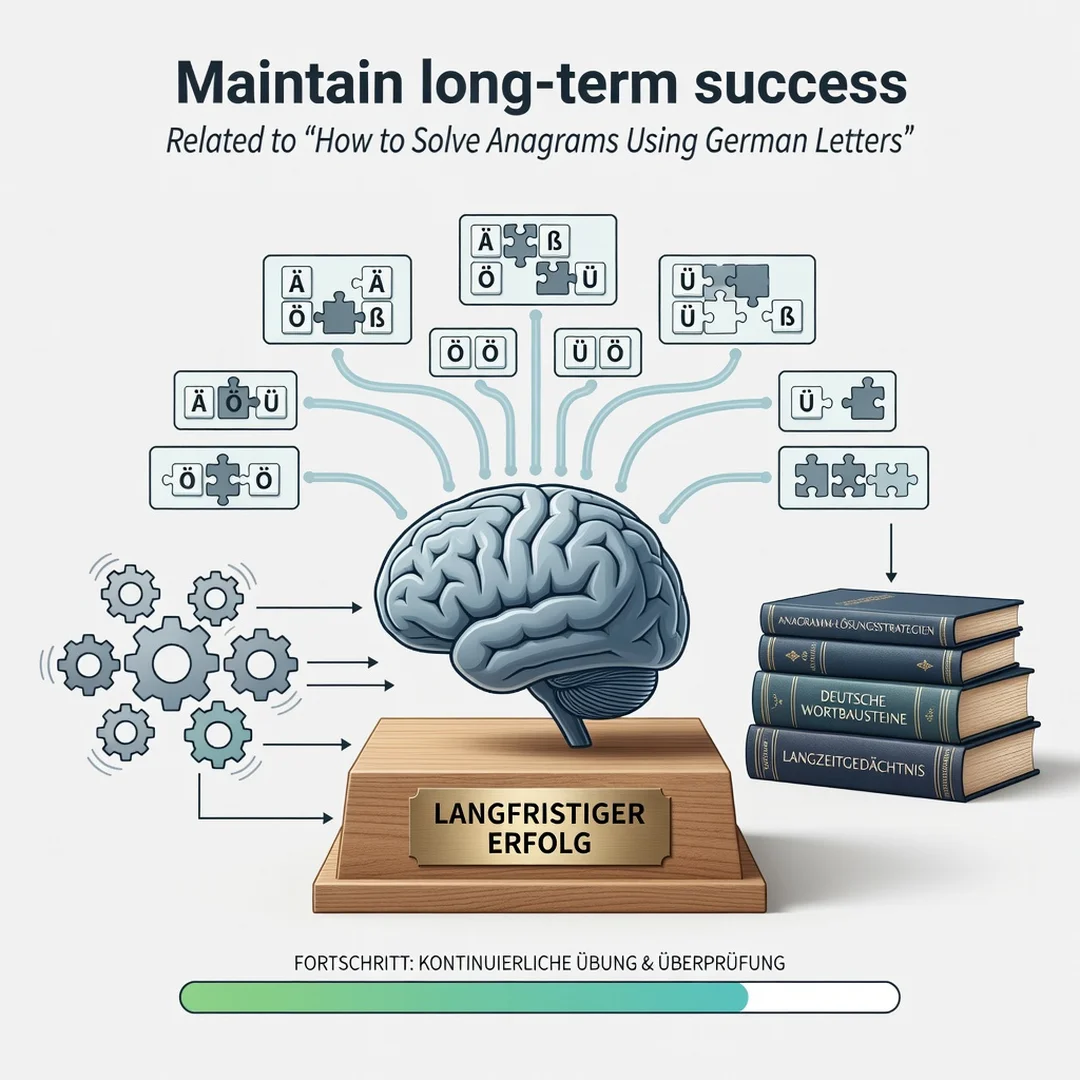
An umlaut changes both the sound and the letter count of a word. In strict anagram puzzles, ä is a distinct letter from a, so “schön” (S C H Ö N) cannot be rearranged into a word using plain O. However, in looser puzzles, solvers are sometimes allowed to substitute ae, oe, and ue for the umlauted vowels. Always check the puzzle’s rules first. If no rule is stated, assume strict letter identity — treat ä, ö, and ü as separate characters.
The ß (Eszett) problem
The ß is unique because it has no uppercase form in traditional German orthography (though capital ẞ exists for official use). In anagrams, ß almost always corresponds to a double S sound. Some puzzles treat ß as a single letter; others split it into SS. Knowing which convention the puzzle uses prevents you from missing valid solutions. A word like “Straße” contains one ß, but if the puzzle treats it as SS, you now have two S letters to work with.
Letter frequency and common German patterns
German letter frequency differs from English. E, N, I, S, R, and A are the most common letters. The digraphs CH, SCH, and CK appear frequently. German words also tend to be longer and more compound-heavy than English words. Recognizing common prefixes (ver-, be-, ge-, er-) and suffixes (-ung, -heit, -keit, -lich, -en) gives you anchor points when rearranging letters.
Anagram types
- True anagrams: Every letter is used exactly once. Example: “Leben” becomes “Nebel.”
- Partial anagrams: Only a subset of letters is rearranged. Common in crossword-style clues.
- Multi-word anagrams: Letters form a phrase rather than a single word. Example: “Tor” + “Schluss” rearranged into “Schloss” + “Tür.”
- Cryptic anagrams: Part of a larger clue, often signaled by words like “verwirrt,” “durcheinander,” or “neu.”
Each type demands a slightly different solving strategy, but the core skill — manipulating German letters systematically — remains the same.
Deep Dive: Step-by-Step Method
This section walks you through a complete, repeatable process for solving German anagrams. Follow the steps in order when you are learning; with practice, several steps will merge into a single intuitive motion. The step headings below are fixed and must be used exactly as written.
Step 1: Understand the fundamentals
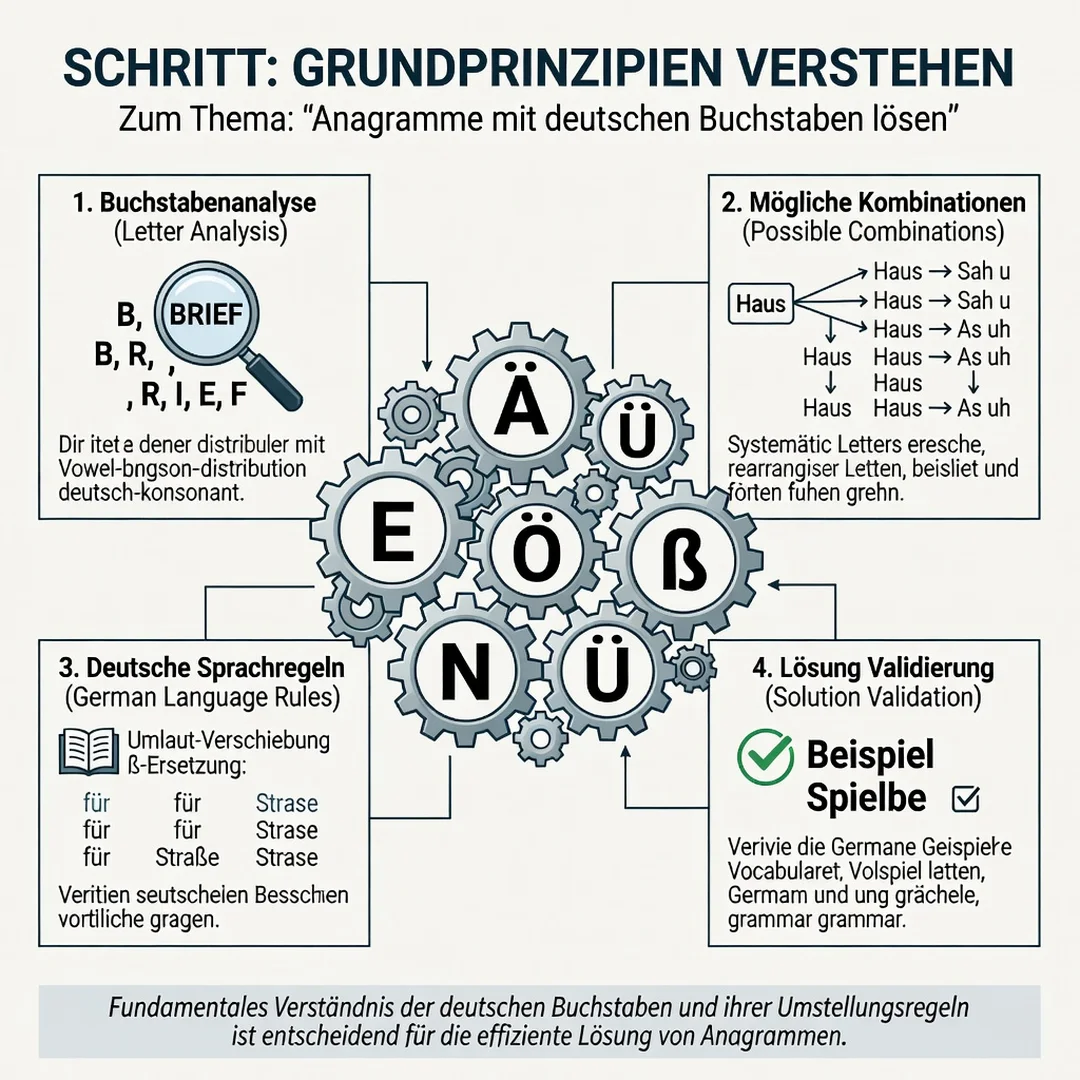
Start by confirming the rules of your puzzle. Ask yourself: Are umlauts treated as distinct letters or as ae/oe/ue digraphs? Is ß a single letter or SS? Are you solving a single-word anagram or a phrase? Write down the exact letter inventory, including special characters. For example, if the puzzle gives you “GRÜN,” your inventory is G, R, Ü, N — four letters, one of which is an umlauted U. If the puzzle instead gives “GRUEN,” your inventory is G, R, U, E, N — five letters. This single distinction changes every subsequent step, so never skip it.
Next, familiarize yourself with common German letter combinations. The cluster SCH is extremely common; so are CH, CK, and the suffix -EN. When you see these clusters in your letter set, they often stay together in the solution. Recognizing them early narrows your search dramatically.
Step 2: Assess your starting point
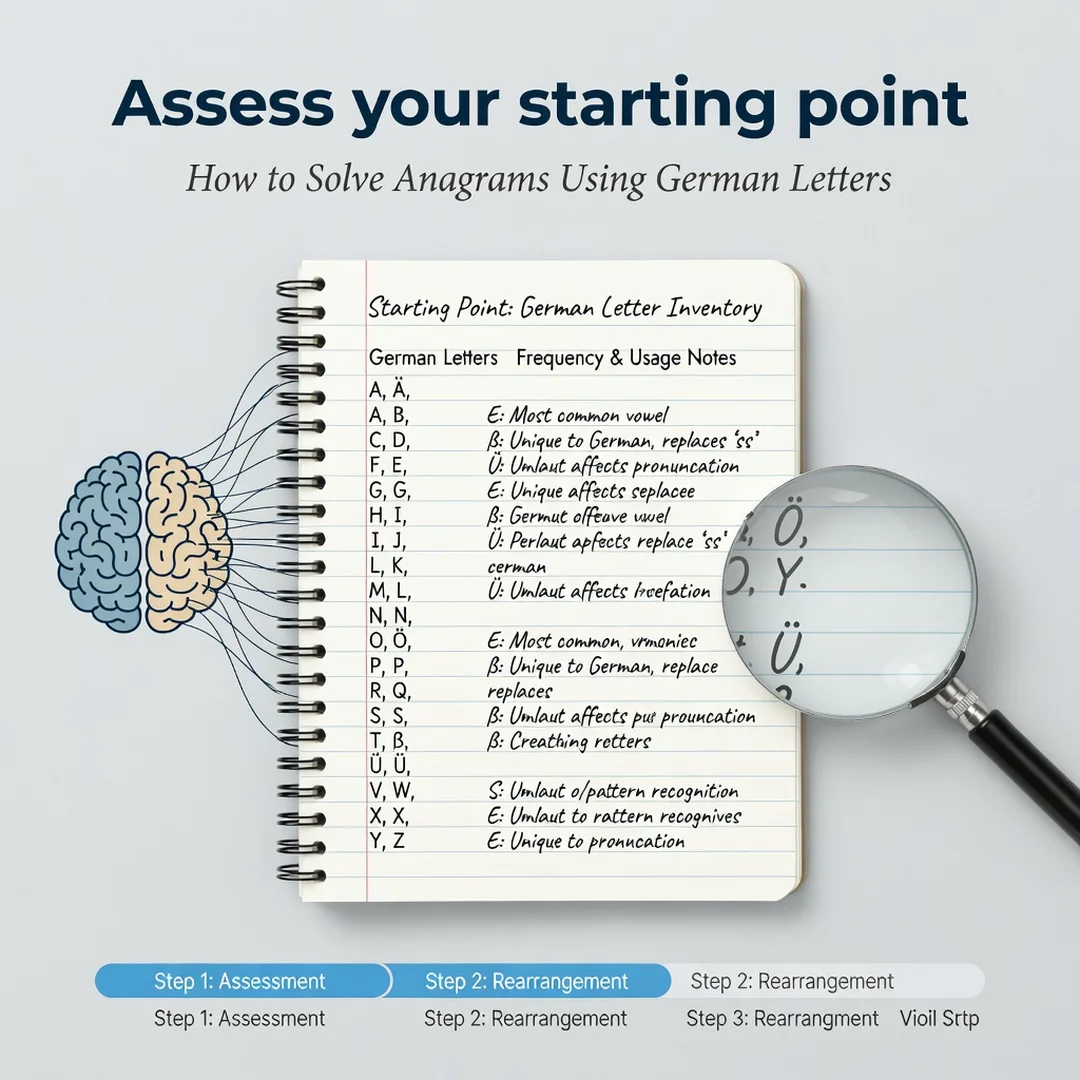
Take stock of what you already know. Do you recognize any part of the scrambled letters as a real German word? Even a fragment like “heit” or “ung” is a valuable clue. Count the vowels and consonants. German words typically alternate between vowel and consonant clusters, but compound words can have long consonant runs (e.g., “Schriftsteller”).
If you are using a digital tool, enter the letters exactly as given, including umlauts. If the tool does not support umlauts, convert them to ae/oe/ue and note that the results may include words that would not be valid under strict rules. Assess your own skill level honestly: a beginner should focus on short words (4–6 letters) before attempting 10-letter compounds.
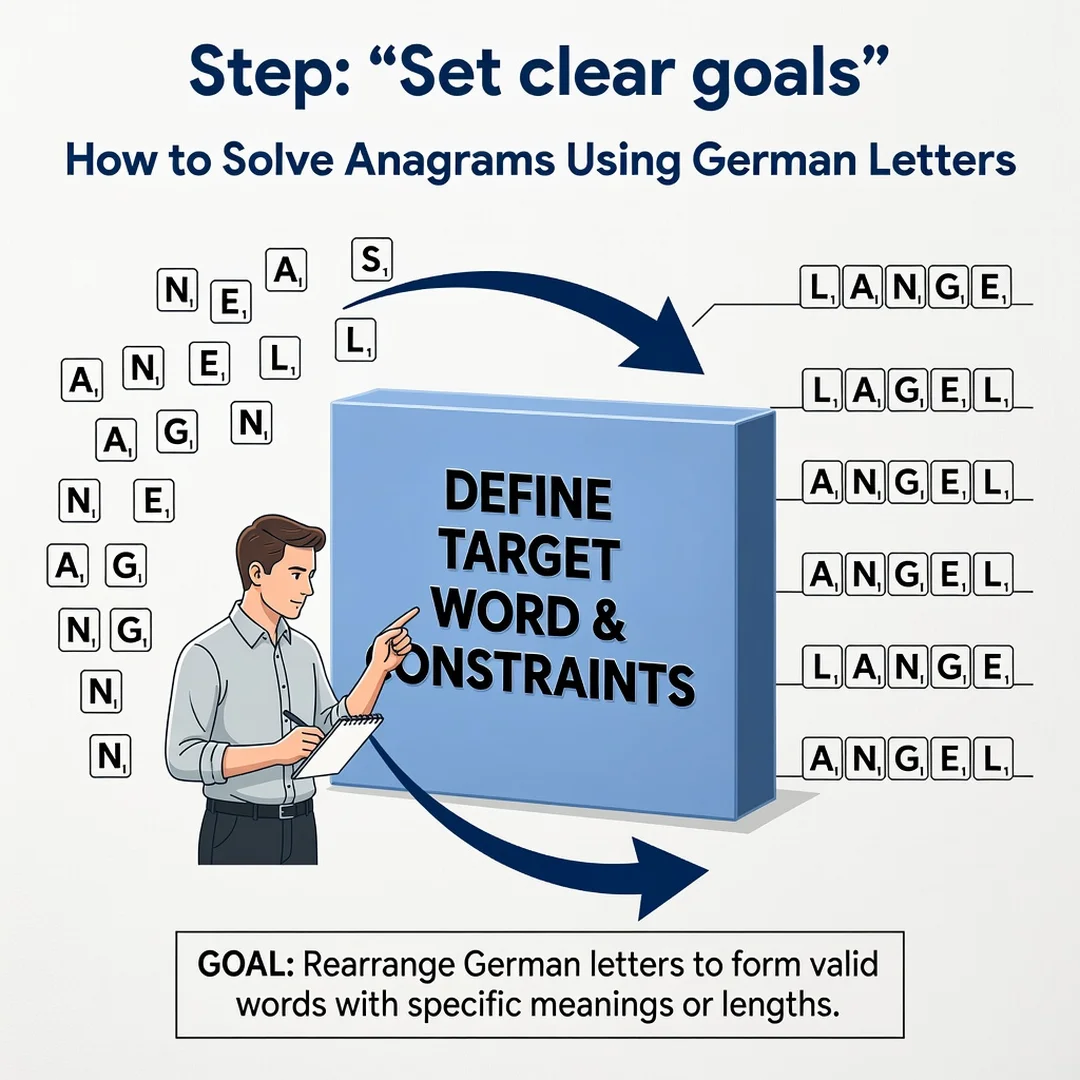
Step 3: Set clear goals
Define what success looks like for this particular puzzle. Are you trying to find one valid word, or all possible anagrams? Are you under a time limit? Do you need to explain your solution to someone else? Your goal determines how much effort to invest in each technique.
For casual solving, aim for one correct answer and stop. For competitive play or learning, aim to find every valid anagram within a reasonable time. Set a personal benchmark: for example, “I will solve any 6-letter German anagram in under two minutes.” Clear goals keep you focused and make progress measurable.
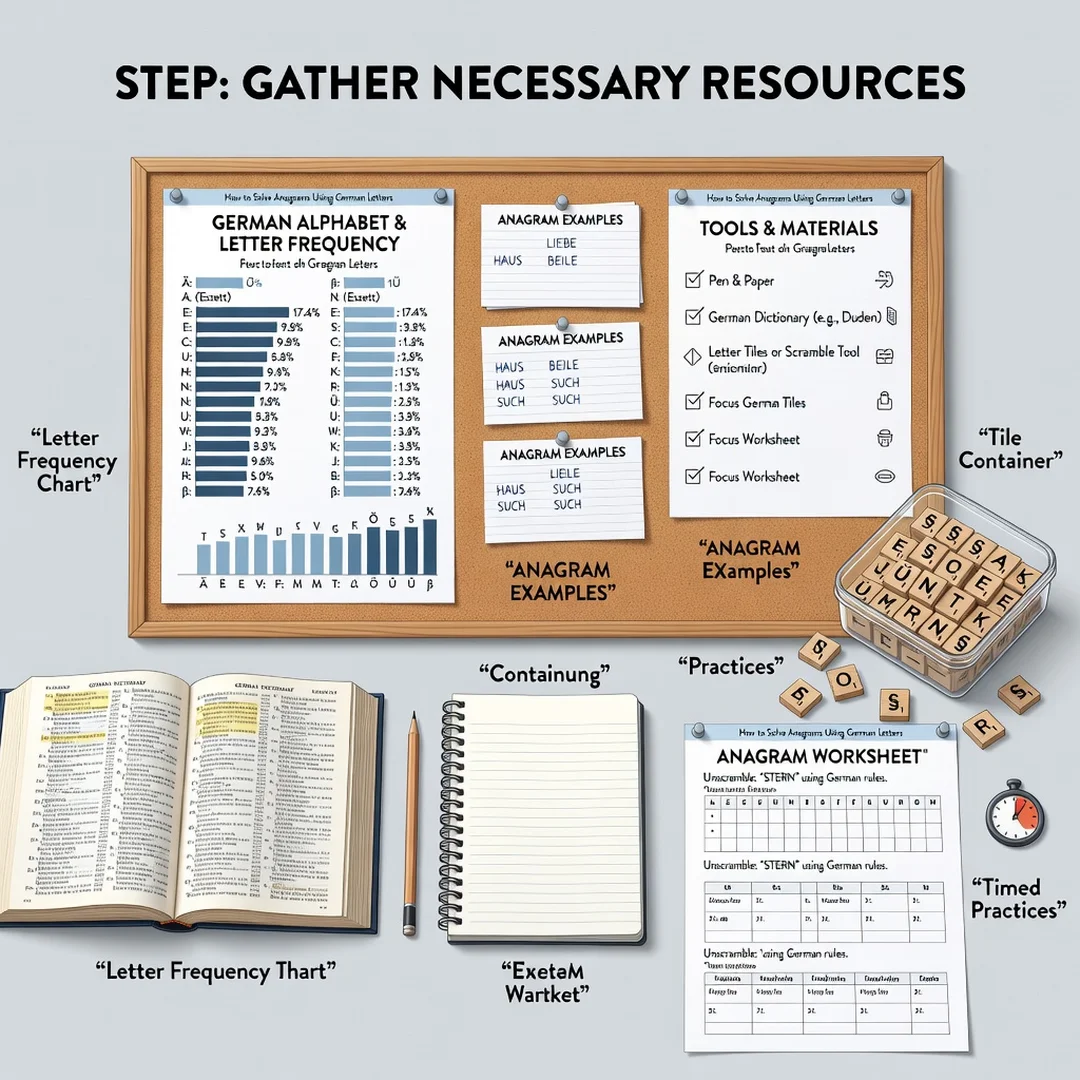
Step 4: Gather necessary resources
You need three categories of resources: reference, tools, and practice material.
- Reference: A reliable German dictionary (Duden is the standard). For anagram-specific work, a reverse dictionary or anagram dictionary that lists words by sorted letter order is invaluable.
- Tools: Online anagram solvers that support German characters. Verify that the tool handles ä, ö, ü, and ß correctly. Some popular solvers allow you to toggle between strict and digraph modes.
- Practice material: Puzzle books, newspaper anagram columns (many German newspapers publish daily word puzzles), or apps with German word lists. Consistent practice with real puzzles beats theoretical study every time.
Keep a notebook or digital file of solved anagrams. Over time, this becomes a personal database of patterns and solutions that speeds up future solving.
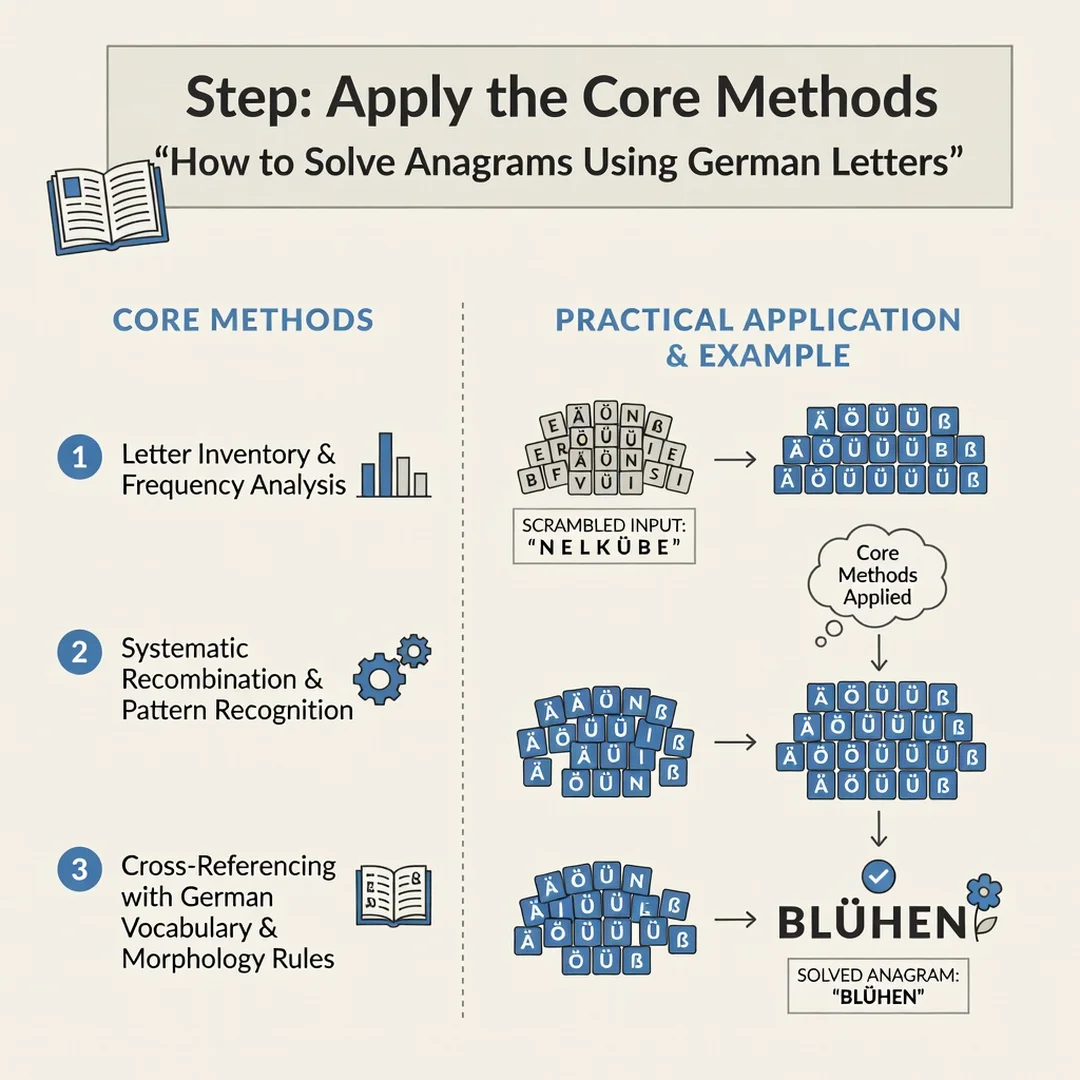
Step 5: Apply the core methods
Now you solve. Use these techniques in combination:
- Sort and scan: Arrange the letters alphabetically. For “NIEDLICH,” sorted letters are C D E H I I L N. Scanning sorted letters often reveals hidden words because you see repeated letters and common clusters side by side.
- Anchor common clusters: Look for SCH, CH, CK, and common suffixes (-EN, -ER, -UNG, -LICH). Place these clusters mentally and see what remains.
- Vowel-consonant balance: German words rarely have more than three consecutive vowels or four consecutive consonants (except in compounds). If your tentative arrangement violates this, try a different grouping.
- Try prefixes: German uses separable and inseparable prefixes heavily. Test GE-, BE-, VER-, ER-, ZER-, ENT-, and MISS- as starting points.
- Use the umlaut backward: If you have an Ü and no obvious word, try treating it as U plus an E somewhere else in the word. This trick often unlocks solutions that strict thinking blocks.
- Brute-force with structure: For short anagrams (4–6 letters), systematically try each letter as the first letter, then each remaining letter as the second, and so on. This is slow but guaranteed for very short puzzles.
When you find a candidate word, verify it against your dictionary. German has many near-words that look plausible but are not standard. Verification prevents false positives.
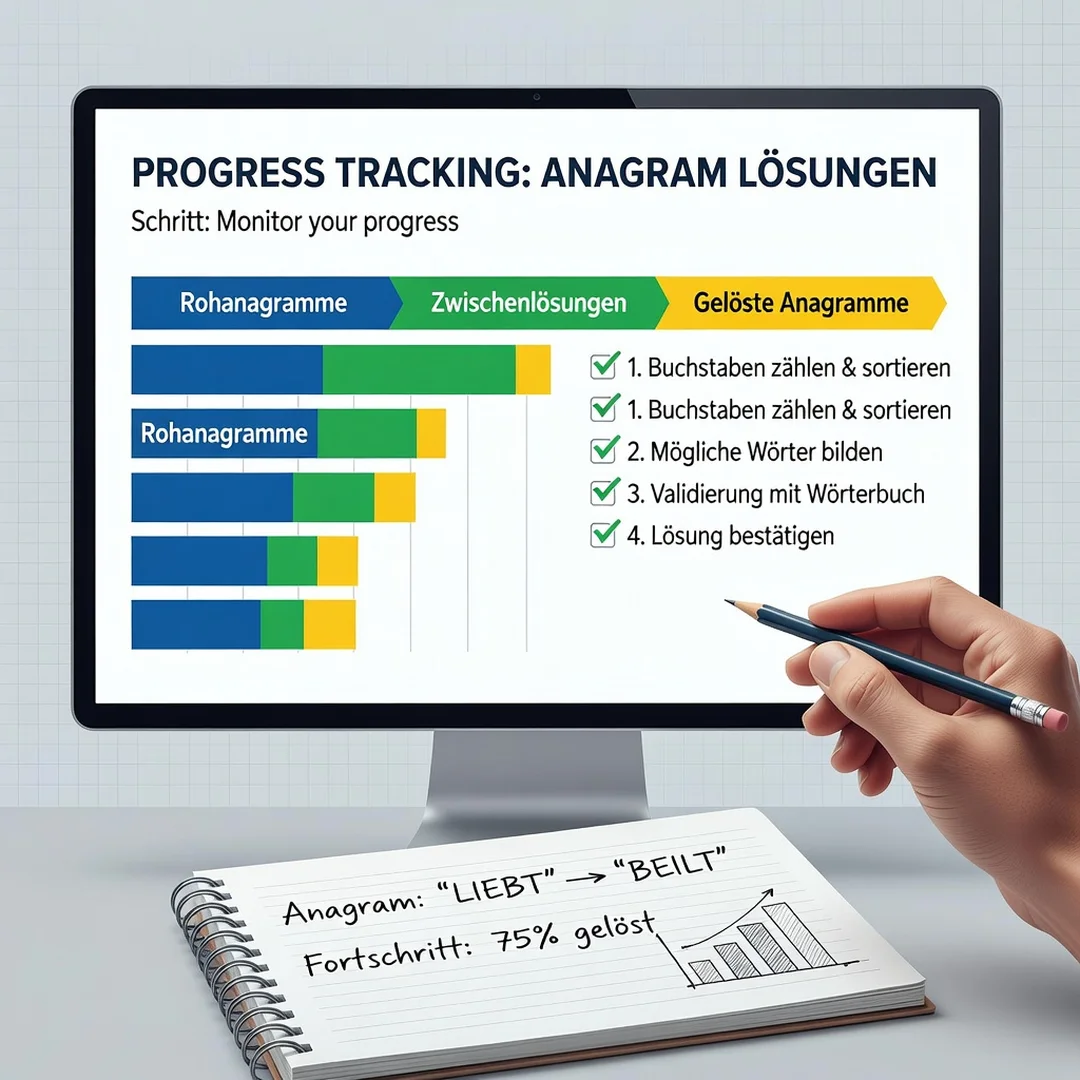
Step 6: Monitor your progress
Track your solving times, success rate, and the techniques that worked. After each session, note which anagrams stumped you and why. Was it an unfamiliar umlaut convention? A compound word you didn’t know? A rare letter combination? Logging these details turns each puzzle into a learning opportunity.
Review your log weekly. You will likely see patterns: perhaps you consistently miss words ending in -UNG, or you forget that ß can be SS. Targeted practice on your weak spots produces faster improvement than random solving. Reliable information and consistent habits lead to better long-term outcomes — this is as true for anagram solving as for any other skill.
Best Practices
These practices separate casual solvers from confident ones. Adopt them gradually and they will become automatic.
- Always confirm the umlaut rule first. Five seconds of checking saves minutes of frustration.
- Practice without tools regularly. Tools are training wheels. Solve at least a few puzzles per week entirely by hand to build genuine pattern recognition.
- Learn 50 common German suffixes and prefixes. They appear in a huge percentage of anagrams. Mastery here pays exponential dividends.
You now have a solid foundation for How to Solve Anagrams Using German Letters. Apply the best practices above and revisit this guide as your needs evolve.