

German vocabulary can feel daunting, especially when you hit letters that seem rare in the language. If you’re searching for German words with Q, X, and Y, you’ve found the right guide. While these letters are less common than in English, they still appear in everyday nouns, verbs, and borrowed terms worth knowing.
Below, you’ll find clear examples of German words with Q, X, and Y, along with their meanings and simple usage tips. Whether you’re learning for travel, study, or curiosity, this list makes these unusual letters easy to remember and use with confidence.
Introduction
German vocabulary can feel intimidating at first, especially when you encounter letters that seem rare or foreign. Among the 26 letters of the Latin alphabet, Q, X, and Y stand out in German because they appear far less often than in English. Yet these letters are not curiosities to be ignored. They open the door to a distinctive set of words that reveal how German borrows, adapts, and preserves vocabulary from Latin, Greek, French, and English. This article explores German Words With Q, X, and Y: Examples and Meanings with clear, practical guidance. Whether you are a language learner, a traveler, a crossword enthusiast, or someone simply curious about German, understanding these words helps you read more confidently, spell more accurately, and recognize patterns that make the language easier to learn.
Many learners skip over words beginning with Q, X, or Y because they assume such words are too rare to matter. In reality, a small but useful set of these words appears in everyday texts, signs, and conversations. Knowing them can improve your comprehension and give you a richer vocabulary. This guide provides examples, meanings, and strategies you can apply immediately.
Key Concepts
Before diving into specific words, it helps to understand a few core ideas about how Q, X, and Y function in German.
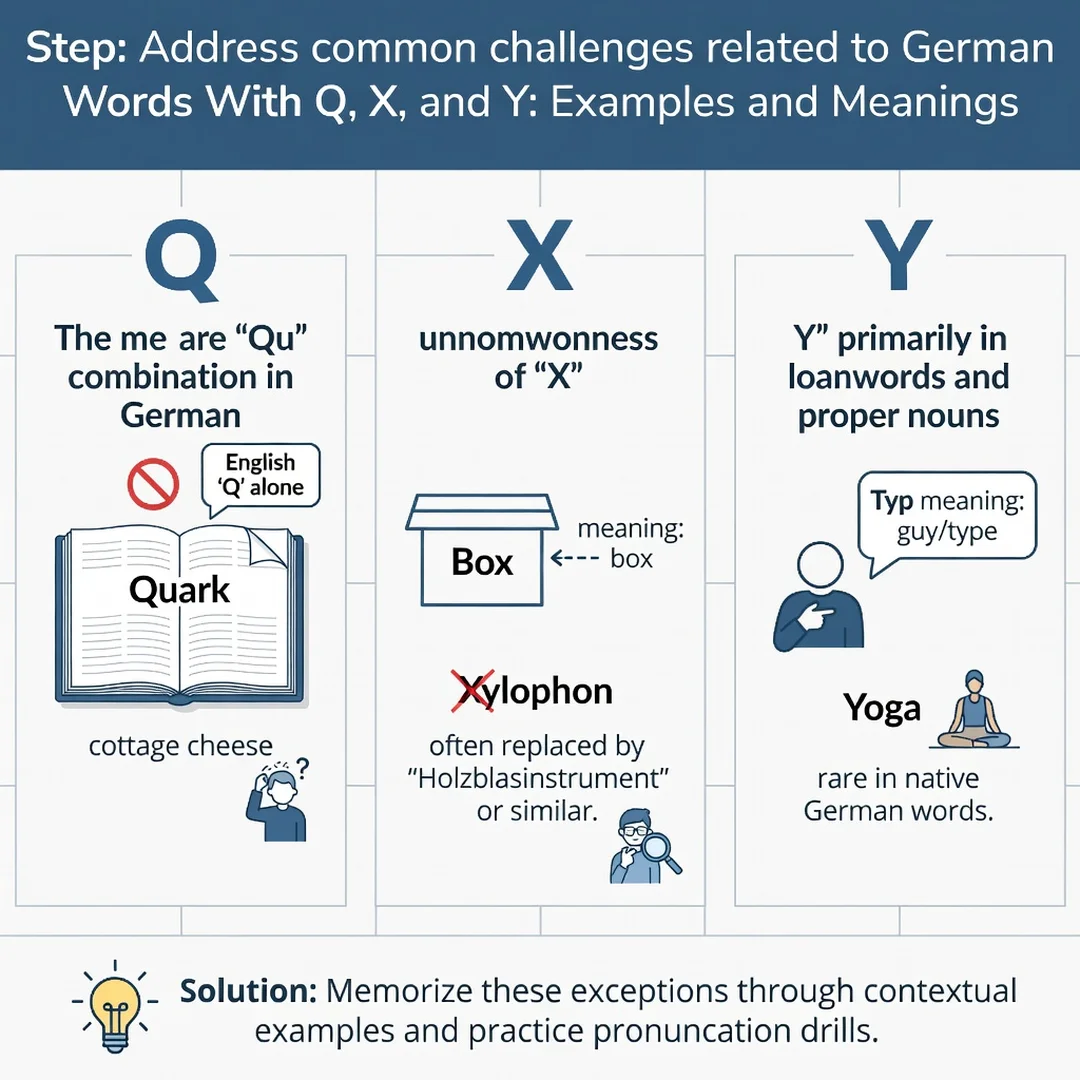
Frequency and origin
Q, X, and Y are among the least frequent letters in German. Most German words with Q come from Latin or Romance languages, often related to science, mathematics, or formal writing. X appears in words of Greek origin, technical terms, and a few native German words. Y is the rarest of the three in native vocabulary and appears mostly in loanwords from Greek, English, or French.
Pronunciation basics
- Q in German is almost always followed by U and pronounced like the English “kv” sound, as in Quelle (source).
- X is usually pronounced like the English “ks,” as in Xylophon (xylophone).
- Y has two common pronunciations: as a consonant similar to the German “j” in Yoga, or as a vowel like the German “ü” in words such as Physik (physics).
Why these words matter
Understanding the fundamentals of German Words With Q, X, and Y: Examples and Meanings helps you make informed decisions about what to study next. These words often appear in academic, scientific, and technical contexts. They also show up in names, brands, and borrowed terms. Recognizing them prevents confusion and builds confidence.
Common patterns
German words with Q almost always begin with “Qu.” Words with X often contain “x” in the middle or at the start, and many are internationalisms. Words with Y frequently come from Greek roots and appear in fields like medicine, mathematics, and philosophy. Spotting these patterns helps you guess meanings and spellings more accurately.
Deep Dive
Let us examine each letter in detail, with examples and meanings you can use right away.
German words with Q
The letter Q in German is nearly always paired with U. Here are some practical examples:
- die Quelle – source, spring, origin. Used for water sources and also for sources of information.
- die Qualität – quality. A common word in business and everyday speech.
- die Quantität – quantity. Often paired with Qualität in discussions of trade-offs.
- das Quiz – quiz. Borrowed from English but fully integrated.
- quer – across, diagonal, crosswise. As in quer durch die Stadt (across the city).
- die Quittung – receipt. Useful when shopping.
- quälen – to torment, to torture. Also used figuratively for nagging thoughts.
- der Quark – quark (a dairy product) or nonsense, depending on context.
- die Quote – quota, share, rating. Common in media and statistics.
- quasseln – to chatter, to babble. Informal but widely understood.
Notice that many Q words are nouns with feminine grammatical gender, often ending in -e or -tät. Learning the article along with the noun is essential.
German words with X
X is more varied. It can start a word, appear in the middle, or end a syllable. Examples include:
- das Xylophon – xylophone. A classic example of a Greek loanword.
- die X-Achse – x-axis. Used in graphs and mathematics.
- der X-Ray – X-ray. Often replaced by das Röntgenbild, but the English term appears in some contexts.
- das Taxi – taxi. The x is pronounced “ks.”
- die Praxis – practice, doctor’s office. A very common word.
- der Text – text. One of the most frequent X words in German.
- die Hexe – witch. A native German word with x.
- sechs – six. The number is pronounced with a “ks” sound.
- wachsen – to grow. The x sound comes from “chs.”
- der Luxus – luxury. A Latin loanword.
- die Axt – axe. Short and useful.
Many learners are surprised that “chs” often sounds like x, as in sechs and wachsen. This means you hear the x sound even when the letter x is not written.
German words with Y
Y is the rarest of the three. It appears mostly in loanwords. Examples:
- das Yoga – yoga. Pronounced with a “j” sound at the start.
- der Yoghurt – yogurt. Also spelled Joghurt; both are accepted.
- das System – system. A very common word in everyday and technical language.
- die Physik – physics. The y is pronounced like “ü.”
- der Typ – type, guy. Informal for a person, as in Er ist ein netter Typ.
- das Symbol – symbol. The y sounds like “ü.”
- die Analyse – analysis. The y is pronounced “ü.”
- der Rhythmus – rhythm. A challenging spelling but common.
- das Gymnasium – secondary school, grammar school. In German, it refers to a type of high school.
- der Yen – yen. The Japanese currency.
- das Hobby – hobby. Fully integrated English loanword.
- die Party – party. Another common English borrowing.
In many Y words, the letter functions as a vowel and is pronounced like “ü.” In others, especially at the start, it sounds like “j.” Context and origin usually tell you which pronunciation to use.
Quick reference table
- Q: Quelle (source), Qualität (quality), quer (across)
- X: Xylophon (xylophone), Text (text), sechs (six)
- Y: Yoga (yoga), System (system), Physik (physics)
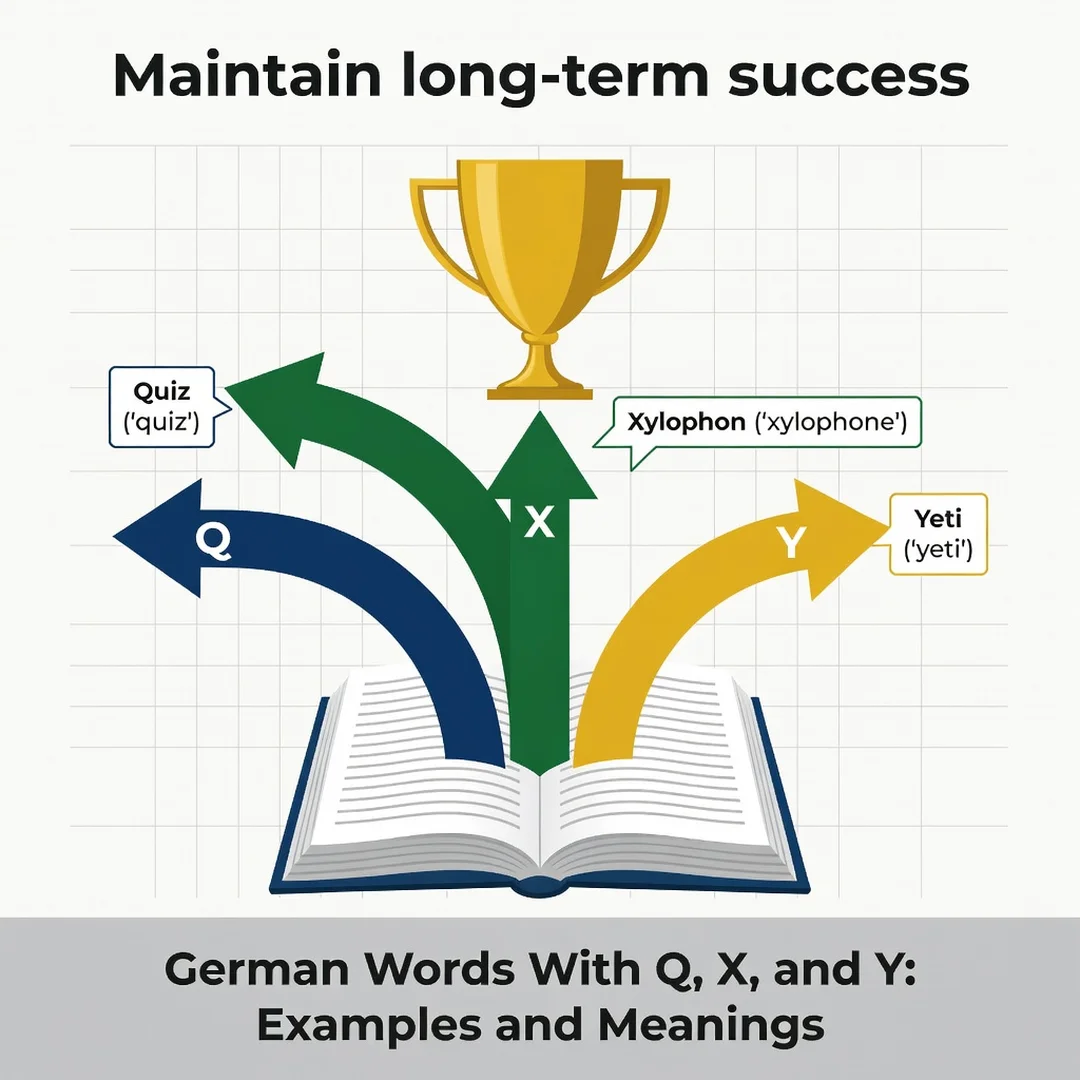
Reliable information and consistent habits lead to better long-term outcomes. Reviewing these words regularly, even in small batches, builds lasting retention.
Best Practices
To learn German words with Q, X, and Y effectively, follow these practical habits.
- Learn nouns with articles. German gender matters. Memorize die Quelle, das Xylophon, das System as complete units.
- Group by letter and theme. Study Q words together, then X words, then Y words. Thematic grouping helps memory.
- Practice pronunciation aloud. The “kv” sound in Q, the “ks” sound in X, and the two Y sounds need repetition.
- Use context sentences. Write one sentence for each word. For example: Die Quelle des Flusses ist in den Bergen. (The source of the river is in the mountains.)
- Connect to English cognates. Many words are internationalisms: Qualität – quality, Text – text, System – system.
- Review with spaced repetition. Apps like Anki or simple flashcards work well for rare letters.
- Read authentic materials. News articles, scientific texts, and product labels contain these words naturally.
- Accept variation. Some words have multiple accepted spellings, such as Yoghurt and Joghurt.
Consistency matters more than intensity. Ten minutes a day yields better results than a single long session once a week.
Step-by-Step Guide
Follow these steps to build a reliable system for learning German words with Q, X, and Y.
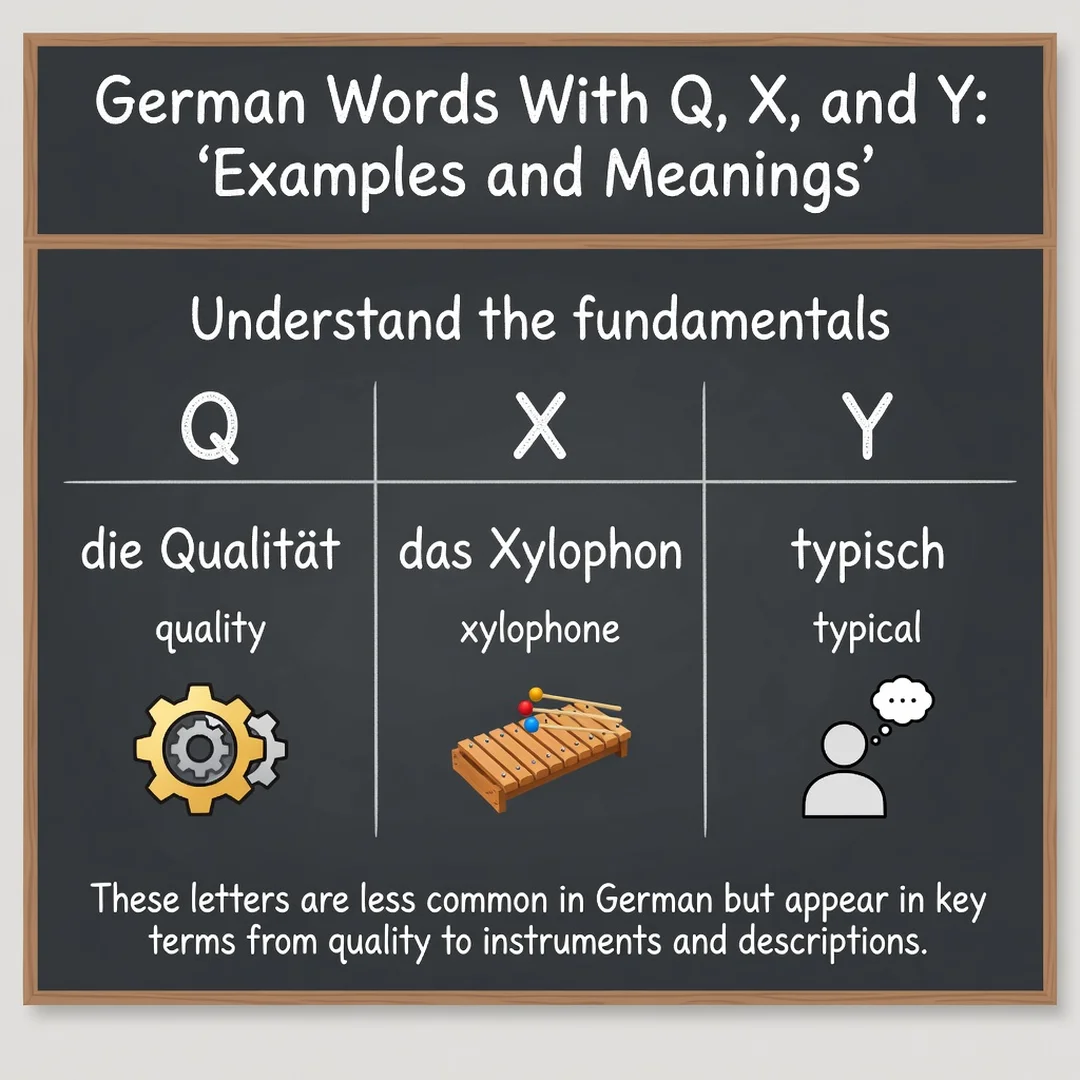
Step 1: Understand the fundamentals
Start by learning how each letter behaves in German. Q is almost always “Qu” and pronounced “kv.” X sounds like “ks,” and the combination “chs” also produces that sound. Y can act as a consonant (“j”) or a vowel (“ü”). Knowing these rules prevents mispronunciation and helps you predict spellings.
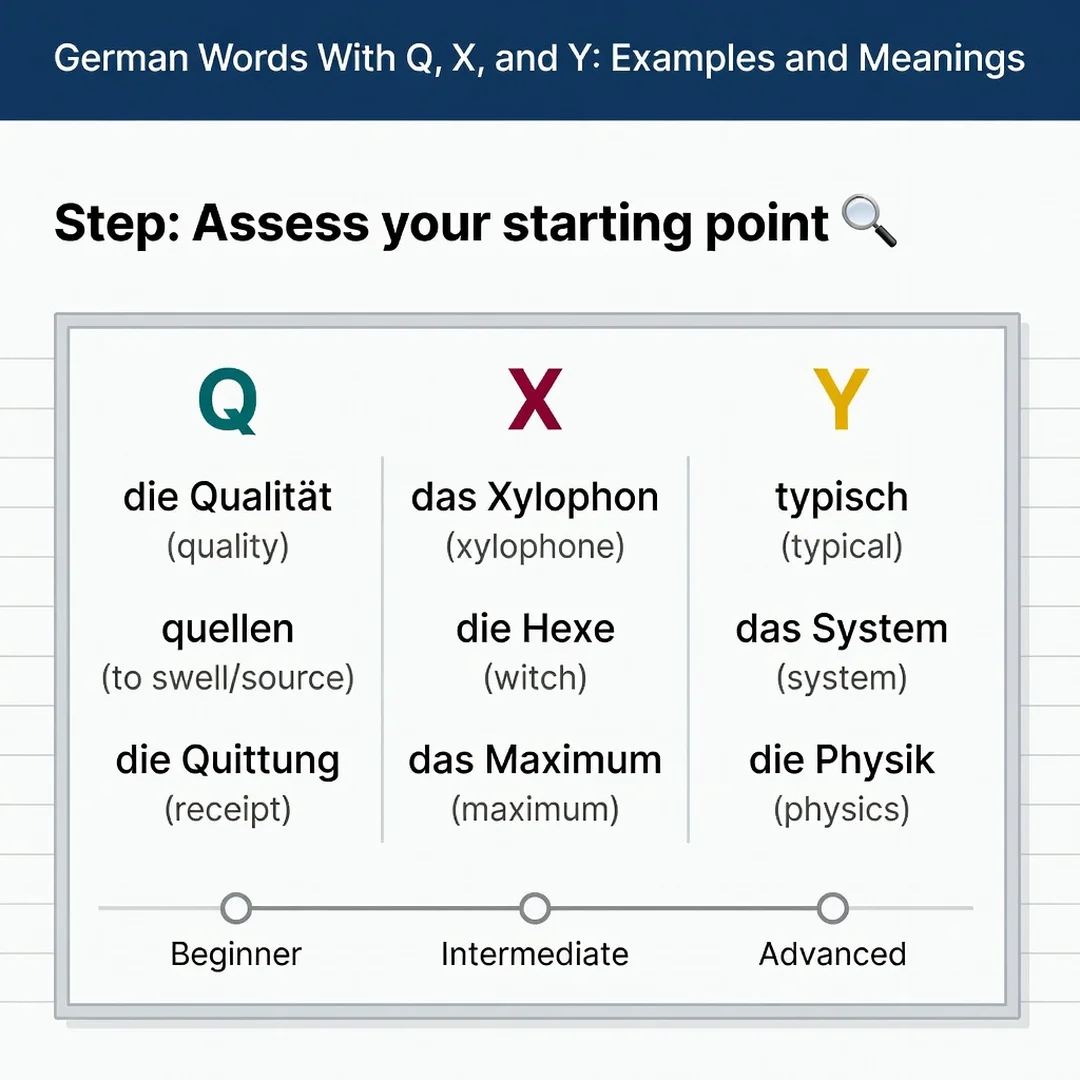
Step 2: Assess your starting point
Test yourself. Write down as many German words with Q, X, and Y as you can in five minutes. Compare your list with the examples in this article. Identify which letters you know well and which need work. If you already know Text and System, focus on Q words and rarer Y terms.
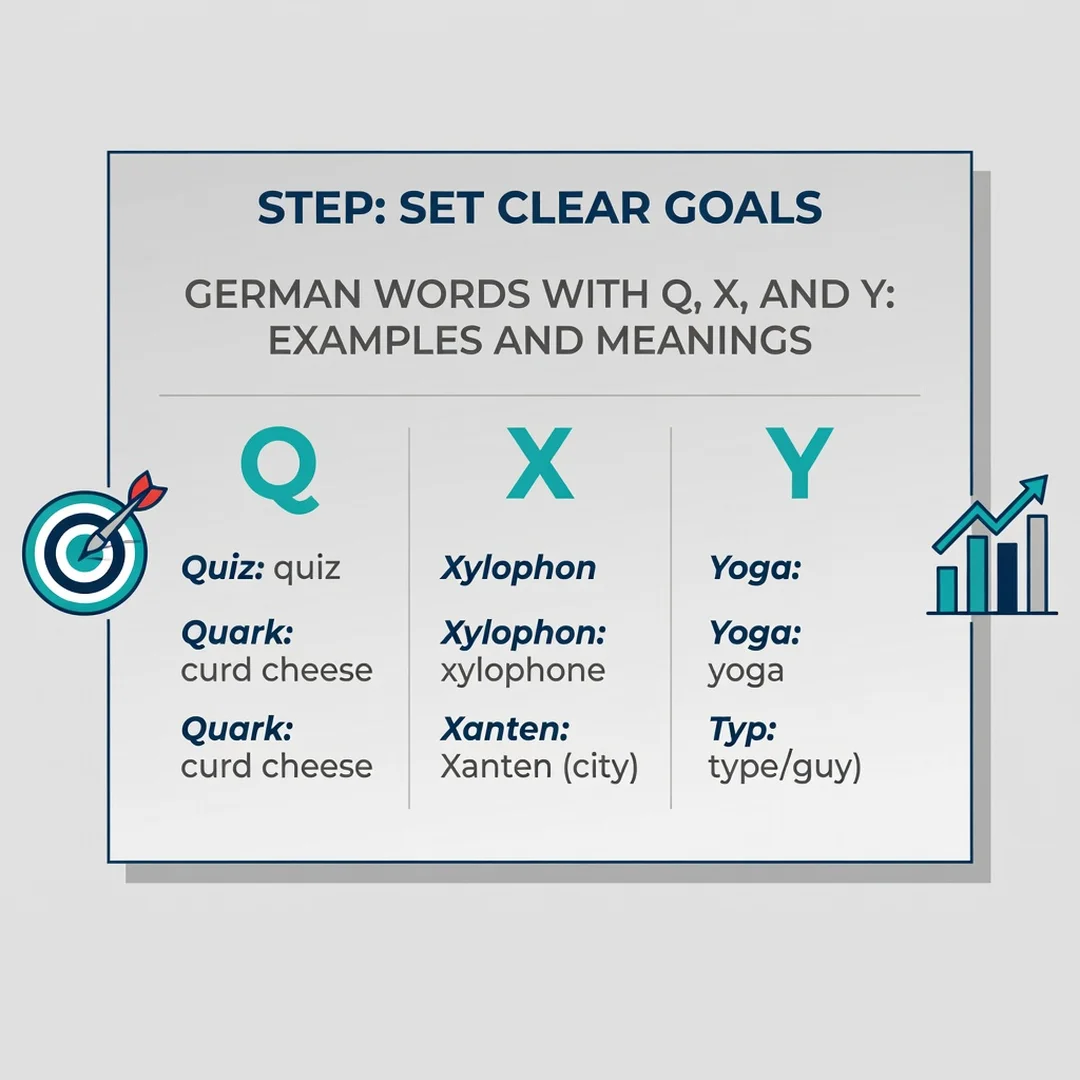
Step 3: Set clear goals
Decide what you want to achieve. A realistic goal might be to learn ten Q words, ten X words, and ten Y words within two weeks. Another goal could be to recognize these words in reading without pausing. Write your goals down and make them specific and measurable.

Step 4: Gather necessary resources
Collect tools that support your learning. A good German-English dictionary, a flashcard app, and a notebook are enough. Online resources such as Wiktionary, DWDS, or Linguee provide example sentences and pronunciation. If you prefer audio, find native speaker recordings or use text-to-speech tools.
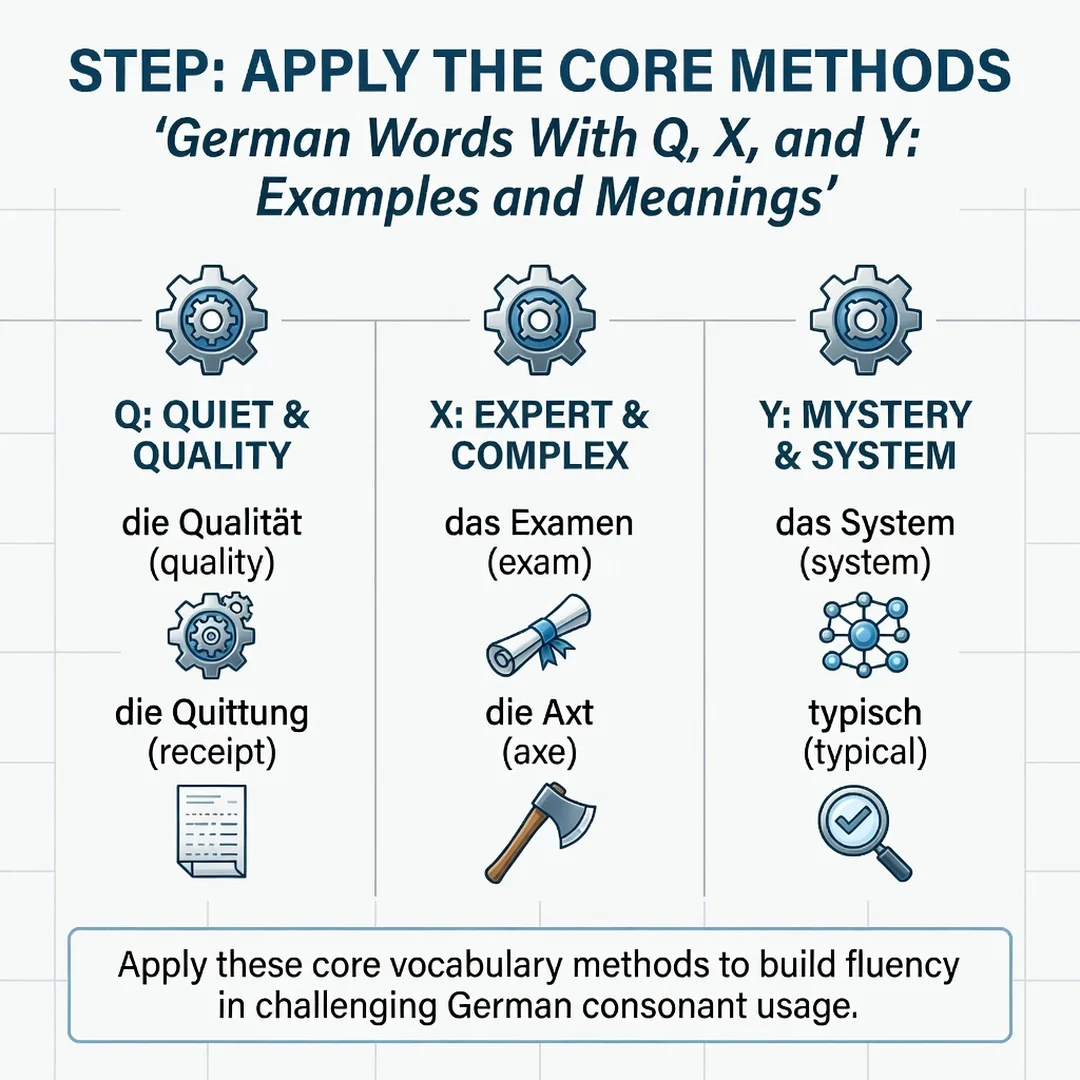
Step 5: Apply the core methods
Use active recall and spaced repetition. Create flashcards with the word on one side and the meaning plus an example sentence on the other. Practice pronunciation aloud. Write short paragraphs using the words. For example, describe your daily routine using Quark, Taxi, and Hobby. The more you use the words, the better you remember them.
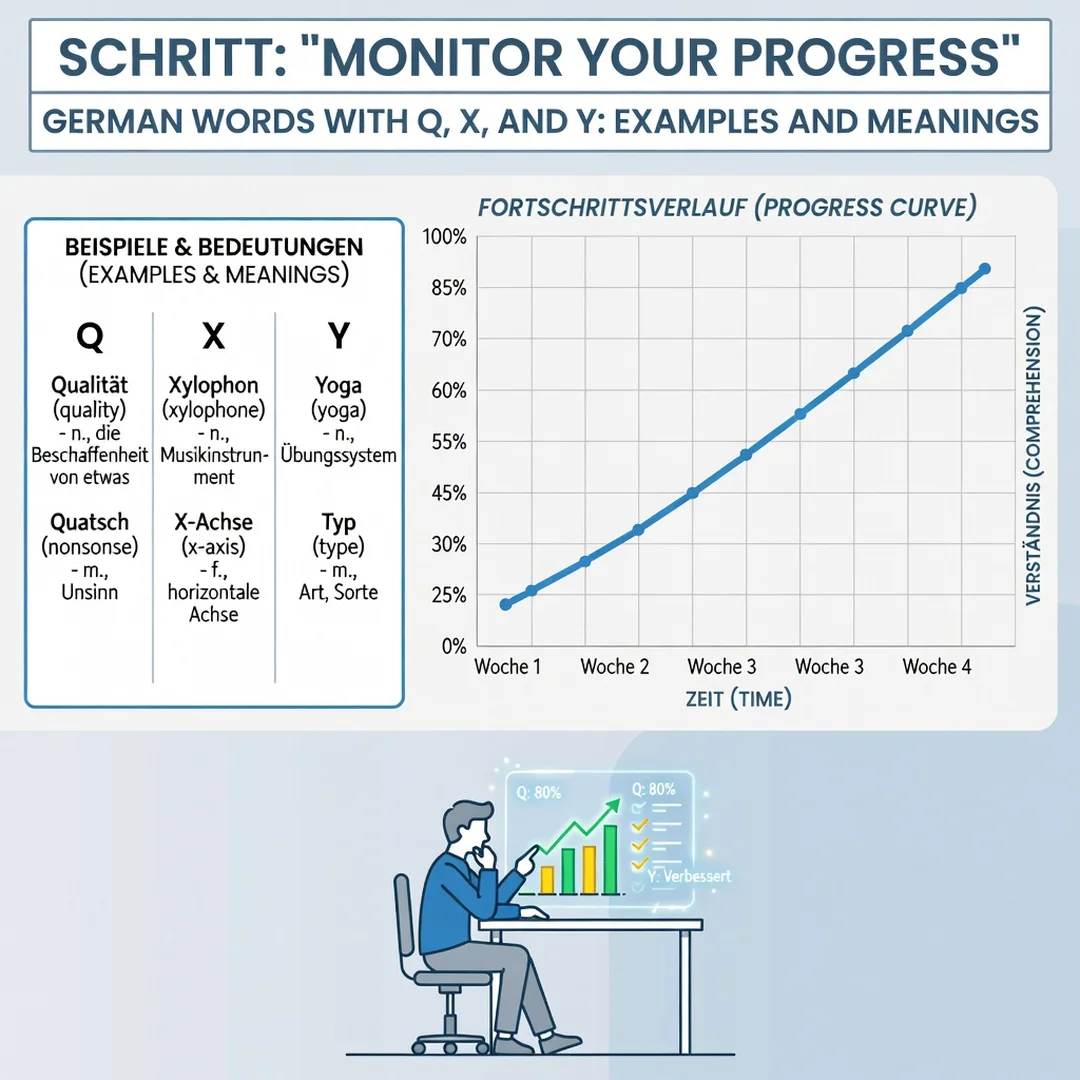
Step 6: Monitor your progress
Review your flashcards weekly. Track how many words you recall without hesitation. Retest yourself with the five-minute writing exercise. Adjust your goals as needed. If you consistently forget certain words, add more context or create mnemonic devices. Reliable information and consistent habits lead to better long-term outcomes, so keep your review schedule steady.
FAQ
What should I know about German Words With Q, X, and Y: Examples and Meanings?
You should know that these letters are rare but useful. Q words almost always begin with “Qu” and often relate to quality, quantity, or sources. X words include common terms like Text, Taxi, and Praxis. Y words are mostly loanwords from Greek or English, such as System, Physik, and Hobby. Learning them improves reading comprehension and spelling. Focus on pronunciation rules and learn nouns with their articles.
Who is this guide for?
You now have a solid foundation for German Words With Q, X, and Y: Examples and Meanings. Apply the best practices above and revisit this guide as your needs evolve.