

German compound words are famous for their length and precision, but they are easier to understand than they look. By combining two or more words into one, German creates vivid terms like Handschuh (“hand shoe,” or glove) that describe everyday objects in a single breath.
In this guide, we break down common German compound words with clear examples and their meanings. Whether you are learning the language or simply curious, you will quickly see how these word-building blocks make German both logical and surprisingly fun.
Introduction
German is famous for its long, seemingly impossible words — Rindfleischetikettierungsüberwachungsaufgabenübertragungsgesetz is a real one, and it once appeared in official documents. But behind the intimidating length lies a simple, logical system: German compound words, or Komposita, are built by joining two or more existing words into a single new one. Once you understand the rules, those long words stop being scary and start being useful.
This article explores German compound words with clear examples and their meanings, and it gives you practical guidance you can apply immediately. Understanding the fundamentals of German compound words helps you make informed decisions — whether you are learning the language, translating documents, or simply trying to read a German news headline without panic. Reliable information and consistent habits lead to better long-term outcomes, and compound words reward exactly that kind of steady practice.
By the end, you will know how compounds are formed, what the most common linking elements are, how to decode unfamiliar words on sight, and which mistakes to avoid. Everything is explained with real examples and plain English.
Key Concepts
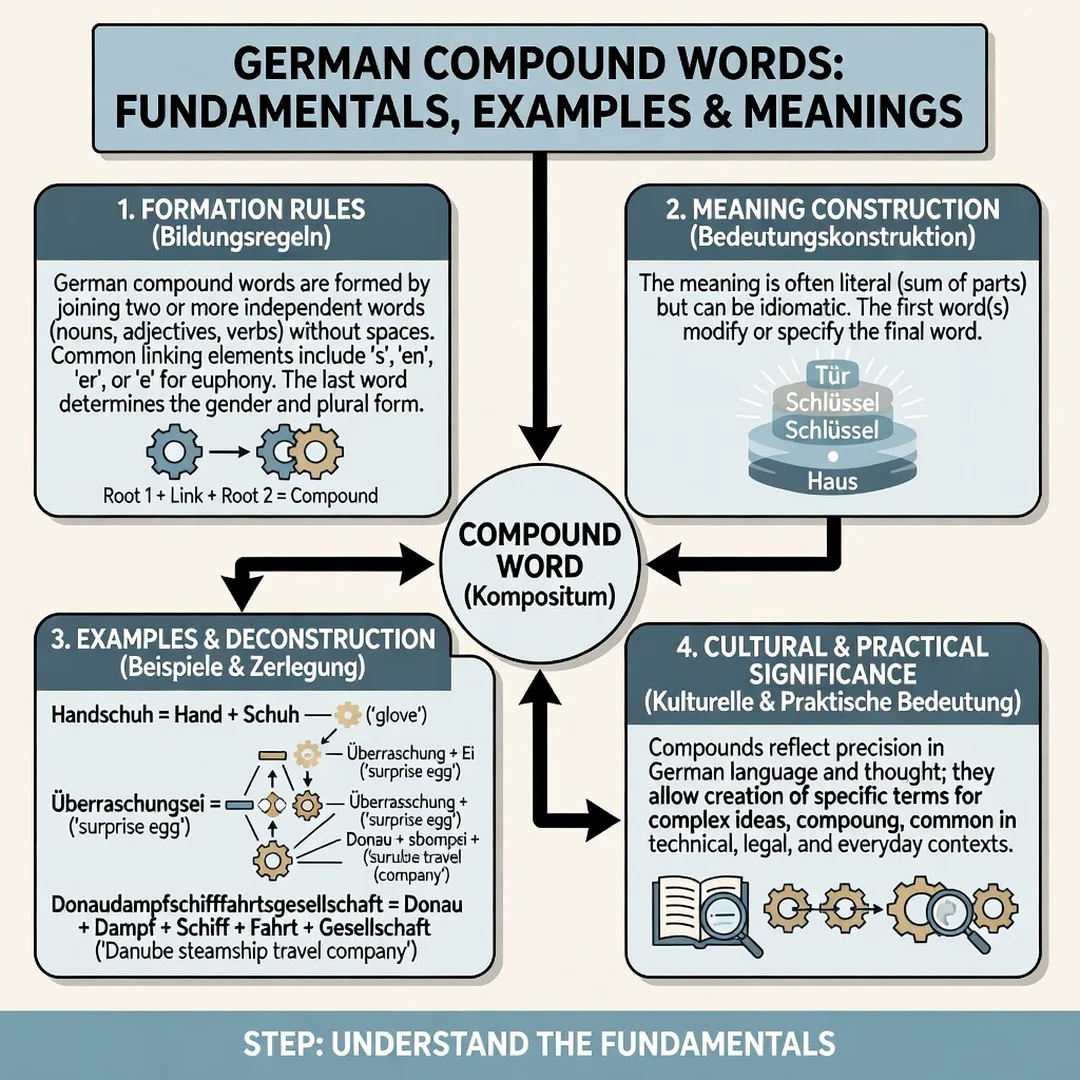
At its core, a German compound word takes a determining word (the first part, called Bestimmungswort) and a base word (the last part, called Grundwort). The base word carries the core meaning and determines the grammatical gender of the whole compound. The first part narrows or modifies that meaning.
Consider Haustür (front door): Haus means “house” and Tür means “door.” The compound is a type of door — specifically, the door of a house. Because Tür is feminine (die Tür), the whole word is feminine: die Haustür. This rule — the last word wins for gender and plural form — is the single most important principle to internalize.
Common categories of compounds
- Noun + noun: der Kühlschrank (refrigerator) = kühl (cool) + Schrank (cupboard)
- Verb stem + noun: das Fahrrad (bicycle) = fahren (to drive/ride) + Rad (wheel)
- Adjective + noun: die Großstadt (big city) = groß (big) + Stadt (city)
- Preposition + noun: der Vorort (suburb) = vor (before/in front of) + Ort (place)
- Multi-part compounds: die Krankenversicherung (health insurance) = Kranken (sick, plural stem) + Versicherung (insurance)
German also uses a special character, the Fugen-s or linking element, to smooth pronunciation between parts. Common linking elements include -s-, -es-, -n-, -en-, and -er-. You see this in Arbeitsplatz (workplace) from Arbeit + Platz, and Sonnenblume (sunflower) from Sonne + Blume. These links are not random; they often follow historical patterns, and exposure through reading is the fastest way to absorb them.
Deep Dive: How Compounds Change Meaning
Compounds are not just convenient — they are often the only way to express a specific concept in German. Where English might use two separate words or a phrase, German fuses everything into one unit. Understanding this helps you make informed decisions about translation and vocabulary building.
Meaning is more than the sum of parts
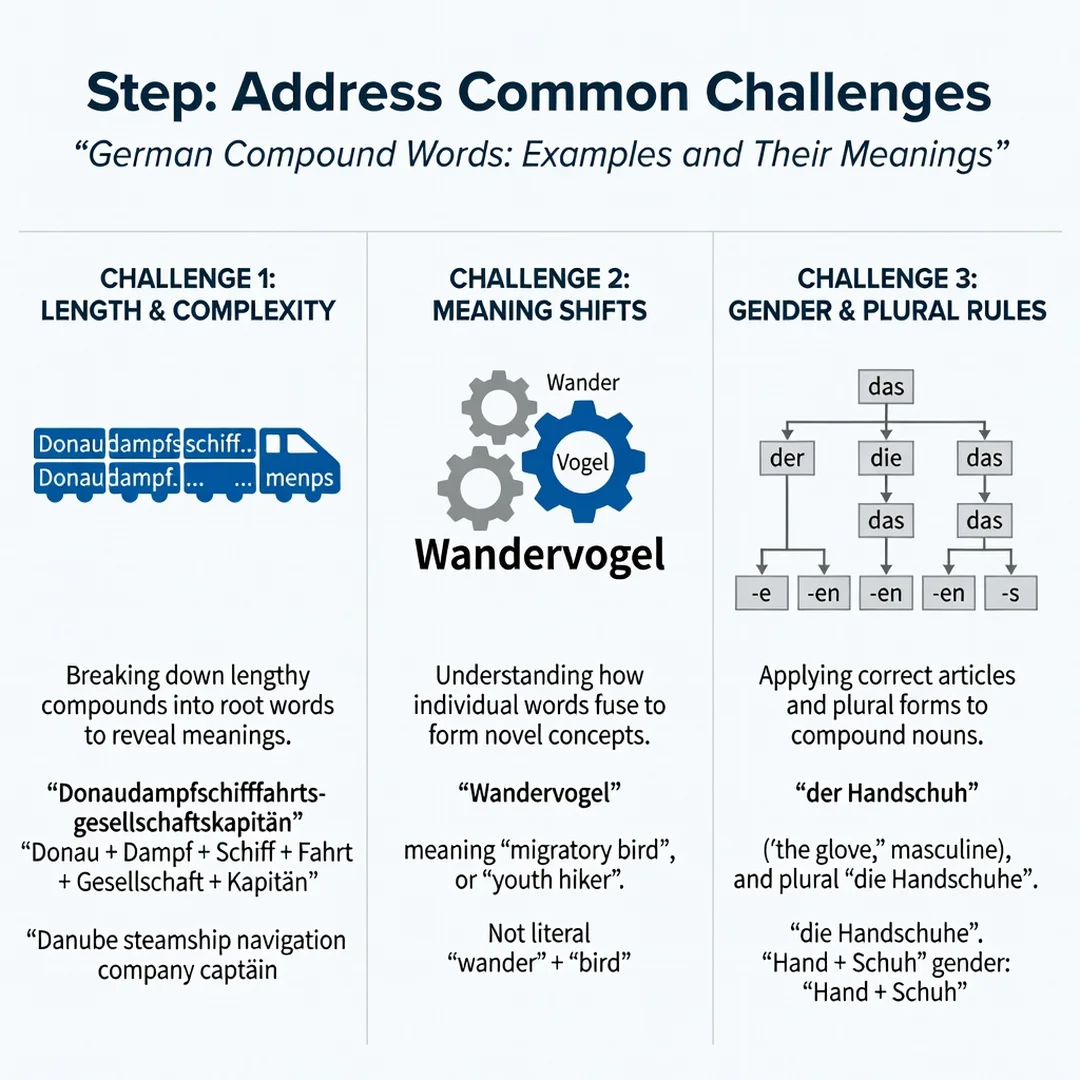
Many compounds mean exactly what they appear to mean: Handschuh (glove) is literally “hand shoe,” and that makes sense. But others drift into figurative territory. Schildkröte (turtle) is “shield toad.” Flughafen (airport) is “flight harbor.” Fernweh is “far pain” — the ache to travel to distant places, the opposite of homesickness. Recognizing that compounds can be literal or idiomatic is essential. When you encounter a new word, ask: is this descriptive or is it a fixed term with its own meaning?
Gender and plurality follow the base word
This cannot be overstated. Der Hausmeister (janitor) is masculine because Meister is masculine. Die Hausarbeit (housework) is feminine because Arbeit is feminine. The plural also follows the final element: die Kühlschränke, not die Kühlschranke. Mastering this rule eliminates a large percentage of gender errors.
Why German builds these words
German compresses information efficiently. Die Straßenbahnhaltestelle (tram stop) contains street, railway, stop, and place in one word, whereas English needs three. This density is a feature, not a bug, and it is why German academic and technical writing relies so heavily on compounds. Once you can segment a word at its joints, you can read almost anything.
Practical decoding strategy
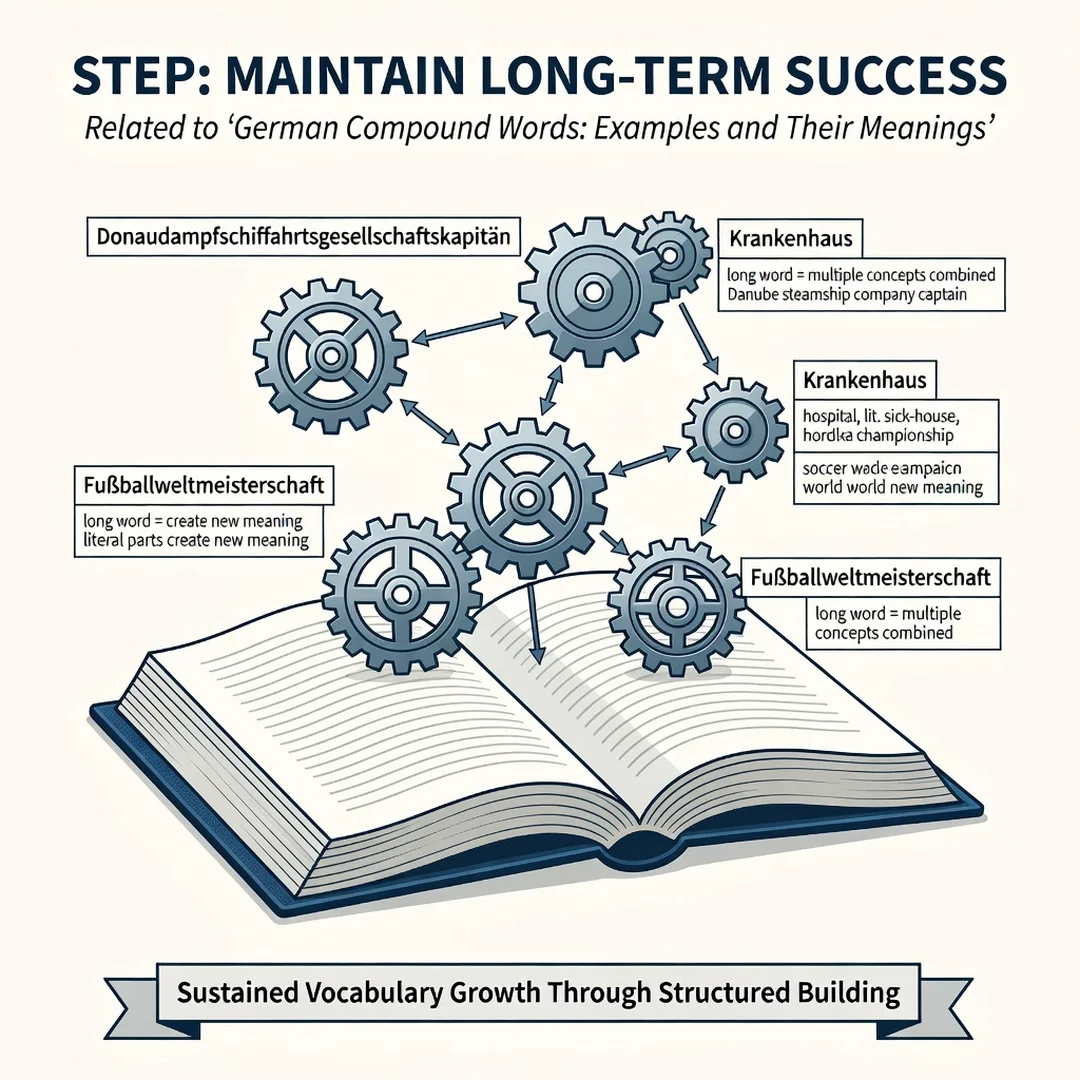
When you meet a long word, work from right to left. Identify the final noun — that gives you the core meaning and gender. Then peel back the preceding elements one by one, treating each as a modifier. For example, Lebensmittelgeschäft (grocery store): Geschäft is “shop,” Mittel is “means,” Lebens relates to “life” — so it is a shop for life’s means, i.e., food. That technique turns a twenty-letter word into three familiar pieces.
Best Practices: A Step-by-Step Approach
The following steps give you a repeatable method for learning, using, and teaching German compound words. Each step builds on the previous one, so work through them in order if you are new to the topic.
Step 1: Understand the fundamentals
Before memorizing lists, make sure you grasp the core mechanics: determining word plus base word, gender from the base, and the role of linking elements. Write out five compounds you already know and label each part. This small exercise cements the structure in your mind and gives you a reliable mental model for every word you meet afterward.
Step 2: Assess your starting point
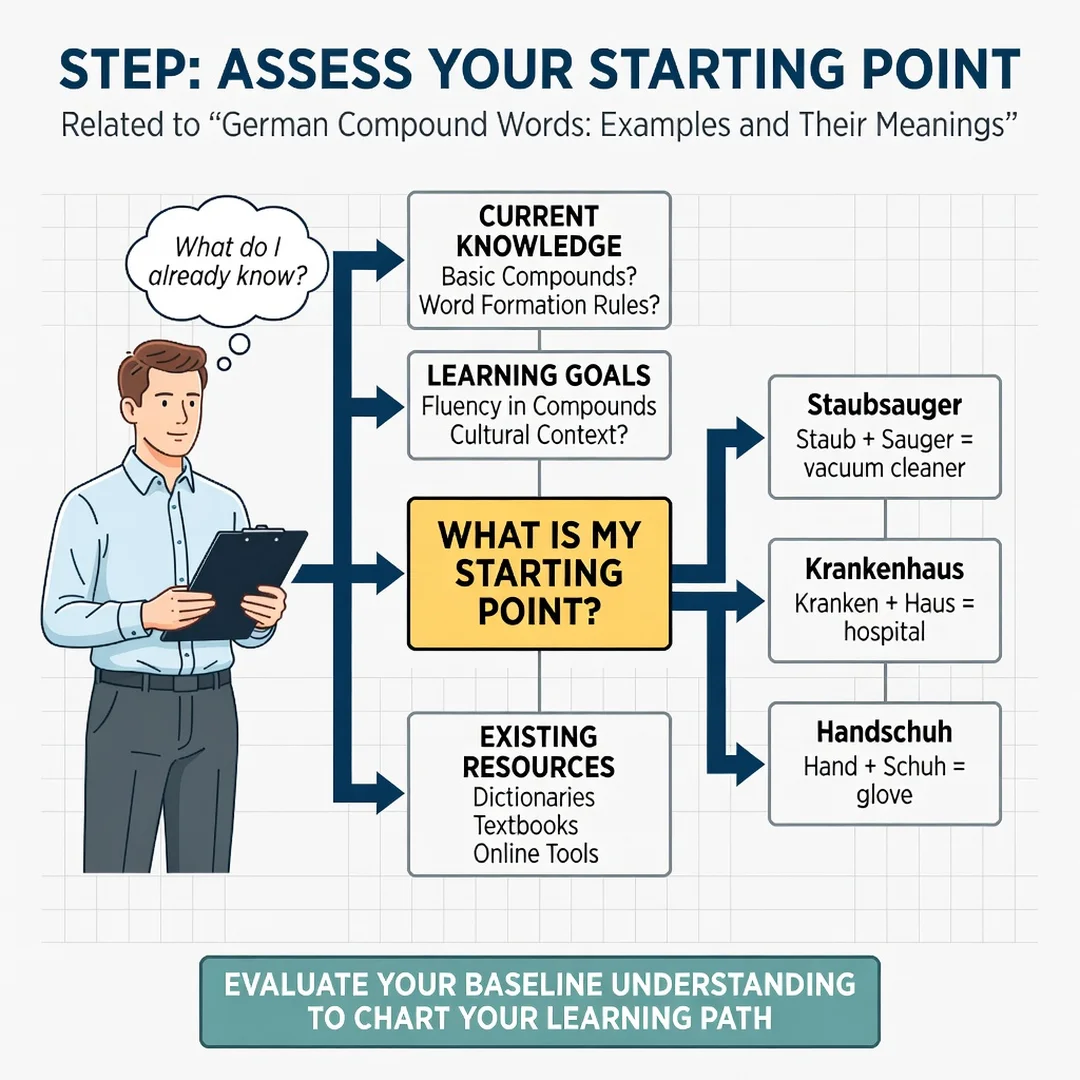
Take stock of what you already recognize. Can you decode Krankenhaus (hospital)? Do you know why das is the article and not der? Identifying gaps now prevents frustration later. A quick self-check across nouns, verbs, and adjectives will show you whether you need more vocabulary, more grammar, or both. Honest assessment leads to better long-term outcomes because you study what actually needs work.
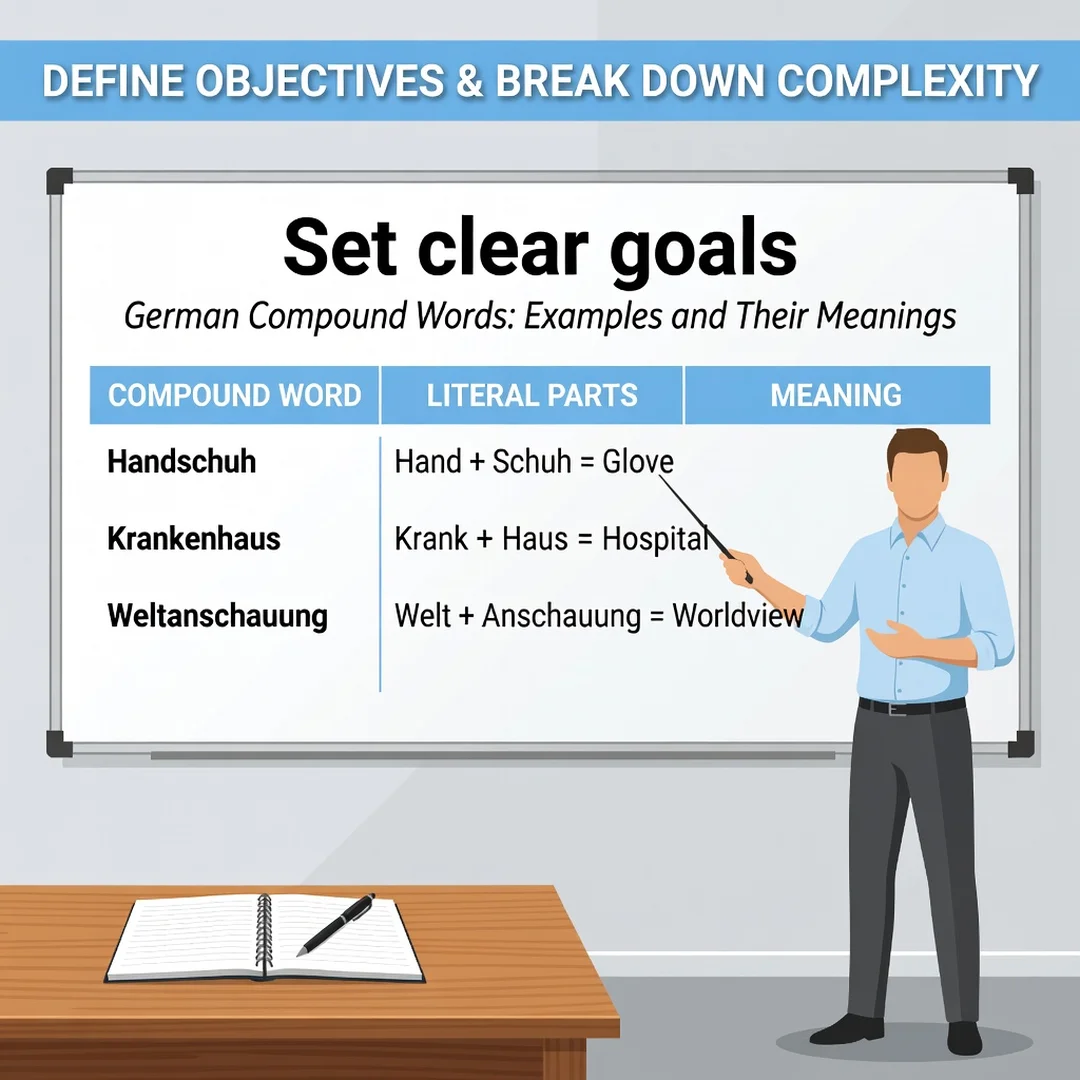
Step 3: Set clear goals
Vague goals like “learn German words” produce vague results. Set specific, measurable targets: learn the fifty most common compound nouns in your field, be able to decode any compound in a news article without a dictionary, or master the ten most frequent linking elements. Clear goals tell you when you are done and keep motivation steady.
Step 4: Gather necessary resources
You need a good monolingual dictionary, since German dictionaries show compound segmentation clearly, plus a frequency list and a notebook or spaced-repetition app. A German news site or podcast provides real-world compounds in context. Reliable information from authoritative sources matters — avoid relying on machine translation alone, as it often splits or mangles compounds.
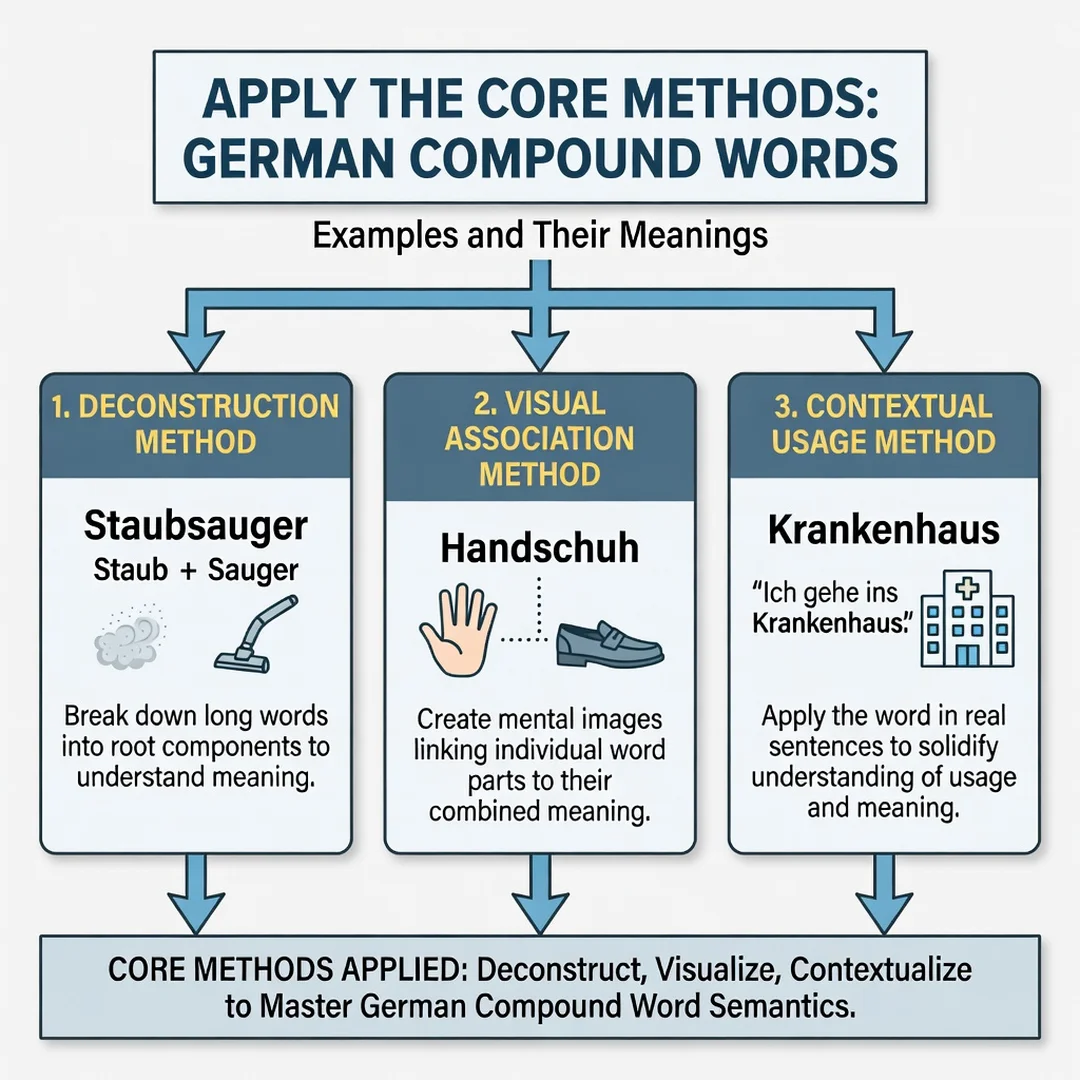
Step 5: Apply the core methods
Now put the system to work. Read German text and underline every compound. Split each into its parts and write the literal meaning beside the actual meaning. Practice producing your own compounds where German allows it, such as combining Apfel and Saft to get Apfelsaft (apple juice). Consistent daily exposure — even ten minutes — beats occasional cramming. This is where the habit of noticing pays off.
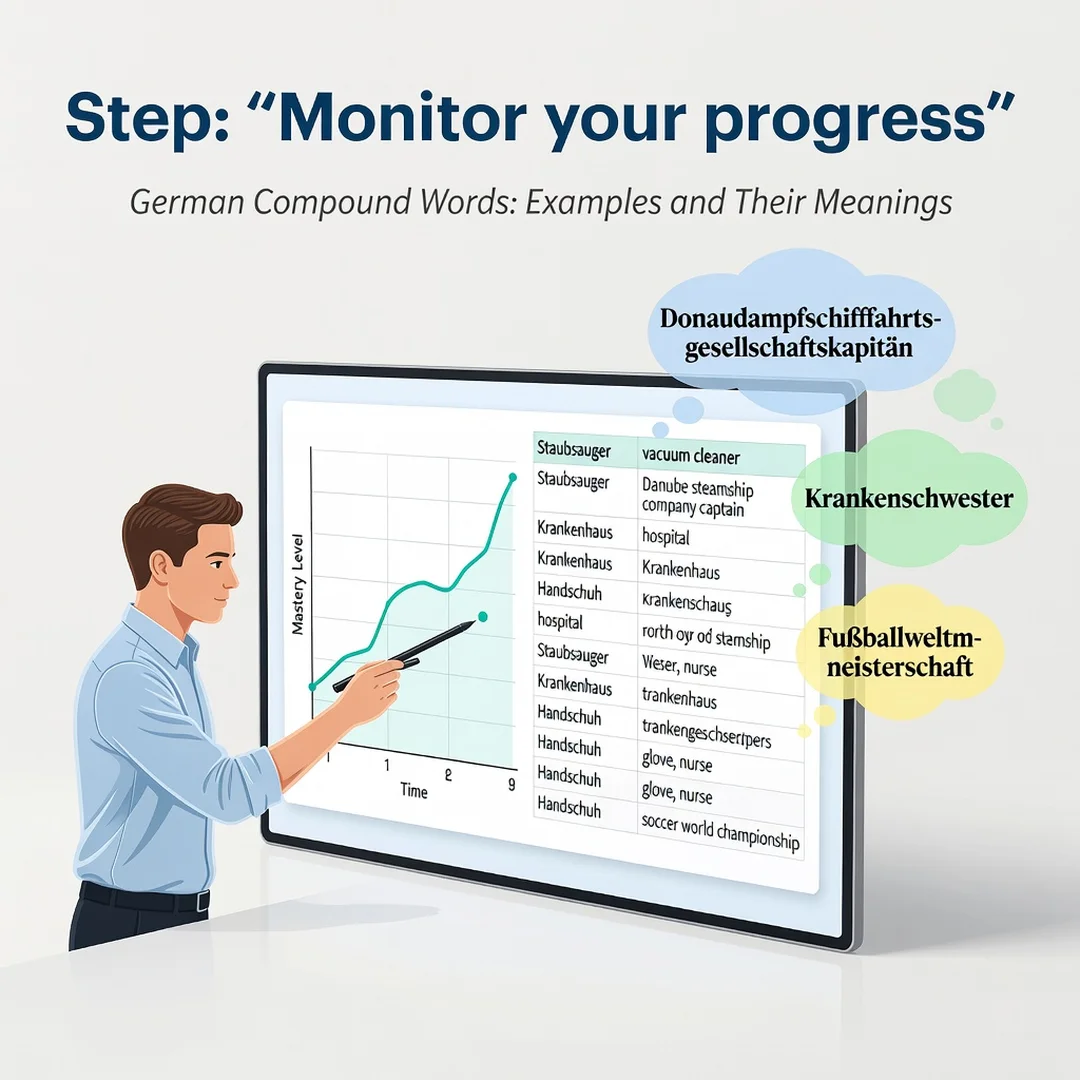
Step 6: Monitor your progress
Track how many compounds you recognize without help each week. Revisit words you misread and analyze why. If a linking element keeps tripping you up, focus on it. Monitoring turns passive reading into active learning and lets you adjust your method before bad habits set in.
FAQ
What should I know about German compound words: examples and their meanings?
The essential thing to know is that compounds are systematic, not arbitrary. The final word determines meaning, gender, and plural form, while earlier parts modify it. Linking elements like -s- and -n- connect parts smoothly. With examples such as Kühlschrank, Arbeitsplatz, and Fernweh, you can see how literal and figurative meanings both arise. Learn the pattern once, and you can decode thousands of words.
Who is this guide for?
This guide is for anyone who wants clear, actionable information about German compound words: language learners at beginner to intermediate level, translators who need to segment words accurately, writers preparing German content, and curious readers who want to understand those famous long words. No prior linguistics background is required — everything is explained in plain English with examples.
Conclusion
German compound words are one of the language’s most rewarding features once you stop fearing their length. The system is logical: a determining word plus a base word, gender and plural taken from the base, and linking elements that smooth the join. By following the six steps — understanding fundamentals, assessing your level, setting goals, gathering resources, applying methods, and monitoring progress — you build a skill that compounds over time, much like the words themselves.
Start small. Pick one article, underline five compounds, and split them apart. Do it again tomorrow. Reliable information and consistent habits lead to better long-term outcomes, and with compounds, that consistency turns intimidating words into familiar building blocks. The long words are not obstacles; they are invitations to read more closely — and to understand more deeply.
Frequently Asked Questions
What should I know about German Compound Words: Examples and Their Meanings?
This guide covers the essentials of German Compound Words: Examples and Their Meanings with practical steps you can apply right away.
Who is this guide for?
Anyone looking for a clear, structured overview without unnecessary complexity.
You now have a solid foundation for German Compound Words: Examples and Their Meanings. Apply the best practices above and revisit this guide as your needs evolve.