

Learning German words containing CH can be one of the trickiest parts of mastering the language, especially since this letter pair has several distinct pronunciations. From the soft “ich” sound to the throaty “ach” sound, getting CH right makes a noticeable difference in how naturally you speak.
In this guide, you’ll find clear examples of common German words containing CH alongside practical spelling tips to help you remember when to use each sound. Whether you’re a beginner or brushing up your skills, these simple rules will boost your confidence fast.
Introduction
German spelling has a reputation for being intimidating, and few letter combinations fuel that reputation quite like CH. It appears everywhere: in everyday words like ich (I), auch (also), and machen (to do), and in famously long compounds such as Krankenhaus (hospital) or Geschwindigkeitsbegrenzung (speed limit). For English speakers, the challenge is not simply memorizing which words contain CH — it is understanding that CH represents at least two distinct sounds, and that spelling patterns, not random chance, determine which one appears.
This article explores German words containing CH: examples and spelling tips that you can put to use immediately. You will learn how to pronounce ich versus Bach, why Kuchen sounds the way it does, and how to spell unfamiliar CH words with confidence. The guidance here is practical rather than academic: each section gives you something concrete to practice, whether you are a beginner sounding out your first German menu or an intermediate learner polishing your writing. Reliable information and consistent habits lead to better long-term outcomes, and that principle guides everything below.
Key Concepts
Before diving into word lists and drills, you need a clear mental model of what CH actually does in German. There are three core ideas to grasp.
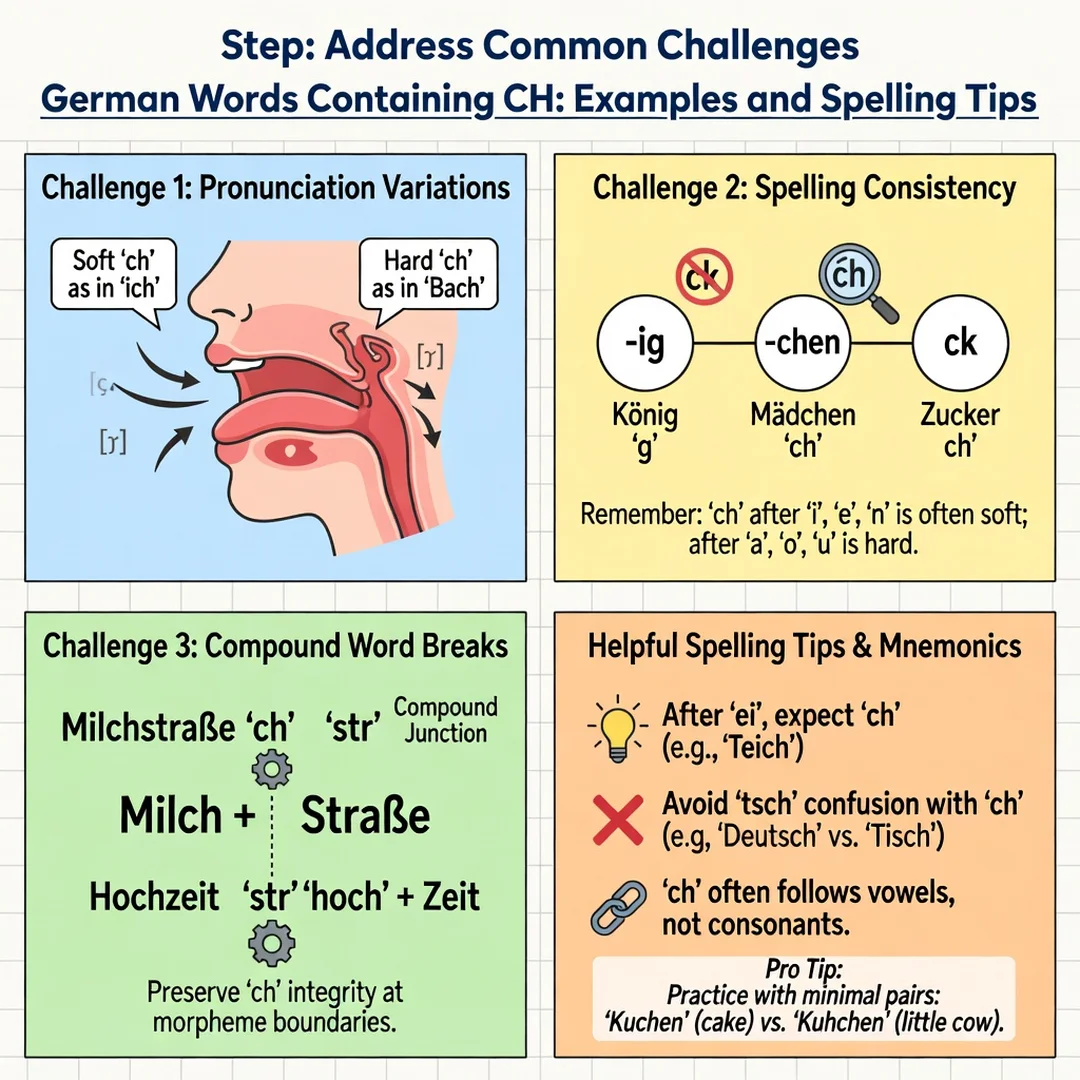
CH is not one sound — it is two (or three)
German CH has two main pronunciations, plus a special case:
- The soft “ich-Laut” ([ç]): a breathy sound made with the tongue high near the hard palate, close to the “h” in the English word “hue.” It appears after front vowels (i, e, ä, ö, ü), after consonants (l, n, r), and in the diminutive suffix -chen. Examples: ich, Milch (milk), Mädchen (girl), Kirche (church).
- The hard “ach-Laut” ([x]): a raspier sound produced further back in the throat, similar to the “ch” in Scottish “loch.” It appears after back vowels (a, o, u) and after the diphthong au. Examples: Bach (stream), noch (still), Buch (book), auch (also).
- The [k] sound: in a small set of words, CH is pronounced like a hard English “k.” This happens most reliably at the start of words before a vowel, as in Chaos, Charakter, and Chor, and in some borrowed words like Chlor.
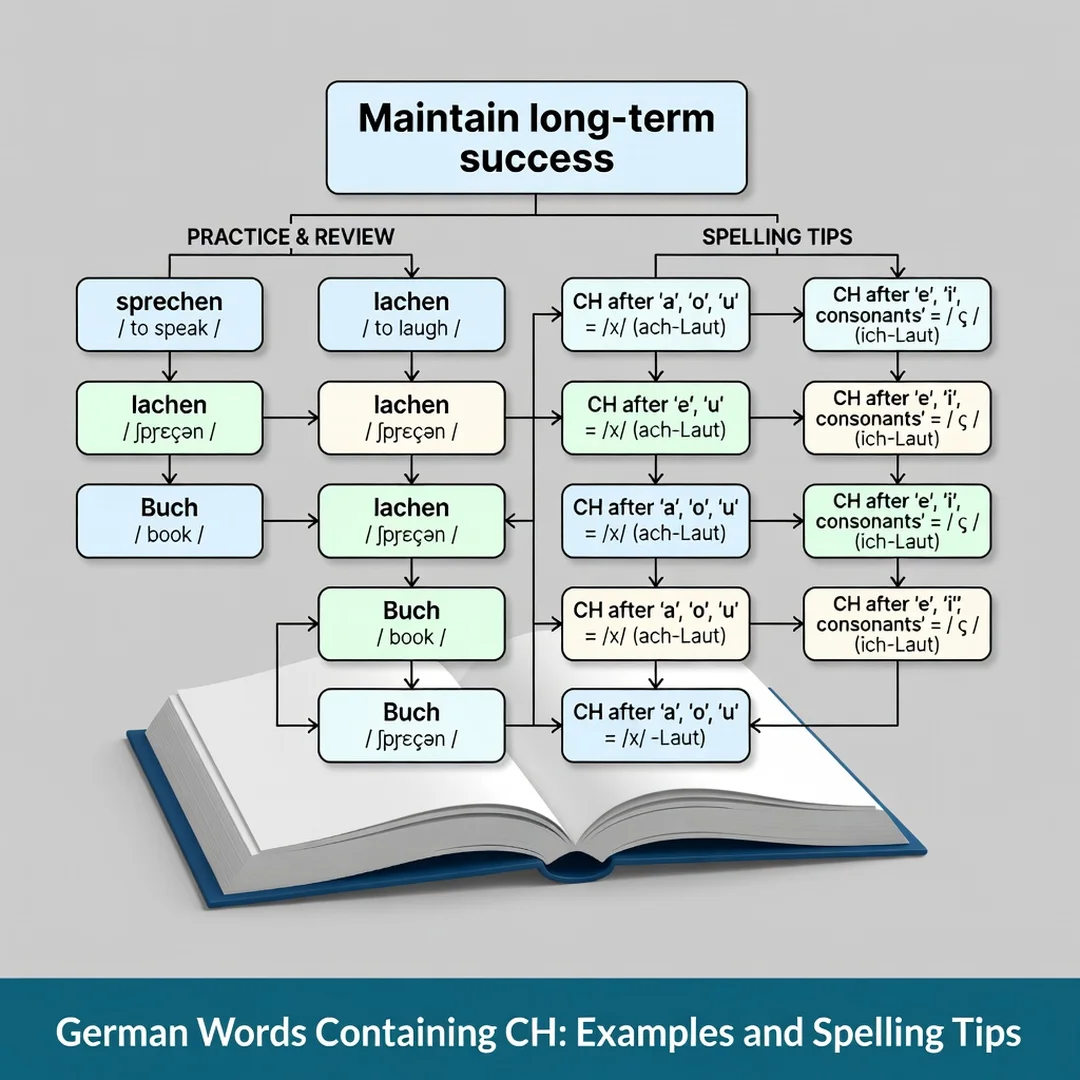
Spelling is predictable once you know the vowel rule
The sound of CH is largely determined by the letter immediately before it. That single rule unlocks thousands of words. If you can identify the preceding vowel, you can predict the pronunciation — and if you can hear the sound, you can often predict the spelling.
CH vs. other similar-looking combinations
German also uses sch (the “sh” sound, as in Schule), ch in loanwords from French (often pronounced “sh,” as in Chance), and the separate letters C and H that occasionally sit side by side across a syllable boundary (as in Bäche, the plural of Bach). Distinguishing these cases prevents both pronunciation and spelling errors. Understanding these fundamentals helps you make informed decisions about how to read, say, and write any CH word you encounter.
Deep Dive
Now let’s look at how CH behaves across different word positions and word types, with abundant examples you can use as a reference set.
CH after front vowels and consonants: the soft sound
Words with i, e, ä, ö, or ü before CH take the soft [ç] pronunciation:
- ich — I
- mich — me
- dich — you (informal accusative)
- sprechen — to speak
- Gesicht — face
- Bücher — books
- Küche — kitchen
- Löcher — holes
- leicht — easy
- München — Munich
The same soft sound follows the consonants l, n, and r: Milch, durch (through), manchmal (sometimes), Furcht (fear). And it is nearly universal in the suffix -chen, which forms diminutives: Brötchen (bread roll), Mädchen (girl), Hündchen (little dog).
CH after back vowels and au: the hard sound
After a, o, u, or au, CH becomes the throaty [x]:
- machen — to make/do
- Sache — thing
- Nacht — night
- noch — still/yet
- Kuchen — cake
- suchen — to search
- Buch — book
- Kuchen — cake
- brauchen — to need
- auch — also
- Bauch — stomach
Notice how Kuchen and suchen sound different from Küche and Bücher — same CH letters, different vowel, different sound. This contrast is the single most useful thing to train your ear on.
CH at the start of words
Word-initial CH before a, o, u, or l is usually pronounced [k]: Chaos, Charakter, Chor, Christ, chronisch, Chlor. In words borrowed from French, initial CH is often a “sh” sound: Chance, Chef, charmant. These are the exceptions worth memorizing individually.
The -ig ending connection
A related spelling tip: the ending -ig is pronounced like the soft CH in standard German. So König (king) sounds like “Kö-nich,” and wichtig (important) rhymes with richtig. This matters because it explains why learners sometimes hear a CH sound in words that contain no CH at all.
Common spelling patterns to recognize
Certain endings and clusters recur constantly. Learning them as chunks speeds up both reading and spelling:
- -chen (diminutive): Mädchen, Brötchen, Wörtchen
- -lich (adjective suffix): freundlich, möglich, plötzlich
- -chen vs. -ig: both give soft CH-like sounds but different spellings
- ch after n: manch, manchmal, München
- ch after r: durch, Furcht, Storch (stork)
Best Practices
Turning knowledge into skill requires deliberate practice. Here are habits that consistently produce results.
Practice minimal pairs out loud
Record yourself saying Kuchen and Küche, or Bach and Bücher. The physical difference — tongue position and mouth shape — becomes clearer when you exaggerate it. Ten minutes of daily minimal-pair drills beats an hour of passive listening once a week.
Train your ear with native audio
Use dictionary apps with recorded pronunciations, German news clips, or children’s songs. When you hear an unfamiliar CH word, pause and ask: is this the soft or hard version? Then check the preceding vowel to confirm your prediction. This loop builds intuition fast.
Learn words in vowel-context groups
Instead of memorizing random CH words, group them: all the a-words (machen, Sache, Nacht), all the u-words (Buch, suchen, Kuchen), all the i-words (ich, mich, sprechen). Your brain stores patterns more efficiently than isolated facts.
Write by hand to reinforce spelling
Typing autocorrects you; handwriting forces recall. Copy out ten CH words a day, saying each aloud as you write it. Pay attention to the vowel directly before CH, since that is your spelling anchor.
Keep a personal exception list
Words like Chaos and Chance break the rules. Maintain a short list of these exceptions and review it weekly. Consistency matters more than volume: reliable information plus steady habits lead to better long-term outcomes than sporadic cramming.
Step-by-Step Guide
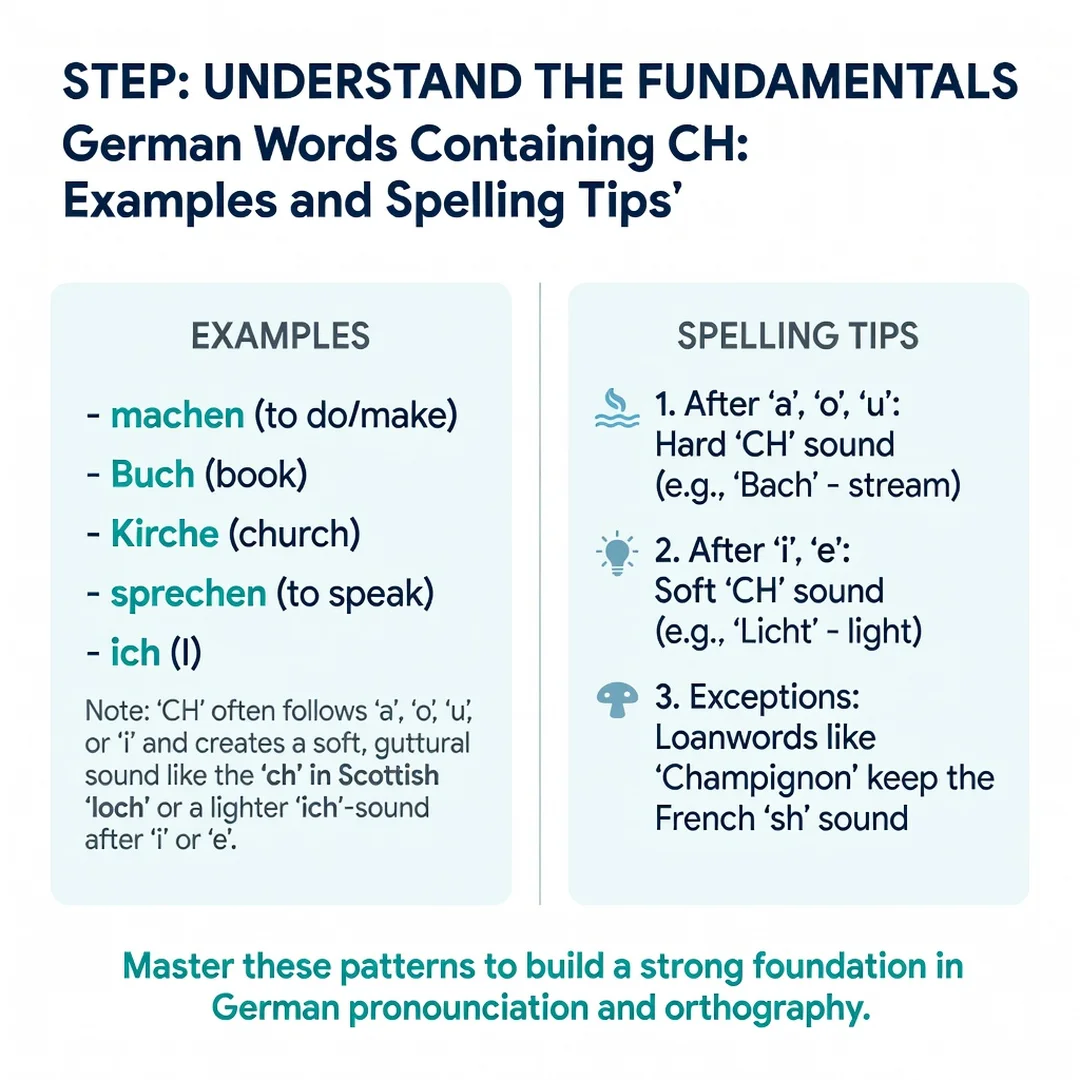
Step 1: Understand the fundamentals
Begin by internalizing the two core CH sounds and the vowel rule that governs them. Say the soft [ç] after i, e, ä, ö, ü, and the hard [x] after a, o, u, au. Read ten example words aloud, five of each type. Do not move on until you can hear and feel the difference in your mouth. This foundational step prevents months of confusion later.
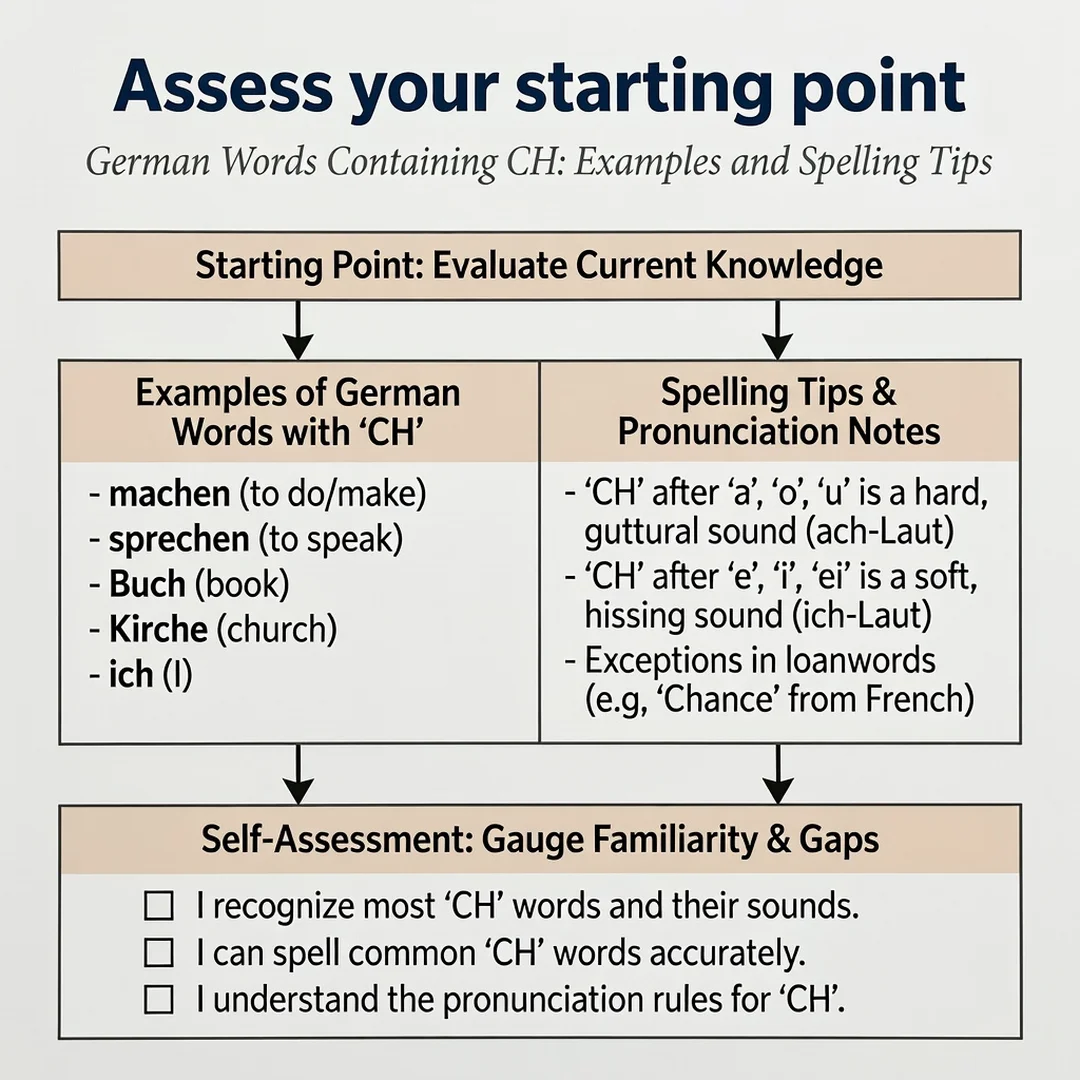
Step 2: Assess your starting point
Test yourself honestly. Read a short German paragraph aloud and mark every CH word. Which ones did you pronounce correctly? Which sounded unsure? If you already know basic vocabulary, your task is refining pronunciation and spelling. If you are starting from scratch, focus first on the top 50 high-frequency CH words. Write down your current level so you can measure progress against it.
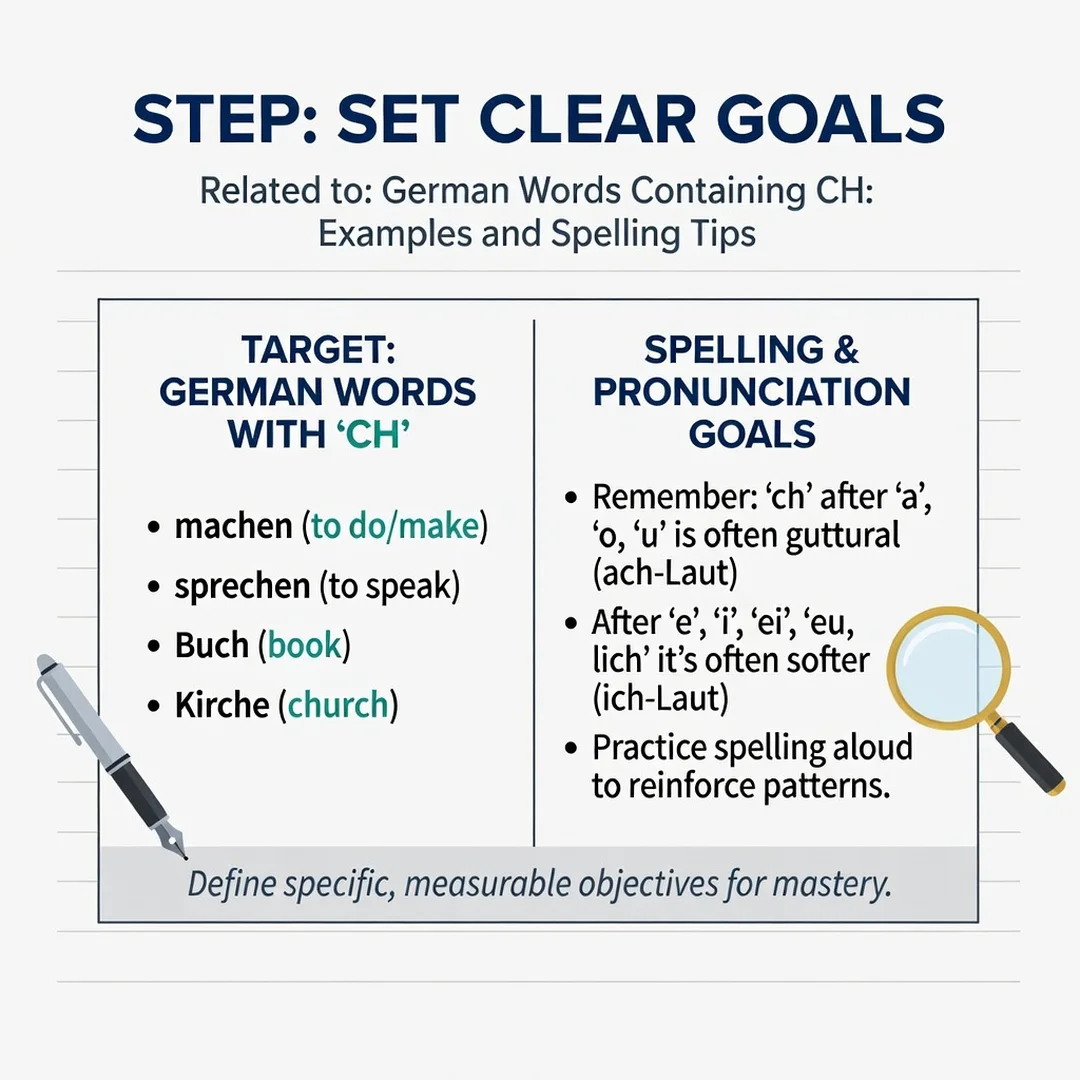
Step 3: Set clear goals
Vague goals like “get better at German” fail. Set specific ones: “Pronounce all CH words in a 100-word text correctly within two weeks,” or “Spell 30 common CH words from dictation by month’s end.” Make goals measurable and time-bound. A clear target tells you exactly what to practice and when you have succeeded.
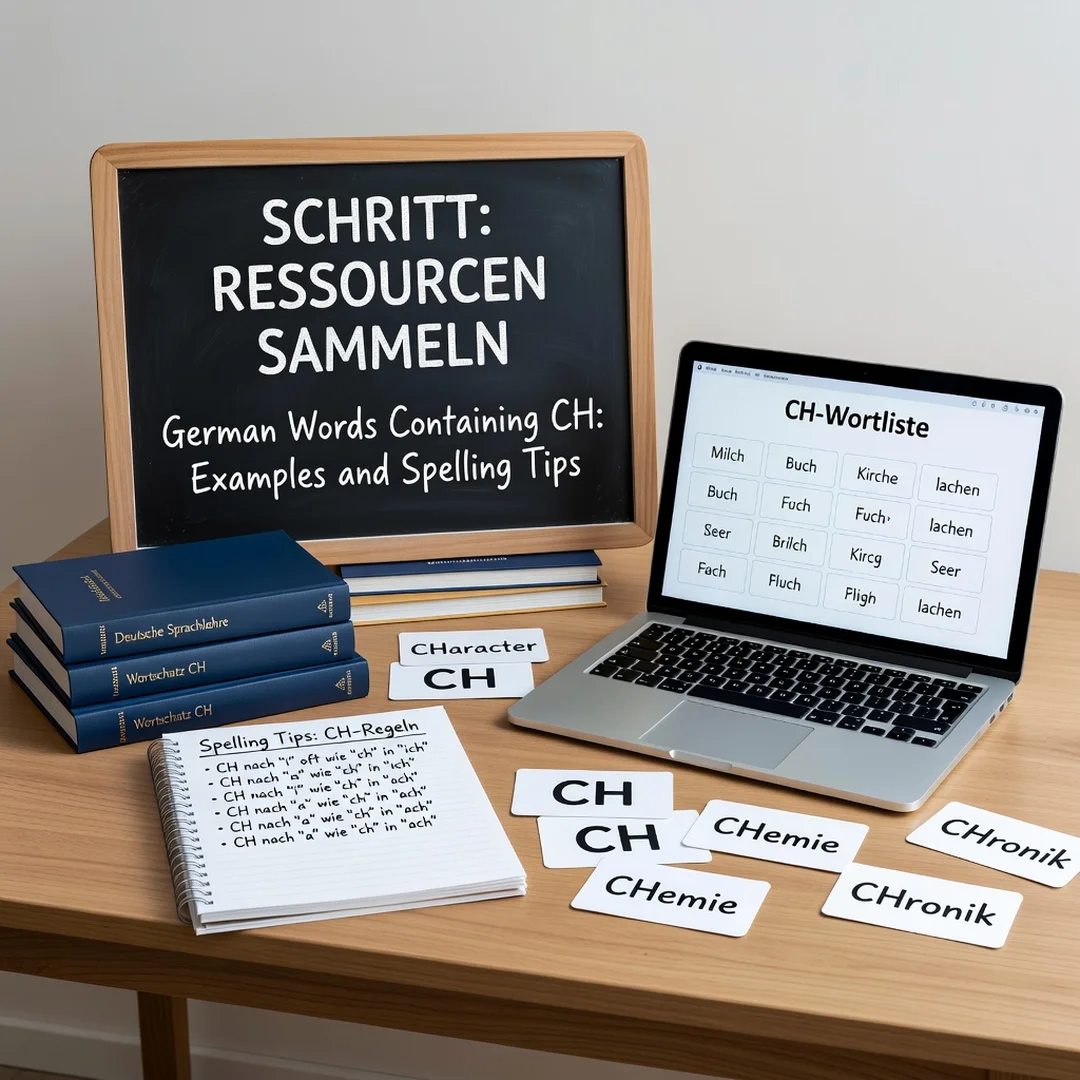
Step 4: Gather necessary resources
You need three things: a dictionary with audio (such as a reputable online German dictionary with native recordings), a list of high-frequency CH words, and a way to record and compare your own speech. A phone voice-memo app is sufficient. Optionally, add a German podcast or news source for daily listening input. Keep the toolkit small so you actually use it.
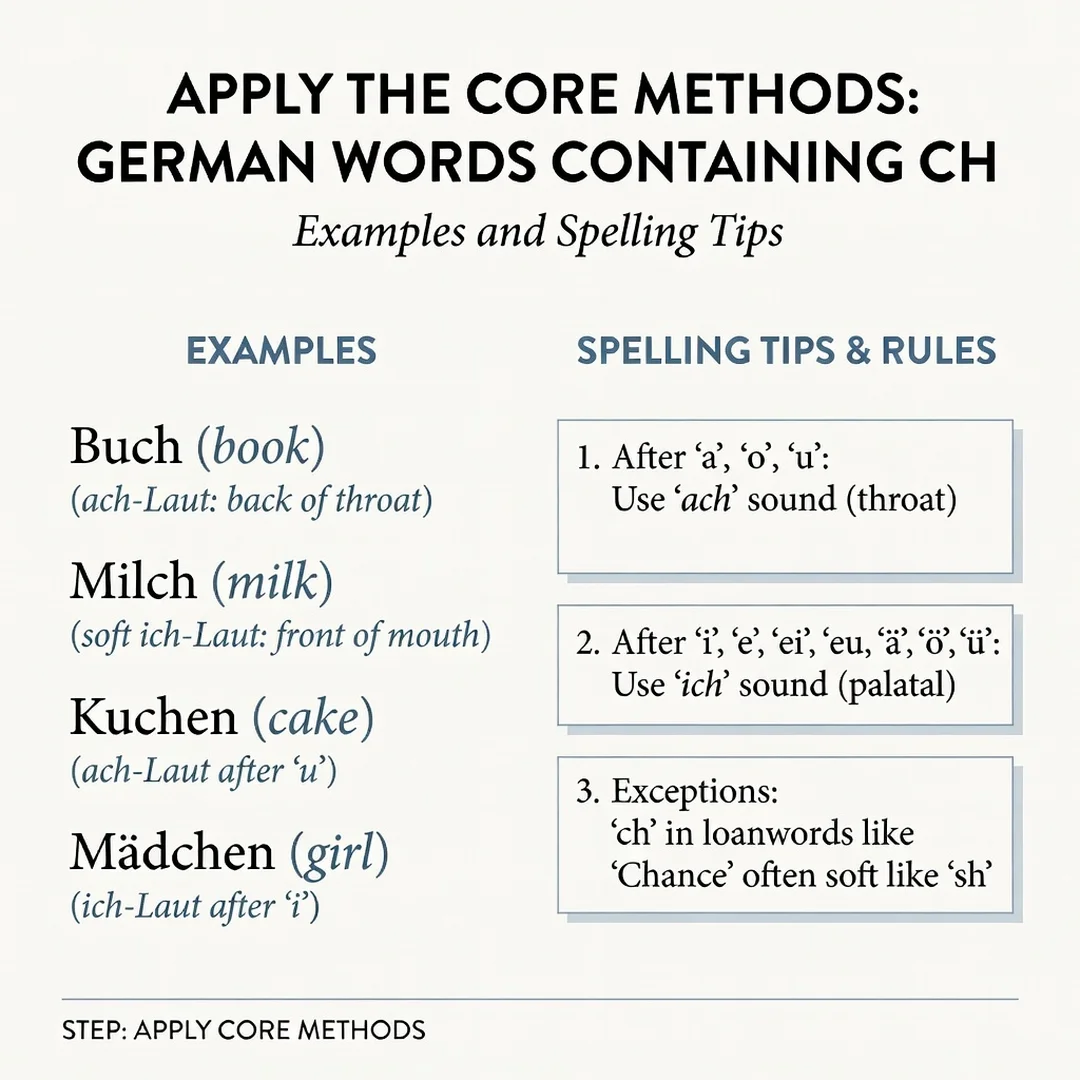
Step 5: Apply the core methods
Now combine the techniques: practice minimal pairs aloud, group vocabulary by preceding vowel, handwrite words while speaking them, and listen to native audio daily. Spend fifteen focused minutes per session. For each new CH word you meet, predict its pronunciation from the vowel, then verify with audio. This active-prediction habit accelerates learning dramatically compared with passive exposure.
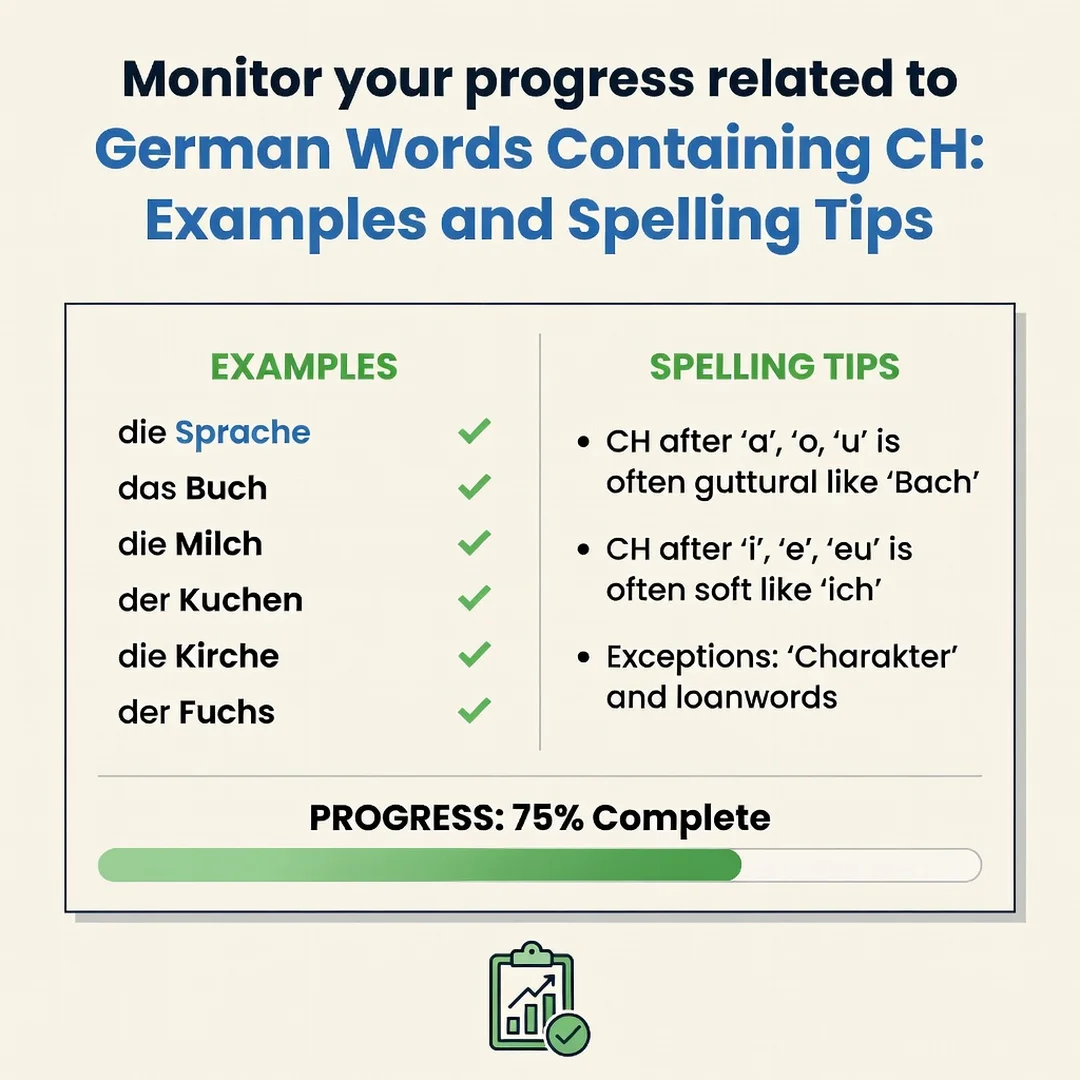
Step 6: Monitor your progress
Every two weeks, retest yourself with a fresh passage or dictation exercise. Track which words still trip you up and add them to your exception list. Celebrate correct pronunciation of previously difficult pairs like Kuchen/Küche. If progress stalls, adjust your method — perhaps more audio, less reading — rather than simply repeating what is not working. Review your goals and set the next one.
FAQ
What should I know about German Words Containing CH: Examples and Spelling Tips?
The most important thing is that CH represents different sounds depending on the vowel before it. After front vowels and consonants it is soft; after back vowels and au it is hard; in some loanwords it becomes a “k” or “sh” sound. Once you internalize this vowel rule, both pronunciation and spelling become far more predictable. Focus on high-frequency words first and practice aloud.
Who is this guide for?
This guide is for English-speaking learners of German at any level — from beginners sounding out their first words to intermediate learners who want to refine their spelling.
You now have a solid foundation for German Words Containing CH: Examples and Spelling Tips. Apply the best practices above and revisit this guide as your needs evolve.