

German words containing SCH are everywhere once you start noticing them — from Schule (school) to schön (beautiful). This three-letter combination is one of the most distinctive sounds in the language, and understanding how it works will sharpen your pronunciation and vocabulary fast.
In this guide, we break down common German words containing SCH, explain the patterns behind them, and show you how to recognize and pronounce them with confidence. Whether you’re a beginner or brushing up your skills, these examples will make the SCH sound second nature.
Introduction
The German language has a distinctive sound that catches the ear of every learner: the “sch” cluster. Pronounced like the English “sh” in “shoe,” this three-letter combination appears everywhere in German, from everyday greetings to complex technical terms. Understanding German words containing SCH is one of the most practical steps you can take when building vocabulary, improving pronunciation, and gaining confidence in reading and speaking.
This article explores German Words Containing SCH: Examples and Patterns with clear, practical guidance. Rather than simply handing you a list to memorize, we will break down where this combination comes from, how it behaves in different positions within words, and what patterns you can rely on to predict pronunciation and meaning. Whether you are a complete beginner or someone brushing up on long-forgotten skills, the material here is designed to be immediately usable.
By the end, you will have a working framework for recognizing, pronouncing, and remembering German words that contain SCH. You will also understand why this small cluster plays such an outsized role in the language and how consistent practice turns passive recognition into active fluency.
Key Concepts
Before diving into examples, it helps to establish a few foundational ideas. These concepts will make the rest of the article easier to follow and give you a mental scaffold for organizing new vocabulary.
What SCH Actually Represents
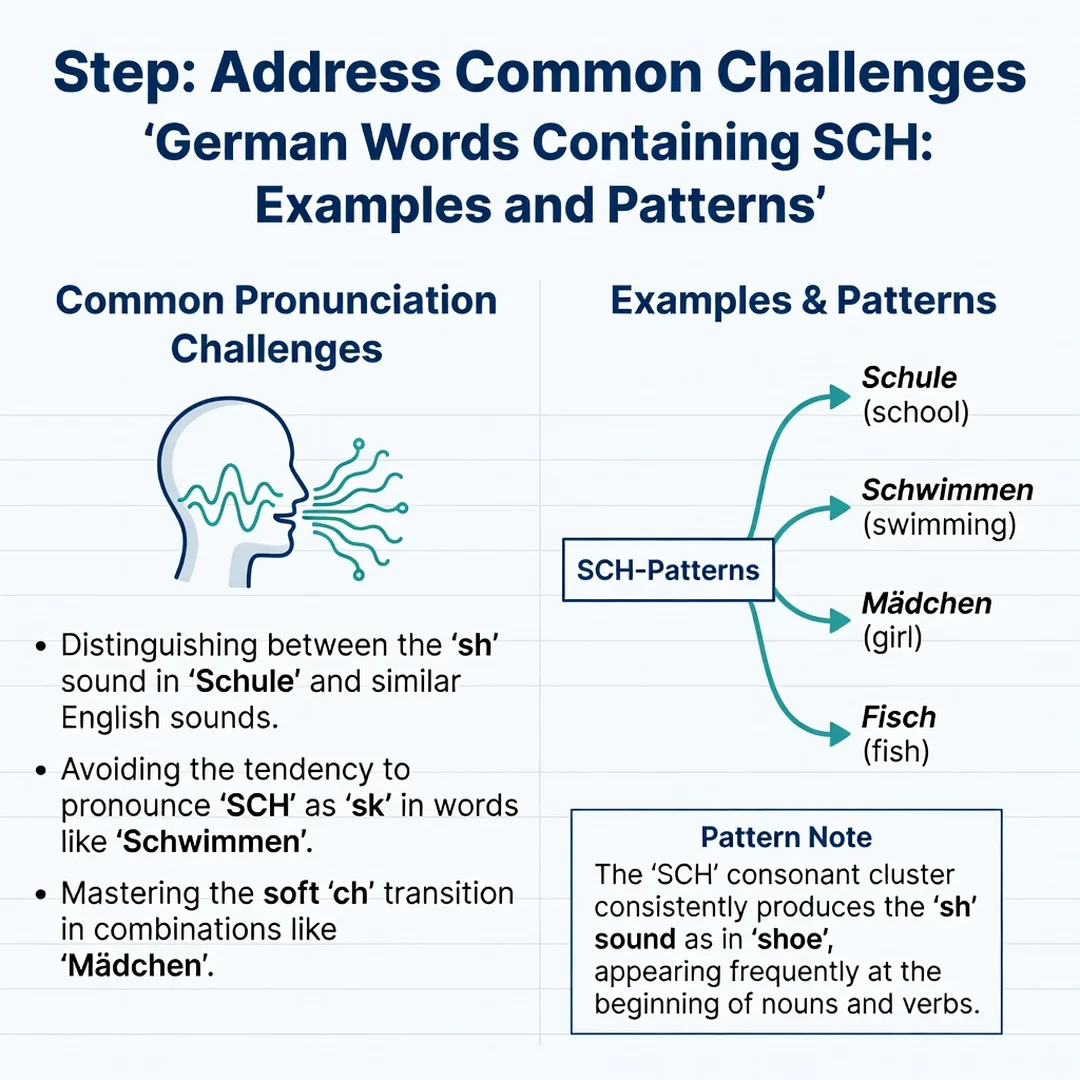
In German, the letters S, C, and H combine into a single phonetic unit. It is not three separate sounds pronounced in sequence. Instead, it produces the voiceless postalveolar fricative, which English speakers recognize as the “sh” sound. This distinction matters because learners who try to pronounce each letter individually end up with awkward, unrecognizable speech.
The combination is so consistent that it functions almost like a single letter in the German alphabet. Once you internalize this, reading unfamiliar words becomes much less intimidating.
Position Matters
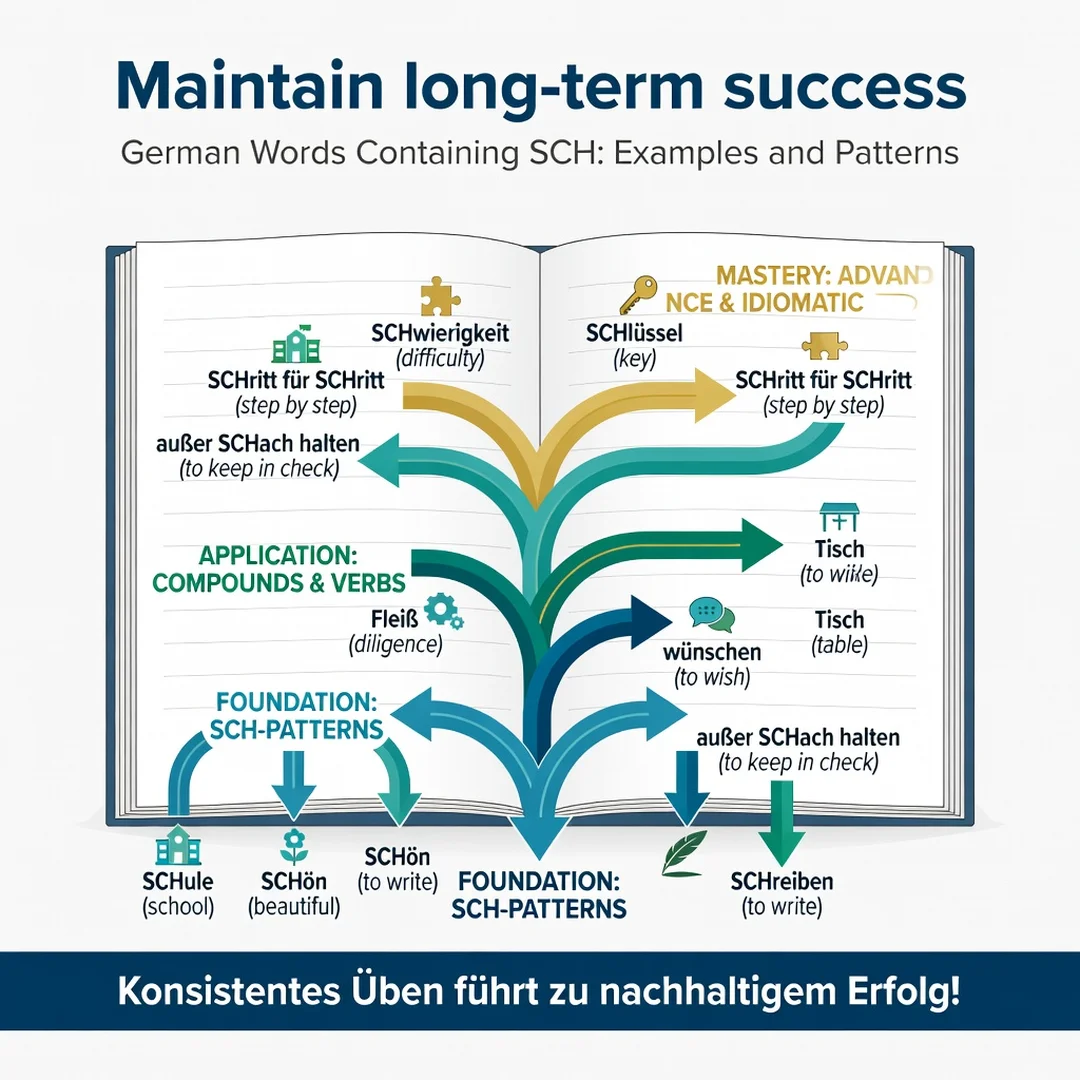
Where SCH appears in a word affects both pronunciation and meaning. At the start of a word or syllable, it is almost always pronounced as the standard “sh” sound. In the middle or at the end, it behaves similarly, though regional accents can introduce subtle variations. Understanding position helps you predict how a word will sound before you say it aloud.
The Role of Word Formation
German is famous for compounding, the practice of gluing words together to create new ones. SCH often appears at the seams of these compounds, which means learning the cluster also helps you decode long, intimidating words. Recognizing SCH as a boundary marker can reveal where one component ends and another begins.
Common Categories
German words containing SCH tend to fall into recognizable categories:
- Nouns for people and professions, such as “der Schauspieler” (actor) and “die Schriftstellerin” (writer)
- Everyday objects like “der Schuh” (shoe) and “die Schere” (scissors)
- Verbs such as “schreiben” (to write) and “schlafen” (to sleep)
- Adjectives like “schnell” (fast) and “schön” (beautiful)
Grouping vocabulary this way makes memorization more efficient and gives you hooks for recall.
Deep Dive
Now that the fundamentals are in place, let’s examine the patterns more closely. Understanding the fundamentals of German Words Containing SCH: Examples and Patterns helps you make informed decisions about how to study, what to prioritize, and where to focus your energy.
The Three Main Positions
SCH appears in three primary positions, each with its own character:
- Initial: Words beginning with SCH are extremely common. Examples include ” Schule” (school), “schlau” (clever), “schwarz” (black), and “schwer” (heavy). The pronunciation is consistent and crisp.
- Medial: SCH appearing in the middle of a word often signals a compound or a derived form. “Entschuldigung” (excuse me) contains SCH after a prefix, while “Flasche” (bottle) has it between vowels.
- Final: Words ending in SCH are less frequent but still important. “Fisch” (fish) and “Tisch” (table) are classic examples, and both are high-frequency vocabulary.
Pronunciation Pitfalls
One common mistake is over-pronouncing the C. In German, the C in SCH is silent as an independent sound; it merely modifies the S and H. Another pitfall is confusing SCH with the separate combination “st” or “sp,” which have their own rules depending on region. In northern Germany, “st” at the start of a word sounds like “sht,” which can blur the line for learners.
To avoid these issues, practice minimal pairs. Compare “sch” words with similar-sounding words that lack the cluster. This trains your ear and mouth simultaneously.
Compound Words and Boundaries
German compounds can be long, but SCH often marks the transition between components. Consider “Schreibtisch” (desk), which combines “schreiben” (to write) and “Tisch” (table). The SCH at the start tells you the first component, while the second component is recognizable on its own. Learning to spot these boundaries accelerates reading comprehension dramatically.
Regional Variations
While standard German pronounces SCH consistently, regional dialects introduce nuances. In parts of Switzerland and Austria, the sound may be slightly softer or more rounded. These variations are worth noting but should not distract beginners. Focus on the standard pronunciation first, then adapt as you encounter native speakers from different regions.
Frequency and Usefulness
SCH is not a rare curiosity; it is woven into the fabric of daily German. Greetings, food, travel, work, and emotions all rely on words containing this cluster. Because it appears so often, mastering it yields immediate returns in comprehension and confidence.
Best Practices
Reliable information and consistent habits lead to better long-term outcomes. The following best practices will help you move from recognizing SCH words to using them naturally.
Practice Aloud Daily
Reading silently will not train your mouth. Spend five to ten minutes each day reading SCH words aloud. Focus on smooth transitions and avoid inserting an extra vowel sound between the S and CH.
Use Spaced Repetition
Flashcards and spaced repetition apps work well for vocabulary. Create a deck specifically for SCH words, and review it regularly. Over time, the words will move from short-term to long-term memory.
Learn in Context
Isolated words are harder to remember than words embedded in sentences. Whenever you learn a new SCH word, write a short sentence using it. This anchors the word to meaning and grammar.
Group by Pattern
Instead of memorizing randomly, group words by position (initial, medial, final) or by category (professions, objects, verbs). Pattern-based learning leverages the brain’s natural talent for recognizing structure.
Listen Actively
Podcasts, news broadcasts, and songs in German expose you to natural pronunciation. Pay attention to how native speakers handle SCH in fast speech. Active listening trains your ear to recognize the sound even when it blends with surrounding words.
Record Yourself
Recording your own speech and comparing it to native examples reveals gaps you might not notice otherwise. This feedback loop is one of the fastest ways to improve pronunciation.
Step-by-Step Guide
Step 1: Understand the fundamentals
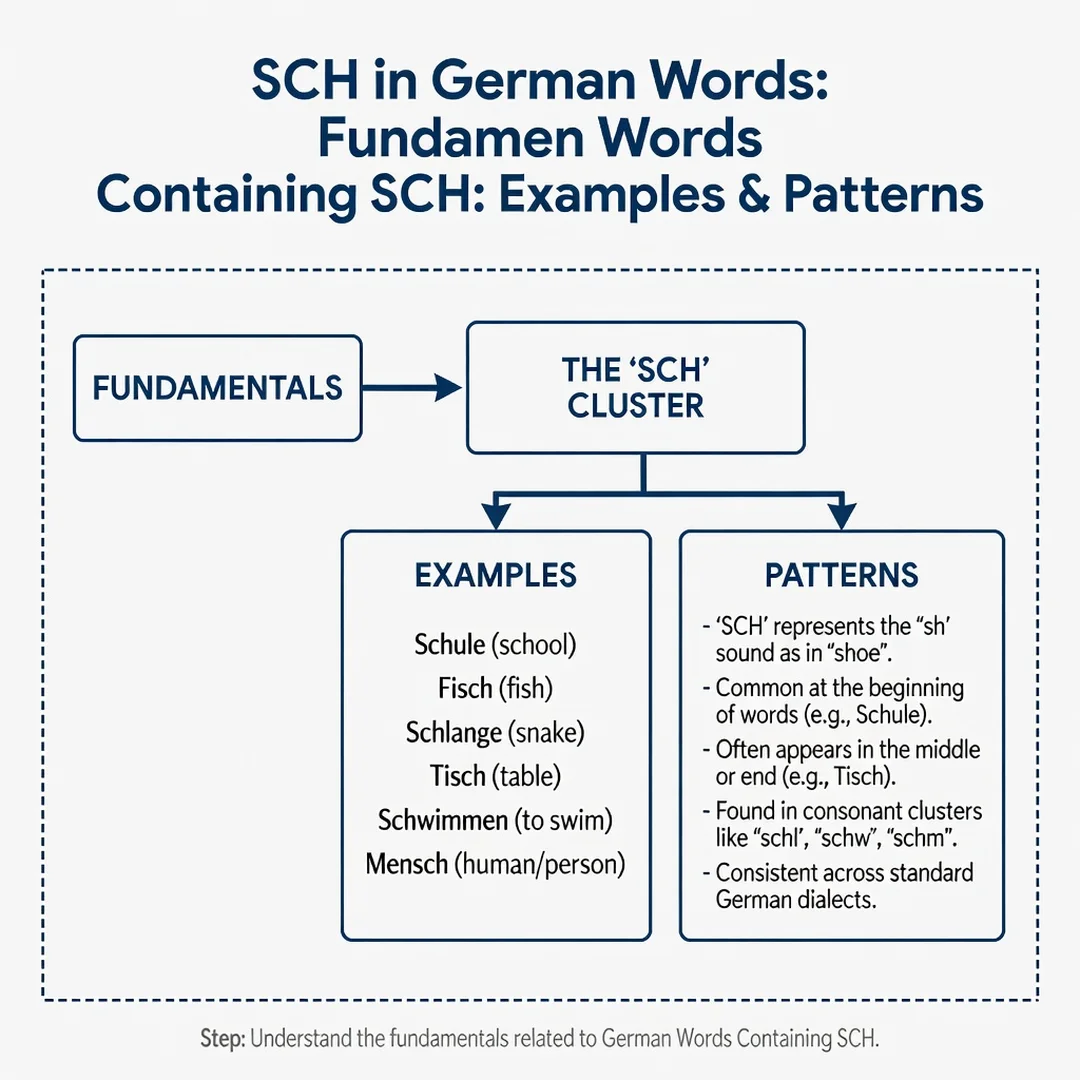
Begin by confirming that SCH represents a single sound, not three separate letters. Practice saying the English “sh” and then transfer that sound to German words. Recognize that position affects pronunciation and that compounds often use SCH as a boundary marker.
Step 2: Assess your starting point
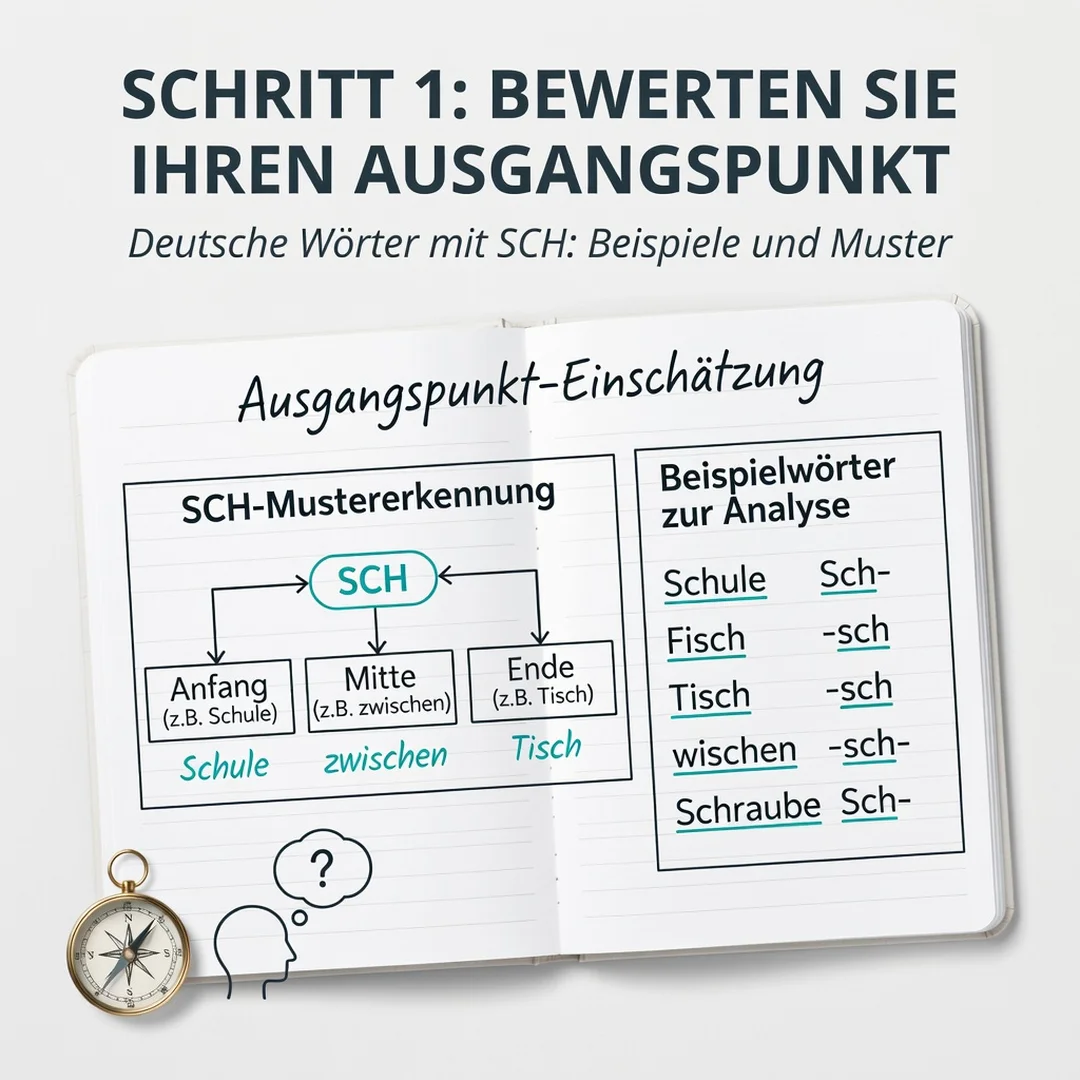
Take stock of what you already know. Can you pronounce “Schule” correctly? Do you recognize “Fisch” and “Tisch”? Identify which positions and categories feel comfortable and which need work. Honest assessment prevents wasted effort.
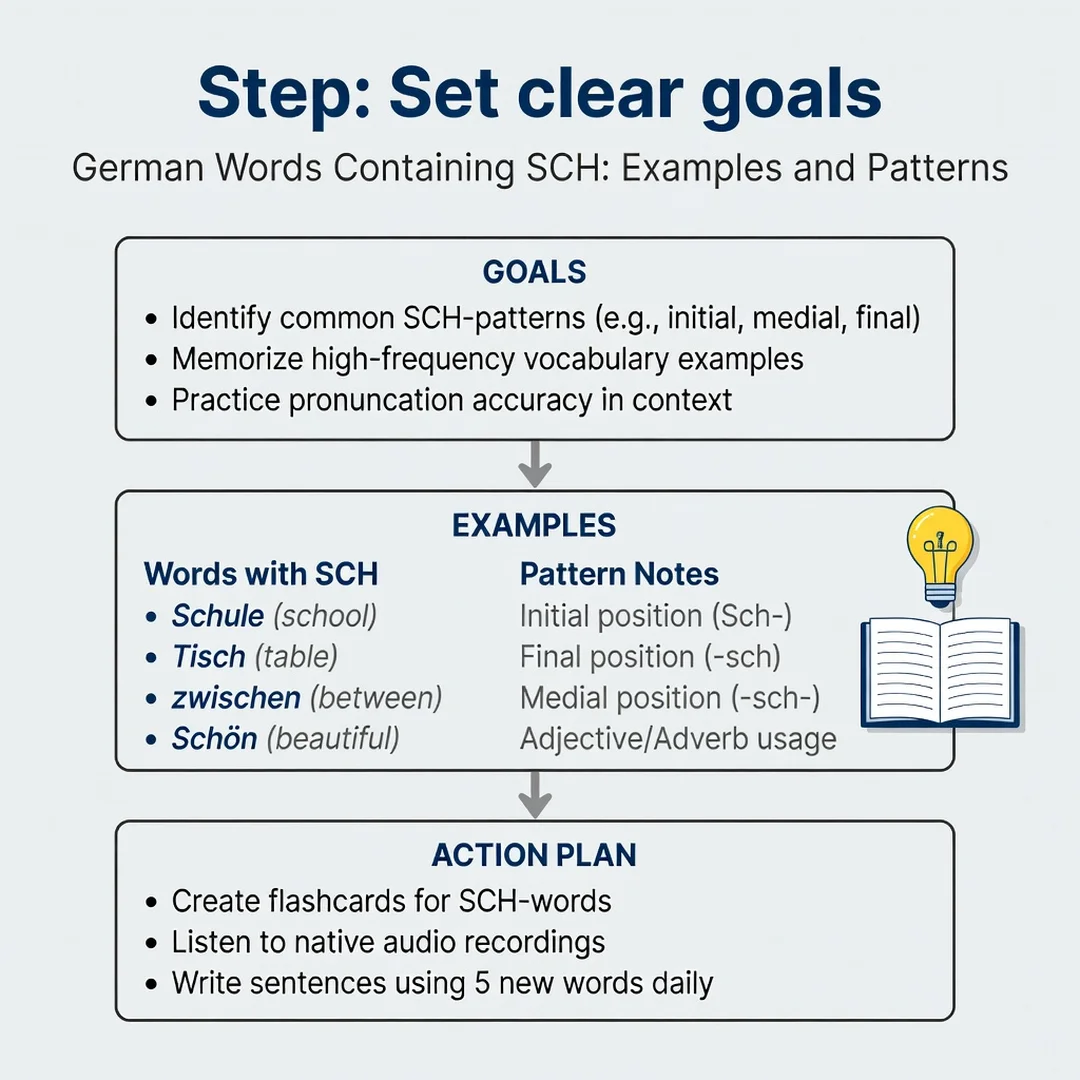
Step 3: Set clear goals
Define specific, measurable objectives. For example, aim to learn twenty new SCH words per week, or to read a short German article aloud without stumbling. Clear goals give your practice direction and make progress visible.
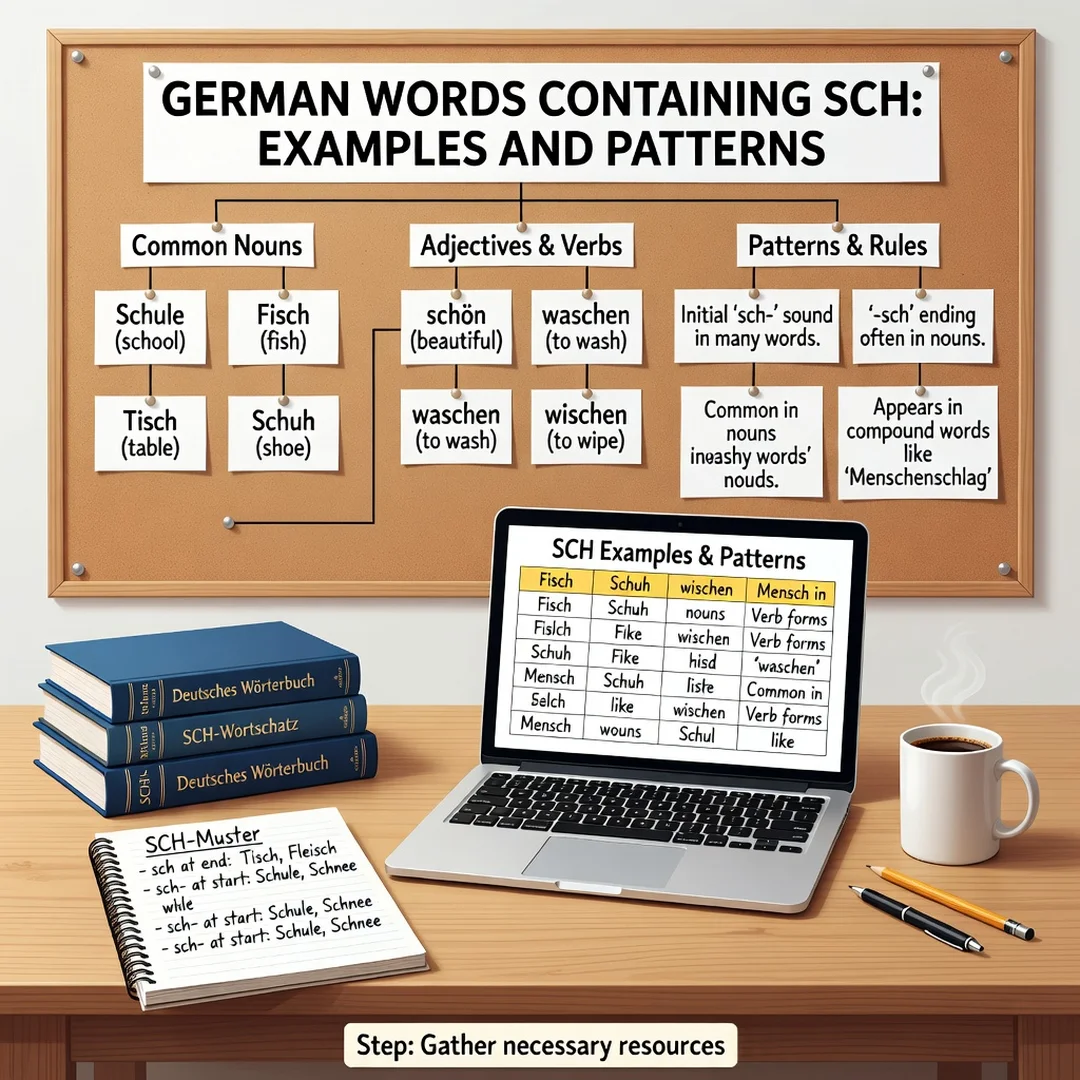
Step 4: Gather necessary resources
Collect tools that support your learning: a dictionary, a flashcard app, audio recordings of native speakers, and perhaps a grammar guide. Having resources ready eliminates friction when you sit down to study.
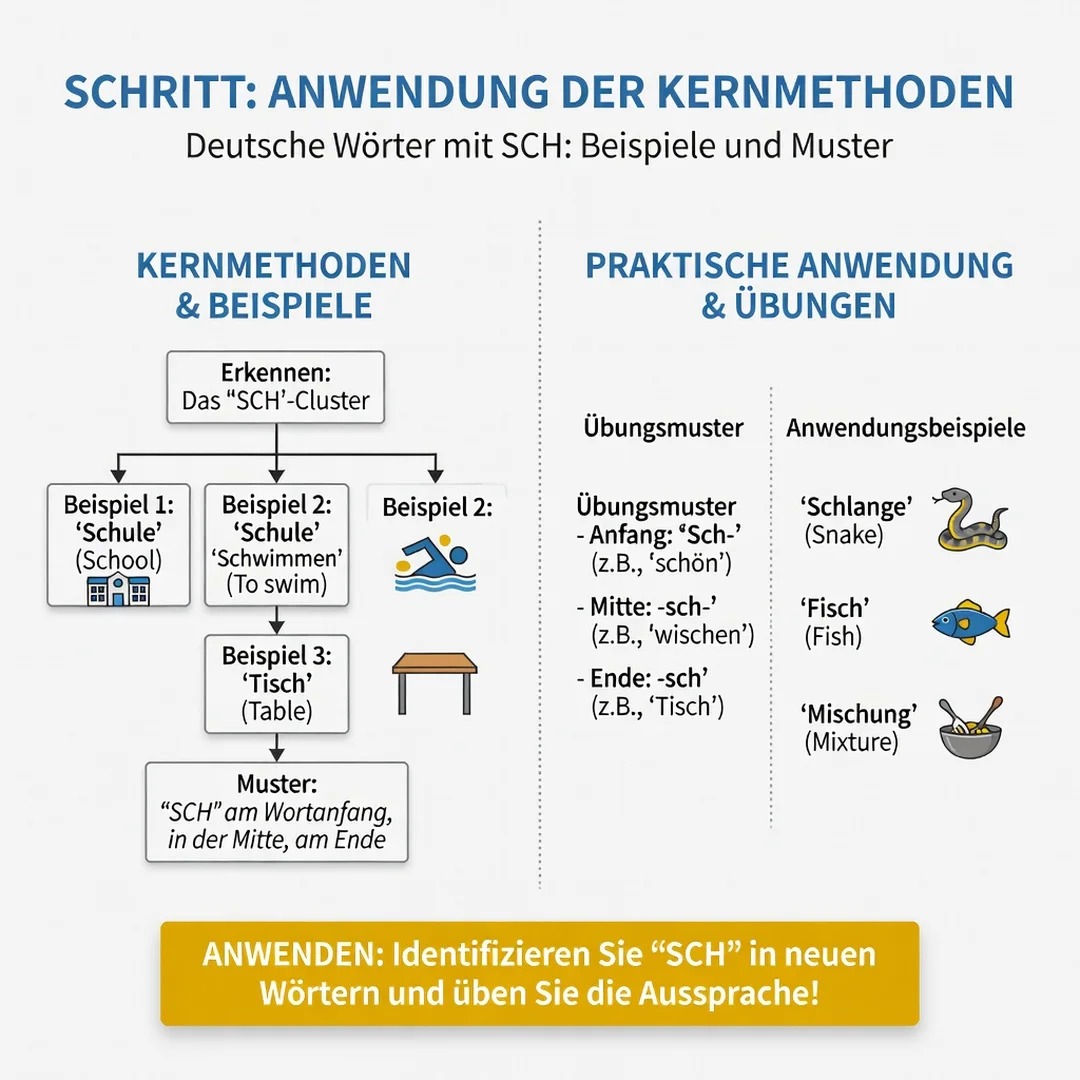
Step 5: Apply the core methods
Use the methods outlined in the Best Practices section. Read aloud, use spaced repetition, learn in context, group by pattern, listen actively, and record yourself. Consistency matters more than intensity, so build a routine you can sustain.
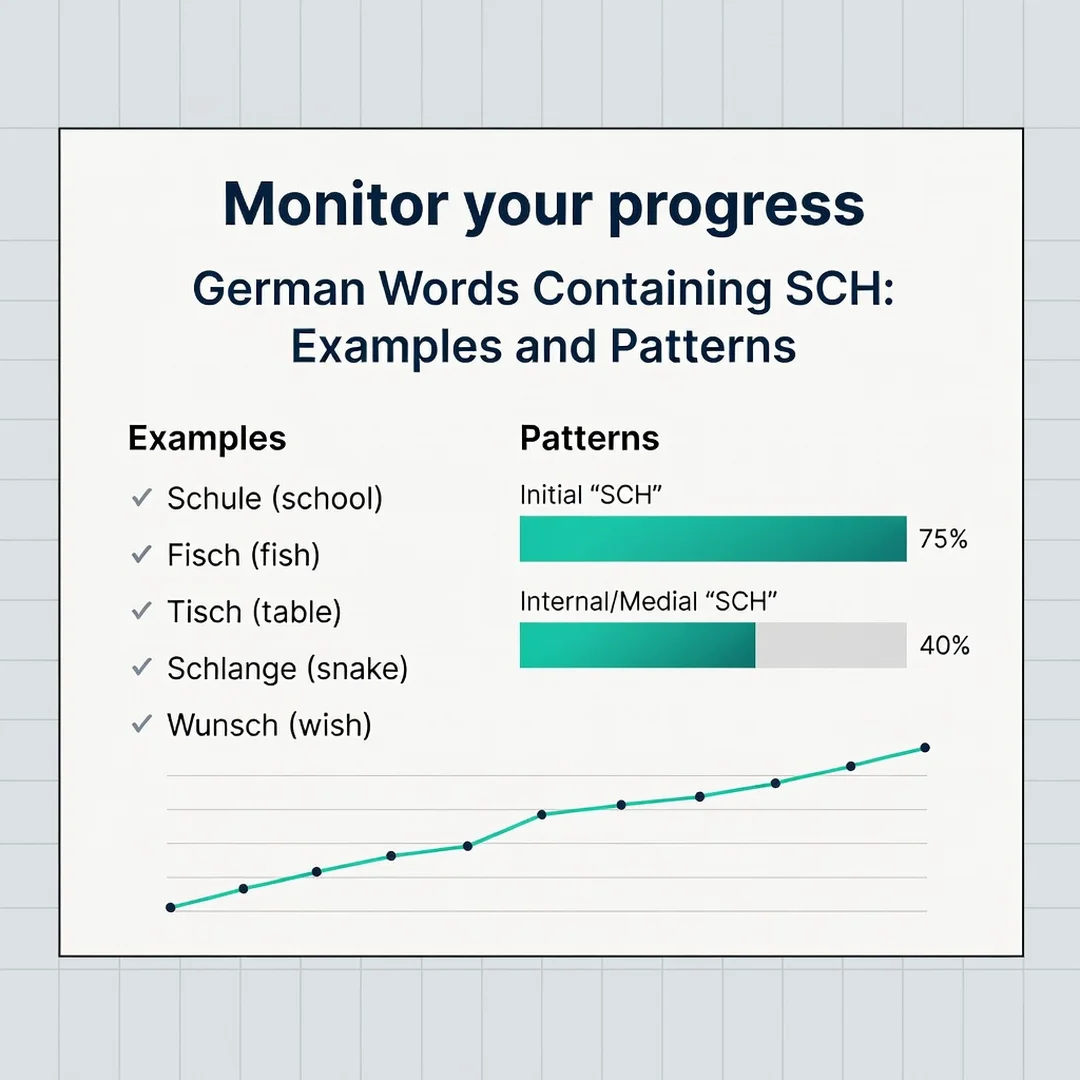
Step 6: Monitor your progress
Review your goals regularly. Track how many words you have mastered, how your pronunciation has improved, and how comfortable you feel reading German text. Adjust your methods based on what is working and what is not.
FAQ
What should I know about German Words Containing SCH: Examples and Patterns?
You should know that SCH is a single phonetic unit pronounced like the English “sh.” It appears at the beginning, middle, and end of words, and it is extremely common in everyday German. Understanding its patterns helps with pronunciation, vocabulary building, and reading comprehension. The key is to practice consistently and learn words in context rather than in isolation.
Who is this guide for?
This guide is for anyone learning German, whether you are a complete beginner or someone returning to the language after a break. It is also useful for teachers looking for clear explanations and examples, and for travelers who want to pronounce German signs and menus correctly. No advanced prior knowledge is required.
How many German words contain SCH?
Thousands. The cluster is one of the most productive in the language. It appears in basic vocabulary, technical terms, names, and compounds. Because German favors compounding, new SCH words are created regularly, especially in professional and scientific contexts.
Is SCH always pronounced the same way?
In standard German, yes. Regional dialects may introduce slight variations, particularly in southern Germany, Austria, and Switzerland, but these are minor. Beginners should focus on the standard pronunciation and adapt later as needed.
Can I learn SCH words without a teacher?
Absolutely. With good resources and consistent habits, self-study is highly effective. Audio recordings, dictionaries, and language exchange partners can provide the feedback a teacher would offer. The most important factor is regular practice.
Conclusion
German Words Containing SCH: Examples and Patterns is more than a niche topic; it is a gateway to confident communication. By understanding the sound, recognizing its positions, and practicing deliberately, you turn a potentially intimidating cluster into a familiar and useful tool. Reliable information and consistent habits lead to better long-term outcomes, so start small, stay consistent, and let the patterns work for.
You now have a solid foundation for German Words Containing SCH: Examples and Patterns. Apply the best practices above and revisit this guide as your needs evolve.