

Every language has phrases that sound perfectly normal at home and completely unhinged abroad. German, though, is in a league of its own. If you came here searching for “funny german idioms,” prepare yourself: pigs whistle, bears dance, louses march across livers, and offended liver sausages sulk in corners. None of it makes sense in English — and all of it is real, everyday German.
Below are 30 genuinely funny German idioms, each with its literal translation, its real meaning, and a one-line note on why it’s funny. Enjoy — and try one out on a German friend. They’ll love you for it.
Funny German Idioms: Why They Sound Absurd in English
The comedy comes from the collision of two things: deadpan German delivery and wildly visual images. A German says ich verstehe nur Bahnhof (“I only understand train station”) with a completely straight face to mean “I don’t understand a word.” The humor isn’t in a joke — it’s in the gap between the solemn tone and the surreal picture. English idioms do this too (“it’s raining cats and dogs”), but German goes further, weirder, and with more farm animals.
There’s a second layer: many of these idioms are fossils. Die Katze im Sack kaufen preserves medieval market fraud; Eulen nach Athen tragen is two thousand years old; jemandem ist eine Laus über die Leber gelaufen preserves medieval medicine’s belief that emotions lived in the liver. You’re not just learning funny phrases — you’re handling antiques. The absurdity survived because the images are too good to throw away, and every generation of Germans has agreed, silently, to keep saying them with a straight face.
The Animal Comedians

1. Da steppt der Bär — Literal: “the bear dances there.” Real meaning: it’s going to be a wild party.
Why it’s funny: Somewhere in German history, dancing bears became the official unit of party quality. No bear, no party.
2. Ich glaub, mein Schwein pfeift — Literal: “I think my pig is whistling.” Real meaning: I must be going crazy; that’s unbelievable.
Why it’s funny: Of all the impossible things, the Germans chose a whistling pig as their disbelief benchmark. Pigs don’t whistle. That’s the whole point.
3. Einen Vogel haben — Literal: “to have a bird.” Real meaning: to be nuts, crazy.
Why it’s funny: It diagnoses mental instability as an ornithological condition. Somewhere there’s a German with a sparrow living in his head, and everyone just accepts it.
4. Einen Kater haben — Literal: “to have a tomcat.” Real meaning: to have a hangover.
Why it’s funny: Your headache is not a headache — it’s a tomcat sitting on your skull. Somehow this makes the hangover feel more legitimate.
5. Wie ein begossener Pudel dastehen — Literal: “to stand there like a drenched poodle.” Real meaning: to look sheepish and embarrassed.
Why it’s funny: The poodle — proudest of dogs, most elaborate of haircuts — reduced to a soggy mess. It’s the most specific humiliation in any language.
6. Den Braten riechen — Literal: “to smell the roast.” Real meaning: to smell a rat, to sense something suspicious.
Why it’s funny: English smells a rat (vermin, danger). German smells a roast (dinner, delicious). German suspicion is just… hungrier.
7. Da lachen ja die Hühner — Literal: “even the chickens are laughing.” Real meaning: that’s utterly ridiculous.
Why it’s funny: The chickens are the Greek chorus of German life, clucking judgmentally at human absurdity from the sidelines of every farmyard.
8. Jemandem einen Floh ins Ohr setzen — Literal: “to put a flea in someone’s ear.” Real meaning: to plant an idea in someone’s head.
Why it’s funny: Inspiration, in the German imagination, is a tiny jumping parasite. Motivational speakers have it easy by comparison.
9. Sich zum Affen machen — Literal: “to make oneself into a monkey.” Real meaning: to make a fool of oneself.
Why it’s funny: It’s DIY humiliation — nobody made you the monkey, you did it to yourself, with your own two hands.
10. Dastehen wie der Ochs vorm Berg — Literal: “to stand like the ox before the mountain.” Real meaning: to be utterly clueless.
Why it’s funny: The ox isn’t just confused — it’s facing a mountain of confusion. Scale matters in German bewilderment.
Food, Drink, and Domestic Chaos
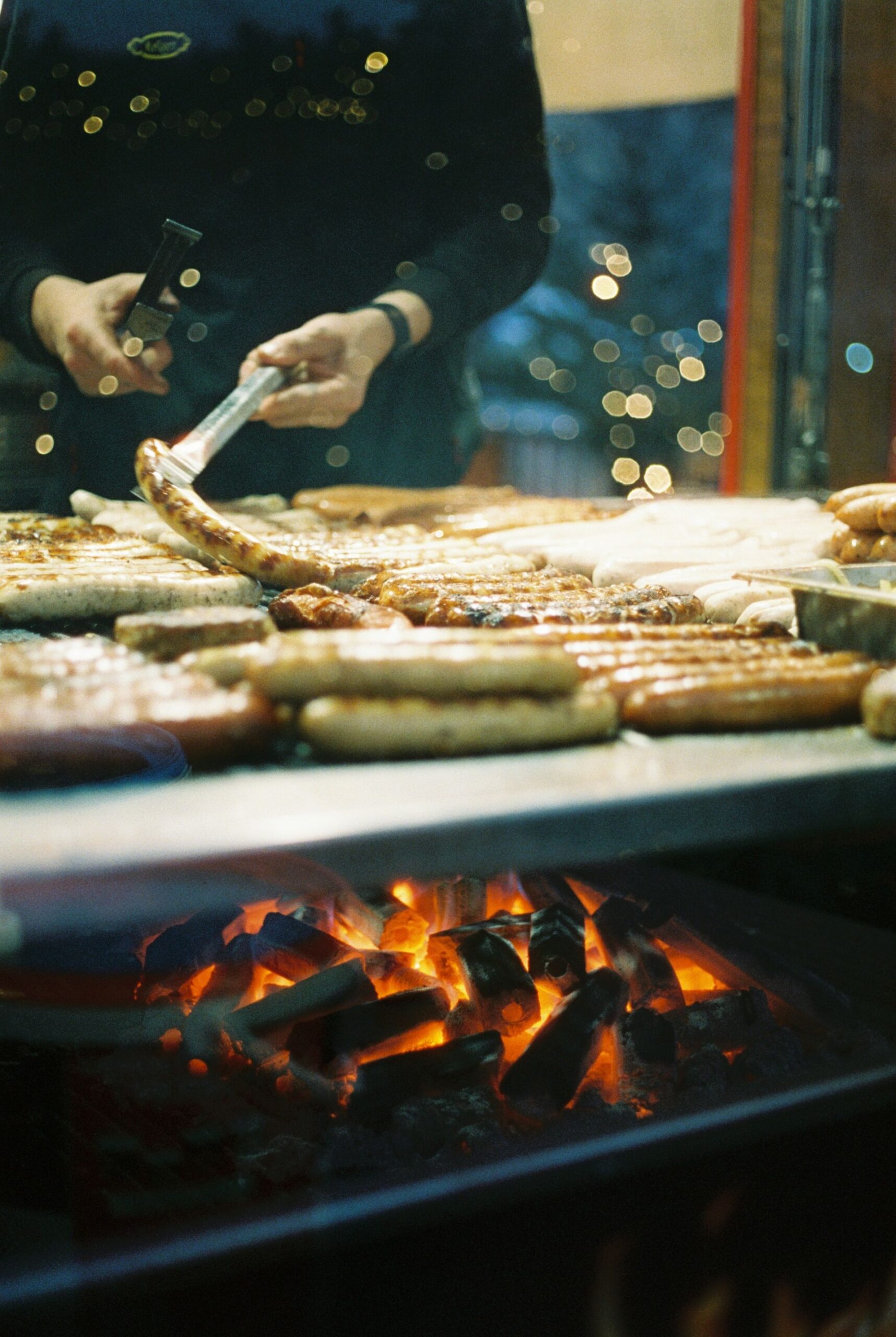
11. Das ist mir Wurst — Literal: “that is sausage to me.” Real meaning: I don’t care.
Why it’s funny: Apathy, measured in sausages. The entire philosophy of not caring, expressed through processed meat.
12. Da haben wir den Salat — Literal: “there we have the salad.” Real meaning: well, what a mess; great, look at this disaster.
Why it’s funny: English has “that’s the way the cookie crumbles.” German looks at a catastrophe and sees… a salad. A tossed, chaotic salad.

13. Jemandem Honig ums Maul schmieren — Literal: “to smear honey around someone’s mouth.” Real meaning: to flatter someone shamelessly, to butter them up.
Why it’s funny: Flattery isn’t spoken — it’s smeared, like jam on toast, all over someone’s face. You can practically see the sticky fingers.
14. Kleinvieh macht auch Mist — Literal: “small livestock also makes manure.” Real meaning: every little bit helps.
Why it’s funny: It’s meant to be encouraging — save those pennies! — but the motivational image is farmyard manure. German thrift, in a nutshell.
15. In den sauren Apfel beißen — Literal: “to bite into the sour apple.” Real meaning: to bite the bullet, to do the unpleasant necessary thing.
Why it’s funny: English courage is a bullet (danger, war). German courage is a sour apple (a bad snack). Somehow the apple feels worse.
16. Die beleidigte Leberwurst spielen — Literal: “to play the offended liver sausage.” Real meaning: to sulk theatrically.
Why it’s funny: The sulker isn’t just offended — they’ve been cast as an offended liver sausage in the drama of their own making. It’s a role, and they’re committed.
17. Wie die Made im Speck leben — Literal: “to live like a maggot in bacon.” Real meaning: to live in total luxury.
Why it’s funny: The ultimate luxury lifestyle, modeled on a maggot. In bacon. German aspiration has never been more vivid or more disgusting.
18. Ins Fettnäpfchen treten — Literal: “to step into the little fat pot.” Real meaning: to put one’s foot in it, to commit a social blunder.
Why it’s funny: Social embarrassment is a small pot of fat on the floor, and you — congratulations — stepped right in it. Barefoot, presumably.
19. Tomaten auf den Augen haben — Literal: “to have tomatoes on one’s eyes.” Real meaning: to be oblivious, to miss the obvious.
Why it’s funny: Blindness, but make it produce. Why tomatoes? Nobody knows. The mystery is part of the charm.
20. Ins Gras beißen — Literal: “to bite into the grass.” Real meaning: to kick the bucket, to die.
Why it’s funny: English death is a kicked bucket (household accident). German death is biting grass (lawn maintenance gone wrong). Dark, specific, oddly peaceful.
Beautiful Nonsense: Ten More
21. Nicht alle Tassen im Schrank haben — Literal: “to not have all cups in the cupboard.” Real meaning: to be a bit crazy, not quite right in the head.
Why it’s funny: Sanity is a complete set of kitchenware. Lose a cup, lose your mind. German psychology runs on dishware inventory.
22. Du gehst mir auf den Keks — Literal: “you’re going on my cookie.” Real meaning: you’re getting on my nerves, you’re annoying me.
Why it’s funny: Annoyance is a person physically climbing onto your cookie. It’s trespass, but delicious trespass.
23. Ich verstehe nur Bahnhof — Literal: “I only understand train station.” Real meaning: I don’t understand a single word.
Why it’s funny: Of all the words in the German language, the confused brain retains exactly one: train station. Legend says WWI soldiers only wanted to hear the word that meant “going home.”
24. Die Kirche im Dorf lassen — Literal: “to leave the church in the village.” Real meaning: don’t exaggerate, keep things in proportion.
Why it’s funny: Exaggeration is apparently a church-relocation project. Calm down, put the church back, nobody’s impressed.
25. Einen Korb bekommen — Literal: “to get a basket.” Real meaning: to be rejected, turned down (originally romantically).
Why it’s funny: Rejection arrives as wickerware. You shot your shot, and all you got was this basket.

26. Alte Zöpfe abschneiden — Literal: “to cut off old braids.” Real meaning: to break with tradition, to ditch outdated habits.
Why it’s funny: Tradition is hair, and progress is a haircut. German reform, one braid at a time.
27. Mit dem linken Fuß aufgestanden sein — Literal: “to have gotten up with the left foot.” Real meaning: to be in a bad mood all day.
Why it’s funny: Your entire bad day is blamed on a foot — specifically the left one. The right foot is innocent and would like that noted.
28. Das passt wie die Faust aufs Auge — Literal: “it fits like the fist in the eye.” Real meaning: it doesn’t fit at all, it’s completely wrong.
Why it’s funny: It’s the idiom of anti-fit: the “fit” being described is a punch in the face. German precision even extends to describing total mismatch.
29. Jemandem ist eine Laus über die Leber gelaufen — Literal: “a louse ran over someone’s liver.” Real meaning: someone is grumpy, in a bad mood for no clear reason.
Why it’s funny: This is the heavyweight champion of absurd German idioms. Medieval medicine put emotions in the liver; the louse is just the universe’s final insult. A tiny parasite, jogging across your organs, ruining your day.
30. Schwein haben — Literal: “to have pig.” Real meaning: to be lucky.
Why it’s funny: After all the whistling pigs, dancing bears, and liver louses — the most-used idiom in German is simply owning a pig. Luck isn’t a leprechaun or a horseshoe. It’s livestock. And honestly? It works.
Want the full stories — origins, usage tips, and which of these natives actually say daily? Dive into our German idioms explained master guide, the German animal idioms deep dive, and how to use German idioms naturally.
How to Use Funny German Idioms (Without Overdoing It)
Funny idioms are social gold — but only if you spend them wisely. A few rules from people who’ve watched learners try:
Start with the safe crowd-pleasers. Ich glaub, mein Schwein pfeift!, das ist mir Wurst, and Tomaten auf den Augen haben are universally loved and almost impossible to misuse. Germans genuinely delight in hearing learners say them — it’s the fastest compliment a beginner can earn.
One per conversation. Dropping five funny idioms in two minutes turns you into a performing seal. Natives use these sparingly, at moments of genuine surprise or amusement. Wait for the moment: the unbelievable news (mein Schwein pfeift!), the obvious thing someone missed (Tomaten auf den Augen?), the friend who’s sulking (spiel nicht die beleidigte Leberwurst!).
Mind the register. Most funny idioms are casual — perfect for friends, parties, and relaxed colleagues. Das ist mir Wurst in a job interview is a memorable choice for all the wrong reasons. When in doubt, keep the comedy for after hours.
Pronunciation matters more than usual. Funny idioms live or die on delivery. Da steppt der Bär! needs energy; ich verstehe nur Bahnhof needs the deadpan shrug. Listen to how natives say them — in shows, in podcasts — and copy the music, not just the words. Our guide on how to use German idioms naturally covers delivery in detail.
Don’t explain the joke. If someone laughs, smile and move on. If they don’t, don’t translate it literally and explain why it’s funny — explaining die beleidigte Leberwurst in English is how friendships end.
Key Takeaways
- These 30 funny german idioms prove the rule: German humor lives in the gap between deadpan delivery and surreal images — whistling pigs, dancing bears, liver louses.
- The funniest are also the most memorable, which makes them the best idioms to learn first: ich glaub, mein Schwein pfeift, das ist mir Wurst, Tomaten auf den Augen haben.
- Every joke here is a real, working idiom — Germans actually say these, daily, with straight faces.
- Use the funny ones with friends first; they’re social gold. For the full list of everyday expressions, see our common German idioms with translation.